The Spruce Grouse is a well-camouflaged, elusive bird that lives in the coniferous forests of North America. This medium-sized grouse is often called “Fool Hen”, due to its fearless behaviour. It has adapted itself to the boreal forests or the taiga, where it thrives. The Spruce Grouse, with its unique seasonal diet and cryptic feathers, is an interesting bird that plays a vital role in northern ecosystems. This in-depth article will explore everything from the bird’s appearance and diet to its habitat, behaviour, and conservation.
The Spruce Grouse
The Spruce Grouse inhabits the boreal forests in Canada and Alaska. Its range extends into northern areas of the contiguous United States. This bird belongs to the Phasianidae family, which also includes pheasants and turkeys. It is a specialist in cold coniferous environments. Spruce Grouses are less conspicuous than other forest birds and rely heavily on camouflage to survive. This makes them a fascinating subject for wildlife enthusiasts and birders.
Distribution: Where do Spruce Grouse live?
Spruce Grouse are found in a large area of North America’s boreal zone. The primary range of this bird includes Alaska and the northern border states in the U.S., such as Minnesota, Michigan, Wisconsin, New Hampshire and Maine. These birds prefer dense, coniferous forests. They are especially fond of those forests dominated by jack pine and white-spruce.


Spruce Grouse tend to be sedentary. However, during the winter, some populations will move a short distance on foot in order to reach better foraging grounds. They are a good indicator of the health and condition of the northern forests because they live in the taiga ecosystem.
Habitat Preferences : Deep in Conifers
Spruce Grouse prefers a mature coniferous woodland with a dense understory. It also needs plenty of food. The Spruce Grouse is most often found in forests with a dominant black spruce, jack pine or mixed forest. However, they can also be seen along the edge of clearings or in mixed woodlands. During breeding season, you may see females with their chicks at the edge of logging cuts or regenerating forests. However, even then, they will stay near coniferous cover to protect themselves.
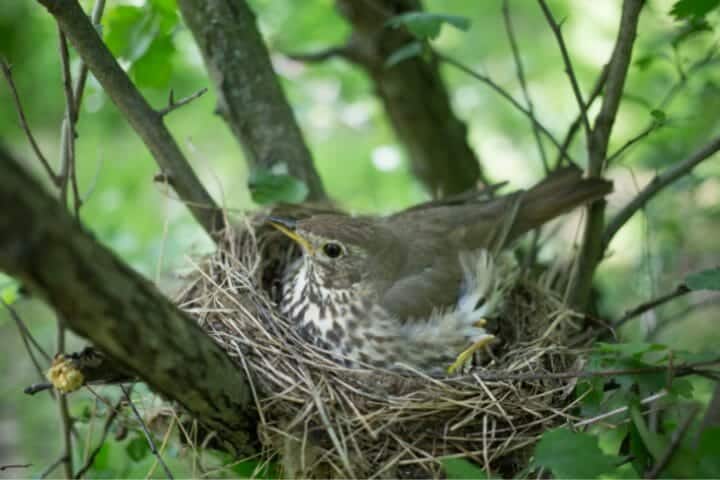
The nests are built directly on the forest floor and hidden by vegetation or branches. Their ground-nesting behaviour and excellent camouflage make them almost invisible until disturbed.
Camouflaged for Survival: Physical Description
The adult Spruce Grouse is a medium-sized bird, measuring between 15 and 17 inches in length (38-43cm) and weighing from 450-650 grams. The appearance of male and female Spruce Grouse differs slightly.
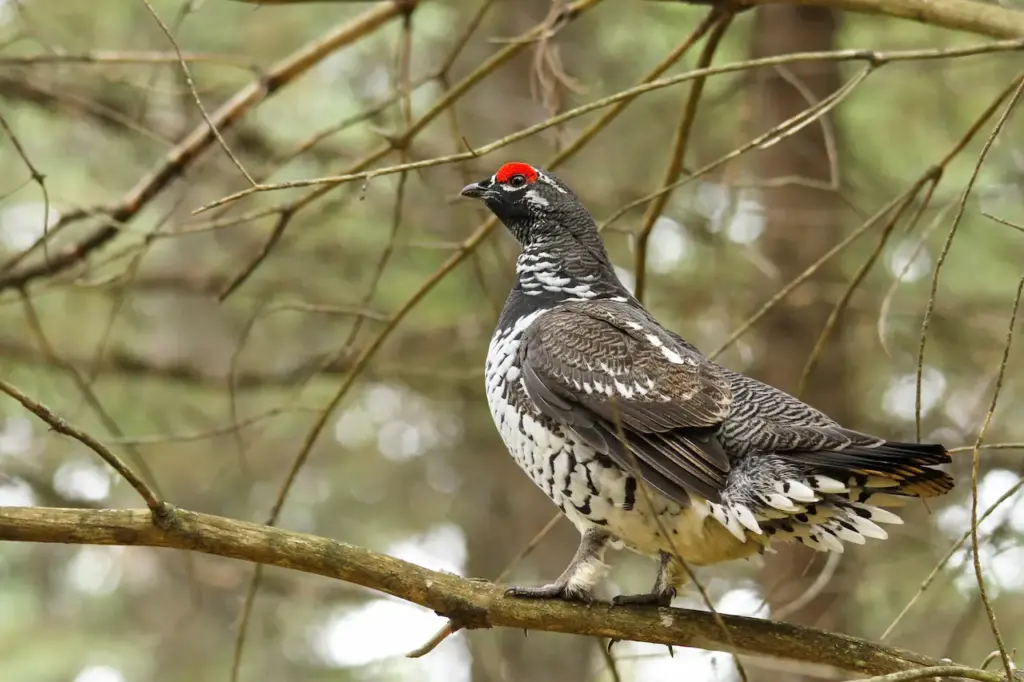
The males are slate grey with a black chest accented with white horizontal bars. They also have a black throat and a red eye comb that is distinctive. The is square, black, with rusty tips to the tail feathers.
Females have a mottled brown colouration, which makes them blend in well with the forest floor. Their underparts are also striped with dark and white, which helps them blend in with the dappled lighting conditions found among trees.
Franklin’s Grouse is an interesting subspecies. C. franklinii, found in the western U.S.A. and Canada, does not have the rusty tips at the tail. Instead, it has white tips along the tail coverts. This makes them easier to identify in the field.
Conifer specialist explains feeding habits and diet
Spruce Grouses have a very specialised diet. This is especially true during the winter months. During the colder months, they feed almost entirely on the cones of coniferous trees such as spruce or pine. Spruce Grouse evolved larger caeca to help them digest and ferment the plant matter.
In the summer, they eat a more varied diet. They eat berries and green shoots as well as flowers. A small amount of bugs is also consumed, especially during the breeding season, when the protein-rich foods help chicks to grow rapidly. Spruce Grouse, like many bird species that eat tough plant materials, also consume small stones and grit in order to help their gizzard break down food.

Foraging Behaviour: Tree and Ground Feeding
Spruce Grouse forage in a quiet, deliberate manner. Depending on the season, they forage on the ground or in trees. In the summer, they can be seen searching through undergrowth for insects or berries, but in winter, they prefer to clip needles from trees.
Outside of the breeding season, they are usually found alone or in small groups. They are difficult to spot in their natural habitat because of their calm demeanour, and they remain still while foraging.
What is the “Fool Hen Mystery”?
The Spruce Grouse’s amazing trust in camouflage is one of its most famous behaviours. It will often remain motionless when approached by humans or other predators. This is to allow its feathers to blend in with the surrounding forest. It is because of this passive defence strategy that it was given the name “Fool Hen”. Early settlers found these birds surprisingly easy to catch and even captured. According to IUCN Red List, this species is well documented.
This behaviour is different in the winter. The Spruce Grouse is more cautious when the leaf cover is low and camouflage is less effective. It will often fly away at a distance between 20 and 150 feet when it is approached. According to iNaturalist, this species is well documented.
Vocalisations & Courtship Displays
The Spruce Grouse, unlike other grouses known for their elaborate vocalisations, is relatively silent. Its communication is mainly low-pitched or soft calls. This is often used when mating occurs or mothers are communicating with their chicks.
The male Spruce Grouse will establish small territories in the breeding season to attract females. They do this by performing displays that include wing flapping and flutter jumping, as well as low drumming noises. These displays are usually brief and occur on low branches, clearings or the forest floor.
Reproduction and nesting
Spruce Grouse only breeds once a year. Mating takes place in the early spring. Shortly afterwards, the female selects a nesting area on the ground.
The average clutch is 4-7 eggs. The female incubates these alone for approximately 21-24 days. The chicks can feed themselves and walk almost immediately after hatching. The mother will continue to protect and care for them until they can fly and feed themselves. This usually happens by the end of summer.
Seasonal Adaptations: from Camouflage and Digestion
Seasonal adaptations are perhaps the most impressive aspect of the Spruce Grouse’s survival strategy. Its diet in summer is flexible and rich in nutrients, which allows for chick raising and growth. Winter presents greater challenges, as food is scarcer and less nutrient-rich, resulting in physiological changes such as an increased caeca size and improved digestion efficiency.
They also go through seasonal changes to their plumage that help them blend in better with the environment. These birds’ ability to adapt to their environment is shown by the way they use camouflage during summer and are wary in winter.
Conservation Status and Threats
The Spruce Grouse, as it stands, is not a threatened species. It is classified by the IUCN as a Least Concern. Nevertheless, some regional populations, especially those in the southern end of their range within the U.S., have seen declines as a result of habitat destruction and forest fragmentation.
The species is at risk of habitat fragmentation due to road construction, clear-cutting and recreational development. For effective conservation, responsible management is required, protection for mature conifer trees and connectivity of habitats in order to allow seasonal changes and movement.
Why the Spruce Grouse is Important
Spruce Grouse is not only a curious but also a rarely seen resident of North America’s northern forests. It serves as a key ecological indicator. Its presence is a reflection of the health and vitality of the boreal forests, which are crucial for the conservation of biodiversity as well as for the regulation of the global climate.
Birdwatchers, conservationists and naturalists see the Spruce Grouse as a symbol for wilderness. It is elusive, mysterious and has adapted to some the most rugged terrains in North America.

Last Thoughts on Celebrating the Spruce Grouse
The Spruce Grouse, with its quiet movements and hidden lifestyle (Falcipennis Canadensis), may not command much attention.
It may not attract the attention of more flashy birds, but its uniqueness makes up for that. This grouse’s camouflage, dietary adaptations, boreal lifestyle and subtle courtship display are all examples of evolution at its finest.
Understanding and protecting species such as the Spruce Grouse is more important now than ever. Keep your eyes open when you are hiking through a spruce swamp or scanning a pinyon ridge. You may spot this secretive sentinel.