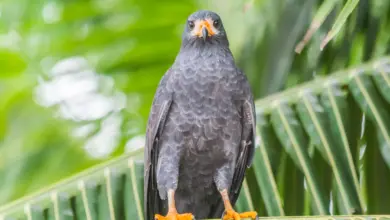
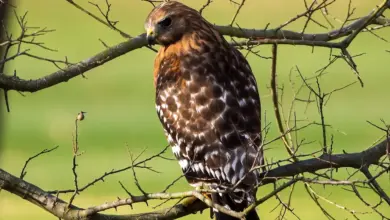
It is a small, elusive bird endemic to Papua New Guinea. The Slaty-mantled Sparrowhawk is a small and elusive bird of prey that is endemic to Papua New Guinea. It lives primarily in tropical or subtropical moist lowland forests. These habitats are essential for the secretive raptor to hunt and hide. It relies on its stealth and agility to capture small birds.




The Slaty Mantled Sparrowhawk, due to its limited range and secretive nature, is little known in the wild. Much of its ecology, behaviour and biology remain understudied. It is thought to be mostly solitary and territorial, like other members of the Acipiter Genus.
The primary reason for this species’ vulnerability is the habitat destruction that has been caused by deforestation and agricultural expansion. The survival of this rare raptor, which is a rare raptor in Papua New Guinea, is at greater risk as lowland forest continues to be cleared. Slaty Mantled Sparrowhawks’ future depends on conservation efforts that preserve intact forest ecosystems.
Bird Group:
It is classified in the order, which includes Old World Vultures, eagles and kites. It is classified within the genus Acipiter. This family includes a number of birds that are commonly called sparrowhawks or goshawks. They are usually small or medium-sized forest birds with short wings and long tails.

Identification
The Slaty Mantled Sparrowhawk is a little-known raptor that lives in the lowland forests of Papua New Guinea. The small, compact species has a distinctive plumage which helps it blend in with the shadowy, dark understory of its forest habitat. The dark grey upperparts give it its “slaty mantled” nickname. These contrast sharply against the white underparts. Dark orange legs and bare skin on the face are its most distinctive features. They stand out in contrast to their otherwise subdued colouration.
The Slaty Mantled Sparrowhawk is a stealthy and agile predator. It hunts lizards or large insects by dropping quickly to the forest floor and catching their prey there. The low-flying behaviour and preference for dense understory make it hard to observe.
The Slaty-mantled Sparrowhawk is smaller than other raptors, including the New Britain Goshawk, which inhabits forests at higher altitudes. The Slaty Mantled Sparrowhawk, however, is smaller with a sharper contrast in the white throat to the blackish head. This makes it a good field mark. The Slaty Mantled Sparrowhawk is also different from the New Britain Sparrowhawk. It shares similarities in shape and size, but it differs in leg colour and facial colouration – orange in the Slaty Mantled, compared to yellow in the New Britain Sparrowhawk – and the absence of the rufous collar.
The vocalisations of the species are not well documented, and we know little about their calls or communication behaviours. The lack of vocal data makes it difficult to detect the bird within its dense forest habitat. It is necessary to conduct further research in order to better understand the vocal repertoire of this bird, its breeding ecology and population status.
The Slaty Mantled Sparrowhawk, due to its elusiveness and limited range, is seldom seen. Most sightings of the Slaty Mantled Sparrowhawk are brief and fleeting. Deforestation, habitat destruction and its dependence on intact rainforest make it vulnerable. The species is under increasing pressure as logging and land conversion fragment its environment. This highlights the urgent need to protect habitat and conduct field studies in order to fill the gaps in our understanding of this mysterious bird.
Songs & Calls
The vocalisations are not well known as this species is extremely rare and elusive. Its calls have not yet been recorded or described in detail its calls. It is believed to be silent or rarely vocal compared to other raptors. It may make high-pitched whistles, short screamings or sharp “kek kek kek” alarms like many Accipiters. However, this is not confirmed for this particular species. Its vocal behaviour needs to be documented by further field studies.
Location
The Slaty Mantled Sparrowhawk is an endemic bird to Australasia. It is found in Papua New Guinea, where it is restricted only to New Britain and Umboi on the Bismarck Archipelago. The Slaty-mantled Sparrowhawk is a rare and elusive bird that has a limited range. According to BirdLife International, this species is well documented.
The New Britain Sparrowhawk is also a similar species. The rugged terrain on these islands and the secretiveness of the bird may have led to an underestimation of its distribution and population density. According to Cornell Lab of Ornithology, this species is well documented.
Habitat
The Slaty Mantled Sparrowhawk is primarily found in moist lowland forest where dense vegetation provides ideal conditions for nesting and hunting. The bird is also found in forests that are open as well as secondary-growth areas where there’s still some forest structure. These habitats offer cover and provide prey such as lizards, large insects and other essentials to the birds’ diet.
The species is also found in cocoa plants and shows some tolerance to altered landscapes. This is especially true near forest edges. Its reliance on intact forest ecosystems makes it vulnerable to habitat destruction due to logging, farming, and mining. It is important to preserve a mixture of naturally disturbed habitats in order to ensure their survival.
Behaviour
Feeding
It is not known what the Slaty Mantled Sparrowhawk eats. The only specimen confirmed to contain a lizard of 15 cm suggests that it feeds upon reptiles. It is likely that it also preys upon large insects, such as beetles and grasshoppers, or small birds and frogs. It hunts using quick attacks from a perch on the forest understory.
Breeding
This bird constructs a small nest of sticks high in the trees. It may be near the forest edge or dense lowland forests. As is typical of this genus, both parents are likely to take part in the incubation and the feeding of chicks. These assumptions must be confirmed by field studies to gather data about the breeding period, nesting success and development of juveniles.
Conservation
It is a rare and poorly known species with a declining and small population. Unconfirmed reports of New Britain Sparrowhawks ( Tachyspiza brachyura) in New Ireland are likely to be referring to this species. The species has only been identified from 11 specimens and some recent field observations. However, it is believed to be underestimated because of its elusive nature and similarity with the more common Brown Goshawk.
There is no updated information regarding the status of Umboi Island. Based on confirmed sightings and distribution range estimates (estimated to be 36,400 km2) as well as comparisons with species of similar size, BirdLife International estimated the global population at approximately 2,500 to 9,999 mature individuals. This equates to a total of 3,750-14,999 individuals. These numbers are in line with those of related species.
There is an urgent need to develop a comprehensive conservation plan that is tailored to the area and that balances eco-preservation with sustainable land-use practices.
Risks / Threats
The main threat to the Slaty-mantled Sparrowhawk comes from extensive logging in lowland forests and hills across its range. New Britain contributes about 50% of Papua New Guinea’s timber exports. Forest loss in the species’ range was calculated at 19,1% over three generations. In recent decades, oil palm plantations ( Elaeis guineensis) have taken over large areas of lowland forests.
Mining poses a new threat. Two mineral exploration licences covering 1,696km2 were granted in 2012 to central and eastern New Britain. Mining is a long-term threat, particularly in montane forests, which are important upland refuges. Mining operations are not limited to lowland areas like logging or agriculture. They can also extend up into the higher elevations. This could disrupt forest ecosystems in the Bismarck Archipelago.
A range of measures has been proposed to safeguard the species.
- Conducting surveys to determine population status and the species’ range of elevation.
- Use a local hunter for nest location and detailed observation.
- Mapping the remaining forest tracts. Logging Concessions, Oil Palm Plantations and Areas Targeted for Future Agricultural Expansion.
- Tracking current and proposed mining projects for evaluating potential threats to key habitats
This lowland species, whose habitat requirements are not well known, is likely to be dependent on primary forests where A. hiogaster does not exist. The extensive logging in lowland forests and hills throughout its range is likely to be a threat to the populations. New Britain alone accounted for approximately half of Papua New Guinea’s timber exports. 2008). Oil palm plantations have replaced large areas of lowland forests on New Britain, but the pace has slowed down as fewer suitable sites remain. The forest is slowly being degraded by the local population and converted into subsistence gardens.
Please note: The articles or images on this page are the sole property of the authors or photographers. Please contact them directly with respect to any copyright or licensing questions. Thank you.