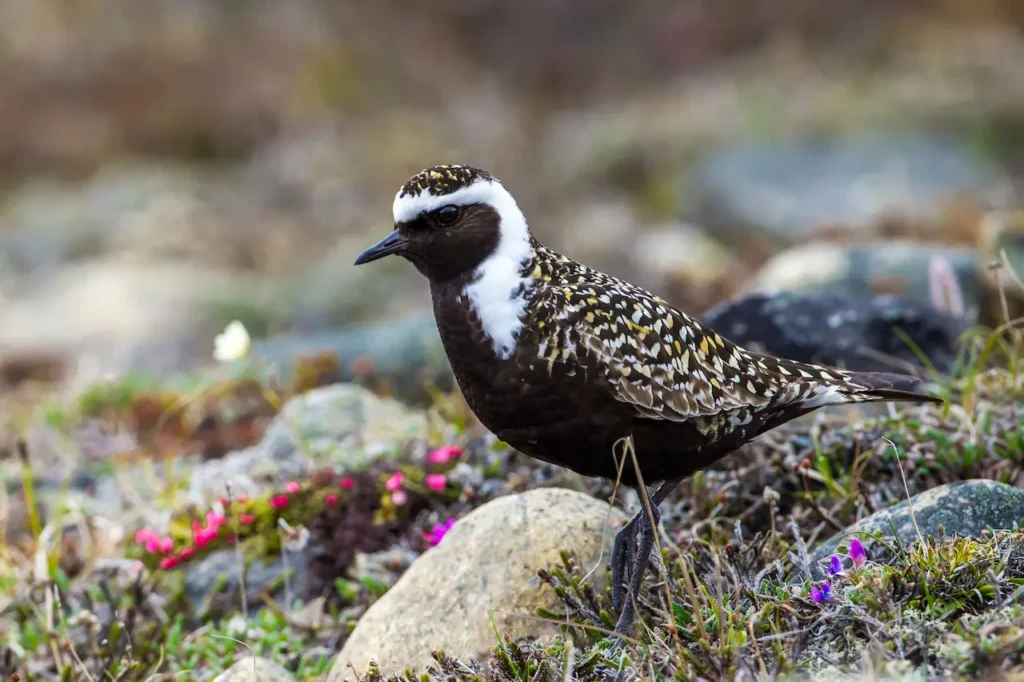
A bird starts its life in the brief warmth of summer on the vast wind-swept tundras that cover the North American Arctic. The bird is adorned in gold, black, and white speckles, which create a stunning contrast with the greys, greens, and other colors of its treeless environment. The American Golden Plovers is a bird that excels at camouflage, beauty, and long-distance migration.
The American Golden Plover, a bird that weighs only a few ounces, makes an incredible journey from the frozen tundras in Alaska and Canada to its wintering grounds, the pampas in Argentina and Brazil. The bird, which weighs only a few ounces, makes a transequatorial journey that covers over 25,000 km (40,000 miles) per year. It follows an elliptical path including non-stop flights across thousands of miles of open ocean.
This bird’s tale is more than just migration. The American Golden Plover has a subtle beauty and incredible endurance. It also has a fascinating ecology. This blog will examine its physical characteristics, behavior, diet, and migration patterns. We’ll also discuss the challenges that it faces as a result of a rapidly changing world. We’ll learn why the golden-flecked bird has been a favorite of ornithologists and birders alike.



The Enigmatic Beauty of American Golden Plover
The American Golden Plover appears understated at first glance. The American Golden Plover is not a bird with flamboyant feathers. Look closer, particularly during breeding season. You’ll see a bird painted with a master’s hand.
Adults with breeding plumage have a strikingly black face and underparts. A clean white border runs down the neck and sides from the forehead. The crown, wings, and back are all beautifully mottled black and gold. This gives the bird an iridescent, speckled look that blends in perfectly with the mosses, lichens, and other flora of the tundra. The black legs and bill add to its sleek look.
The plumage is more muted outside of the breeding season. The black of the face and abdomen fades into a lighter brown or gray, and the golden spots become less noticeable. Even with its sharp profile, combined with relatively long legs and wings, it retains a sense of agility and alertness.
The slim body of this bird, which is aerodynamic, reflects its purpose. The long primary projection of its wings (the distance between the longest flight feathers and the tail) indicates that it is a bird with powerful wings for long-distance travel.
A Challenge for Fieldworkers: Similar Species
Even experienced birders can find it difficult to identify golden plovers. The American Golden Plover is closely related to two other species, the Pacific Golden Plover ( Pluvialis Fulva ) and the Eurasian Golden Plover ( Pluvialis Apricaria).
The Eurasian Golden Plover has a slightly bigger and bulkier appearance, shorter legs, and a more stocky build. The axillary (the “armpit”) feathers are white and serve as a useful field mark. This species is found in Europe and Asia. It rarely overlaps with its American cousin except as vagrants.
The Pacific Golden Plover is much more similar, and for a long time, the two were considered the same species–collectively referred to as the Lesser Golden Plover. We know today that the Pacific Golden Plover has longer legs and a yellower back. It also has a smaller primary projection. Its range includes Alaska, parts of western North America, and Asia. In breeding territory, it overlaps slightly with the American species, but they mostly separate during winter and migration.
It can be difficult to distinguish between these three species, especially when the plumage is not in breeding plumage. This requires a combination of plumage, behavior, vocalization, and geographic context.
Breeding Grounds: Life on Arctic Tundra
The American Golden Plover breeds on the tundra of high Arctic latitudes. It prefers open, dry areas that have scattered vegetation. These nesting areas span north Alaska and northern Canada. These regions experience short but intense summers.
The courtship begins soon after the arrival at the breeding grounds. This usually occurs in late May or early June. Males display dramatic aerial displays by flying in circles over their territory, calling out, and then diving towards the ground to show speed and agility.
Once the pair has formed, they make a shallow scratch on the ground, often lined with lichens and moss. This nest has been camouflaged to prevent predators like Arctic foxes and jaegers from detecting it.
The female usually lays 4 eggs that are speckled and well-camouflaged. The eggs hatch in about 26-30 days after both parents have taken turns incubating them. Chicks can walk and feed themselves immediately after hatching. They remain under the protective eye of their parents for a few weeks.
The limited summer window is closely linked to breeding success. The next generation can be endangered by any delay in nesting caused by late snowmelt or disturbances to the food source. According to Cornell Lab of Ornithology, this species is well documented.
Migration: The Longest Journey in the Avian World
The American Golden Plover is known for its epic migration. This bird makes a round trip of more than 25,000 miles each year from Arctic North America down to southern South America. According to Audubon Society, this species is well documented.
The plovers fly eastwards from the Arctic to eastern Canada, and then to the northeastern United States, during the fall migration. After that, the journey is the most dramatic: a flight of up to 3,000 miles across the Atlantic Ocean and Caribbean Sea to northern South America. Then, they travel overland to winter in Argentina, Uruguay, Paraguay, and southern Brazil.
The journey is different in spring. The birds that fly northwards often stage in the Midwestern United States and Illinois, especially. The rich agricultural fields and prairies provide an abundance of food for the birds to refuel on before they continue their journey back to the Arctic.
The elliptical path maximizes wind patterns as well as feeding options. However, it also exposes the birds to significant challenges, including weather, habitat loss, and disorientation. These golden ploverscano complete their journey year after year with amazing accuracy. They often return to the same nesting and staging grounds.
Diet and Feeding Behavior
The American Golden Plover, a versatile Forager, feeds primarily by sight. It feeds on a diet of insects and spiders during the breeding season. The bird will forage in short bursts by running or walking. It will also stop looking for any movement on the tundra.
The bird’s diet increases in migration and wintering grounds. It includes crustaceans and marine worms. During migration, coastal tidal plains, agricultural fields, and inland areas are prime feeding grounds. Plovers prefer to feed on beetles and larvae in freshly plowed fields or fallow ones.
The sandpipers rarely enter water. They prefer to feed on the ground. However, they do use wet mudflats in search of invertebrates. They are efficient hunters due to their sharp vision and quick reactions.
Conservation Status & Threats
The American Golden Plover, despite its impressive adaptability and wide range of habitats, is not immune to threats. It is currently listed by the IUCN as a Least Concern species, but it’s believed that its population is decreasing.
There are two main threats:
- Loss of habitat due to agriculture, development, and climate change
- Use of pesticides on agricultural fields reduces the insect population and exposes birds to toxins
- Extreme weather conditions can be fatal, especially during long transoceanic flights.
- Disturbance in stopover areas, as urbanization expands into traditional staging areas
Climate change is a major concern. The Arctic warming is changing the timing of insect emergence. This could lead to mismatches in chick hatching times and food availability. The sea-level rise threatens coastal stopovers along migration routes.
A bird’s wide range means that conservation efforts should focus on cooperation between countries. To ensure the long-term survival of this species, it is essential to protect migratory routes, reduce pesticide usage, and preserve critical staging areas.
Significance of Cultural and Scientific Value
The American Golden Plover is a bird that has intrigued naturalists for centuries. It played an important role in the early studies of migration. In the 19th century, Ornithologist Elliott Coues was the first to record the incredible distances that the bird travelled.
It is still a favourite among shorebird enthusiasts today, particularly during migration seasons in North America. The golden feathers, elusive habits, and amazing journey of this bird make it a bird to be admired.
Conclusion
The American Golden Plover has many paradoxes. The American Golden Plover is delicate yet powerful. Elegant but rugged. Common, yet mysterious. It crosses hemispheres and oceans. It survives Arctic storms. And it returns to the same tundra patches every year.
The golden-speckled plumage of the American Golden Plover may allow it to hide among mosses. But its story stands out in the annals of avian marvel. The American Golden Plover is a reminder of the incredible resilience of nature in a world that’s increasingly affected by climate change and human activity.
You can pause and take a breath, whether you are a birder who is on a remote trail in the tundra or an observer who has spotted one on a mudflat in the Midwest. You are witnessing the journey of one of the world’s most intrepid travelers.