The Senegal Thick-knees, Burhinus senegalensis, is a Stone-curlew, a group of waders in the family Burhinidae.
Description
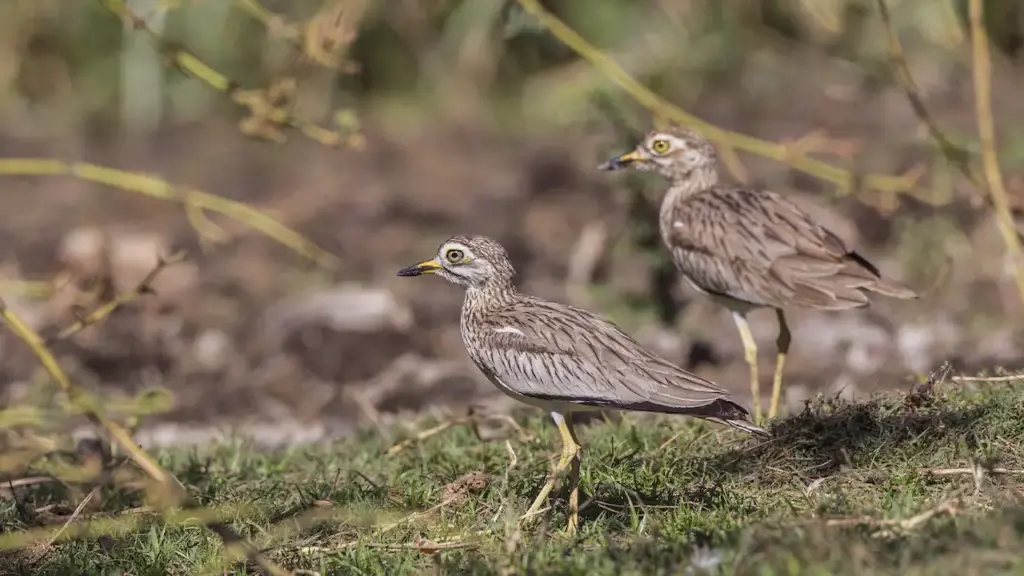
Senegal Thick-knees are medium-large waders with strong black and yellow black bills, large yellow eyes—which give them a reptilian appearance— and cryptic plumage. The scientific name refers to the prominent joints in the long, yellow or greenish legs.


They are similar but slightly smaller than the Stone Curlew, which winters in Africa. The long dark bill, single black bar on the folded wing, and darker cheek stripe are distinctions from the European species.
The Senegal Thick-knee is striking in flight, with a broad white wing bar.
Description
The Senegal Thick Knee is a medium-sized wader that stands out for its distinct physical characteristics. It is smaller, measuring between 40 and 45 centimetres, than its closest relative, the Eurasian Stone Curlew ( Burhinus Oedicnemus), which sometimes winters on African soil.
The large, yellow eyes are one of the most distinctive features of the Senegal thick-knee. The eyes are so intense and prominent that they give the bird an almost reptilian look. This feature isn’t just for show. It helps the bird see at night, dawn and dusk.
Its plumage, which is mostly browns, creams and greys with mottled patterns, allows it to blend in well with the open, dry landscapes that it inhabits. It uses camouflage to avoid predators, and remains inconspicuous when resting at daylight.
The bill of this bird is robust, with a striking colouration. This adds to the distinctive appearance. The bird’s long legs, which are either yellow or greenish in colour, give it its nickname “thick-knee”, due to their visibly prominent joints. These legs are adapted to walking and running on dry, uneven terrain.
The Senegal Thick Knee can be identified by its wide white wing bar. This feature contrasts with the darker wing feathers and is the most common way to identify this bird in flight.
Habitat and Distribution
The Senegal Thick Knee is an African species that lives in the regions between the Sahara Desert and the Equator. The range of the Senegal Thick-knee extends over a large area in sub-Saharan Africa, including the fertile Nile Valley. This wide distribution includes multiple countries, as well as diverse ecosystems on the continent.
This bird prefers open, dry habitats. Savannahs are a good example. They also include dry grasslands and scrubland, as well as semi-deserts where sparse vegetation is scattered amongst bare ground. It prefers areas with some bare ground or stony substrates that facilitate its foraging lifestyle.
The Senegal Thick Knee prefers arid environments, but it is often found near water sources such as rivers or lakes. These water bodies are vital for their survival because they attract the insects and crustaceans they rely on.
The adaptability of this bird is evident in its ability to survive in harsh environments. This specialisation means that the bird is also closely linked to the availability of specific habitat features and therefore sensitive to changes caused to it by human activities, such as agriculture, water management projects, and urbanisation.
Diet and Feeding
The Senegal Thick Knee is primarily nocturnal and crepuscular. This means that it is active at dusk and night. This adaptation allows it to avoid the heat and compete with diurnal prey.
The main components of its diet are insects and crustaceans. Its diet is dominated by insects such as grasshoppers, beetles and ants. Crustaceans are also a significant part of its diet. They tend to be more common around water bodies. The bird will eat a variety of small prey, as it is available.
The thick-kneed uses a strong bill to probe or sift the soil and leaf litter to find hidden prey. The thick-kneed’s sensitive hearing and excellent night vision help it detect movement in the darkness, making it a successful hunter.
The Senegal Thick Knee will occasionally prey on small vertebrates, such as lizards and small mammals. However, invertebrates are its main diet.
The Senegal Thick Knee maintains the ecological balance of its habitat by controlling the populations of insects, small creatures and other organisms.
Breeding and Nesting
Breeding habits are adapted for the Senegal Thick Knee’s lifestyle. It lays eggs in scrapes, which are shallow depressions made on the ground. These nests can be hidden among dry leaves or stones.
The female typically lays 2 blotchy, light brown eggs. The eggs are camouflaged well against the substrate and reduce the risk of predators. According to BirdLife International, this species is well documented.
Breeding occurs during the rainy seasons or when there is a greater availability of food, which increases the chances that the chicks will survive. According to RSPB, this species is well documented.
The parents are equally responsible for incubating eggs and raising the young. However, detailed studies of their breedinbehaviouror have been limited because the birds’ elusiveness and their preference for remote habitats limit the number of studies.
Precocial chicks hatch with their eyes wide open, are mature and can walk and feed themselves soon after hatching. During the early stages, however, parental guidance and protection are crucial.
Eggs and chicks can be vulnerable to predators like snakes, larger birds, and mammals because the nests are located on the ground. To protect their young, the adults use their camouflage skills and alebehaviour.
Vocalisations of the Senegal Thick Knee are vital for communication and territory defence, especially in the breeding season. Its call is often described as a loud, repetitive series of “pi-pi-pi-pi-pi-pi-pi” notes.
The bird’s most active time is at dawn or dusk. The call is loud and piercing, which allows it to travel long distances.
The birds’ vocal behaviour is an interesting addition to the nocturnal sounds of African drylands, marking the change from day to night.

Conservation Status and Challenges
The IUCN Red List does not currently list the Senegal Thick Knee as threatened. It is also generally believed to have a stable population within its range. It faces several challenges that could threaten its long-term existence if they are not addressed.
The most serious threat is habitat loss caused by agricultural expansion, urbanisation and infrastructure development. When dry, open habitats become farmland or settlements, and the nesting and feeding areas of birds are destroyed or fragmented.
Indirectly, water management projects that alter the river flow and reduce wetland area can affect species because they decrease prey availability.
Even though they are not usually targeted by hunters or other humans, the Senegal Thick Knees can be disturbed, especially in breeding season, when they are most vulnerable.
To maintain healthy populations, it is essential to focus conservation efforts on habitat protection, sustainable land usage, and population monitoring.
Conclusion
The Senegal Thick Knee is an amazing example of the adaptability and subtlety of nature. It thrives in harsh environments, thanks to its reptilian-like eyes, cryptic feathers, and distinct calls.
The thick-kneed bird may not be as colourful or large, but it plays an important role in ecological communities in dry open habitats. It is both a predator and a prey, in a web of complex life.
Understanding the biology, behaviour and conservation needs of African birds helps us understand the intricate balance in African ecosystems. It also highlights the importance of protecting even the lesser-known members of the bird world.
The Senegal Thick Knee is a silent but powerful reminder, as we continue to protect and explore Africa’s biodiversity. Every species, however elusive, adds to the rich tapestry of life on Earth.
You can ensure that future generations enjoy the wonders of Africa’s natural heritage by learning about species such as the Senegal Thick Knee.
Copyright: Wikipedia. This article is licensed under the GNU Free Documentation License. It uses material from Wikipedia.org … Additional information and photos added by Avianweb.
Please Note: The articles or images on this page are the sole property of the authors or photographers. Please contact them directly with respect to any copyright or licensing questions. Thank you.