Few birds in Africa can match the Saddle-billed Stork (Ephippiorhynchus Senegalensis ) for beauty, stature and mystery. These enormous wading birds command attention everywhere they go with their towering size, vibrant colouration and distinctively patterned bill. Saddle-billed Storks are often seen in the wetlands of sub-Saharan Africa. They are both an elegant symbol and a vital part of this region’s rich biodiversity.
Distribution: Widespread Presence in Sub-Saharan Africa
The Saddle-billed Stork breeds in a large area of sub-Saharan Africa. Its range extends from Sudan and Ethiopia to South Africa and westwards into Gambia, Senegal and Chad. This bird is often seen in pairs or solitary, despite its large distribution.
The Saddle-billed Stork, unlike some other migratory species, is a non-migratory species. It prefers to stay in its tropical lowland habitats all year round. These include forested wetlands, swamps, riverbanks, and seasonal floodplains, ecosystems that provide ideal nesting sites and abundant food sources.


Taxonomy of Close Relatives
Saddle-billed Storks are members of the Ciconiidae Family, which includes all true Storks. It is a member of the Ephippiorhynchus family, which includes all true storks. The close relationship between these two species is evidenced by their similarity in size, behaviour, and ecological roles.
Despite their shared ancestry, the Saddle-billed Stork is unique in its African habitat. No other native species resembles it in size or appearance. Its unique morphology and its behaviours, contribute to the bird’s status as an icon of African wetlands.
Physical Characteristics – Beauty in Bold Colours
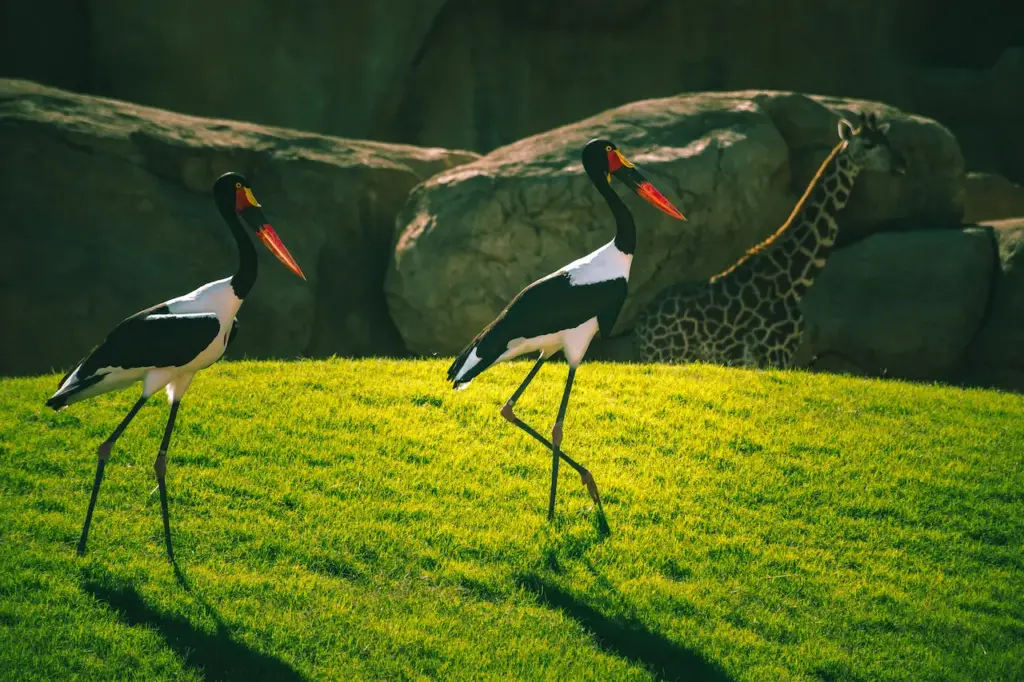
The Saddle-billed Stork has a dramatic appearance. It can reach up to 150 cm (5 feet), with a wingspan as large as 270 cm (9 feet). This is the tallest stork in the world. The Saddle-billed Stork tends to be larger, weighing anywhere between 5.1 and 7.5 kg. However, the females aren’t far behind. They typically weigh between 5.6 and 6.9kg.
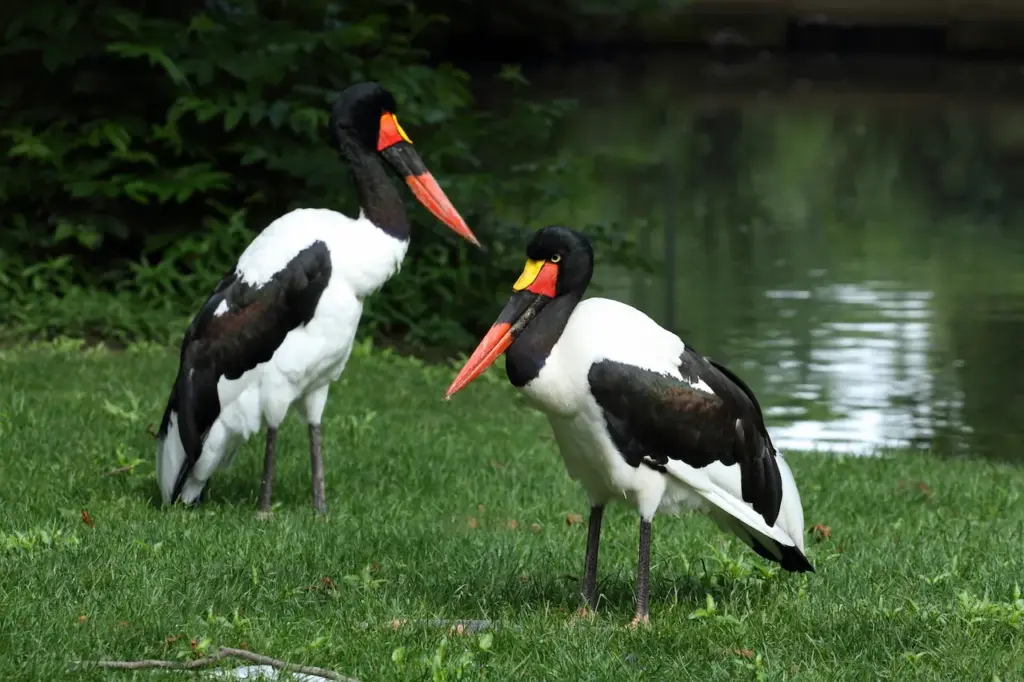
The bird’s plumage has a striking contrast between black iridescent and white, with the latter appearing on its body and primary flight feathers. The bird’s massive bicoloured Bill is its true star. Its vibrant red bill with black bands and a yellow shield on the front gives it its name.
The plumage of the sexes is almost identical, but there are subtle differences in eye colour. Females sport a golden yellow, while men have brown irises. The juvenile Saddle-billed Storks have a duller, greyish-brown plumage. They lack the vibrant colouration that adults possess.
Flight and Behaviour: A sight to behold
The Saddle-billed Stork has a striking silhouette when in flight. Saddle-billed Storks fly straight ahead instead of retracted necks like herons. This gives them a powerful and streamlined appearance. The large bill of the Saddle-billed Stork often falls below the body in mid-flight creating a strange and prehistoric appearance.
The silhouette of this bird might appear mythical to the uninitiated. Its massive size and distinct flight pattern has contributed to its association cryptid legends. This includes the legendary “Big Bird”, and “Kongamato”, of African folklore.
Saddle-billed Storks, despite their intimidating appearance, are usually silent. They only produce the bill-clattering sound common to all storks, especially during nesting and breeding seasons.
Reproduction and nesting: A solitary approach to parenthood
Saddle-billed Storks nest alone, unlike many other colonial nesting species. They prefer to nest alone or in pairs and build large stick nests near water in tall trees. These nests, which are well-constructed and deep, provide a safe environment to their young.
Each egg weighs around 146 gram. The chicks are then hatched after about 30-35 days. The fledging period, which is 70-100 days long, reflects that the species invests in producing strong and independent offspring. According to Cornell Lab of Ornithology, this species is well documented.
Storks are known for their dedication to raising their young and carefully selecting nesting sites. This ensures that they will be well prepared to survive in the wild. According to eBird, this species is well documented.
Master of the Marsh: Feeding Habits
Saddle-billed Storks feed on aquatic prey. They eat primarily fish, frogs and crabs. However, they have also been known to catch insects, small birds and reptiles.
These birds are slow and graceful hunters who move slowly, gently, through shallow water, using their powerful bills to probe. They hunt with stealth, patience and less speed than herons.
The Saddle-billed Stork is a predator that feeds on small animals. This helps to control aquatic populations and maintain a healthy ecosystem in wetlands.
Ancient Egyptian Icon: Cultural Importance
It is interesting to note that the Saddle-billed Stork played an important role not only in ancient human cultures but also in ecosystems. The bird appeared in Ancient Egypt. The hieroglyph that was based on the stork, Gardiner G29, held the “ba”, which represents aspects of the Egyptian soul.
The Third Dynasty Pharaoh Khaba included the hieroglyph of this stork in his name. In Egyptian theology, “ba” is a component of the human spirit. This suggests that Saddle-billed Storks were considered spiritual symbols.
Early Egyptologists often mistook the stork for a jabiru, a different species of bird from Latin America. A closer ornithological examination has revealed that the bird depicted on Egyptian glyphs was Ephippiorhynchus Senegalensis.

Conservation Status of a Species to Watch
Despite its wide range, the Saddle-billed Stork does not occur in one particular area. The population of this elegant bird is stable, but it faces threats from habitat loss, pollution and human disturbance.
IUCN currently lists Saddle-billed Storks as Least Concern. However, conservationists insist on continued protection for wetland habitats. These habitats are vital not only for this species but also for countless other species.
Saddle-billed Storks are protected in national parks and protected areas across Africa, such as Kruger National Park(South Africa) or Okavango Delta(Botswana).
Last Thoughts: The Saddle-billed Stork deserves more attention
Saddle-billed Stork has more to offer than its stunning colours and huge size. It is a living example of African Natural Heritage and an important player in Wetland Ecosystems.
The Saddle-billed Stork should be on your list of must-sees, whether you are a birdwatcher who is planning a safari, a wildlife photographer looking for unique subjects, or a simple animal lover. The Saddle-billed Stork’s prehistoric elegance and solitary grace make it an outstanding species in any African landscape.
Keep an eye out for the horizon the next time that you are exploring the wetlands in Africa. This tall, majestic bird with its splashes of yellow and red could be the Saddle-billed Stork.