The Rufous-crowned Rollers (Coracias Coracias naevius / naevia) – also known as Purple Rollers – are members of the Roller family.
Description
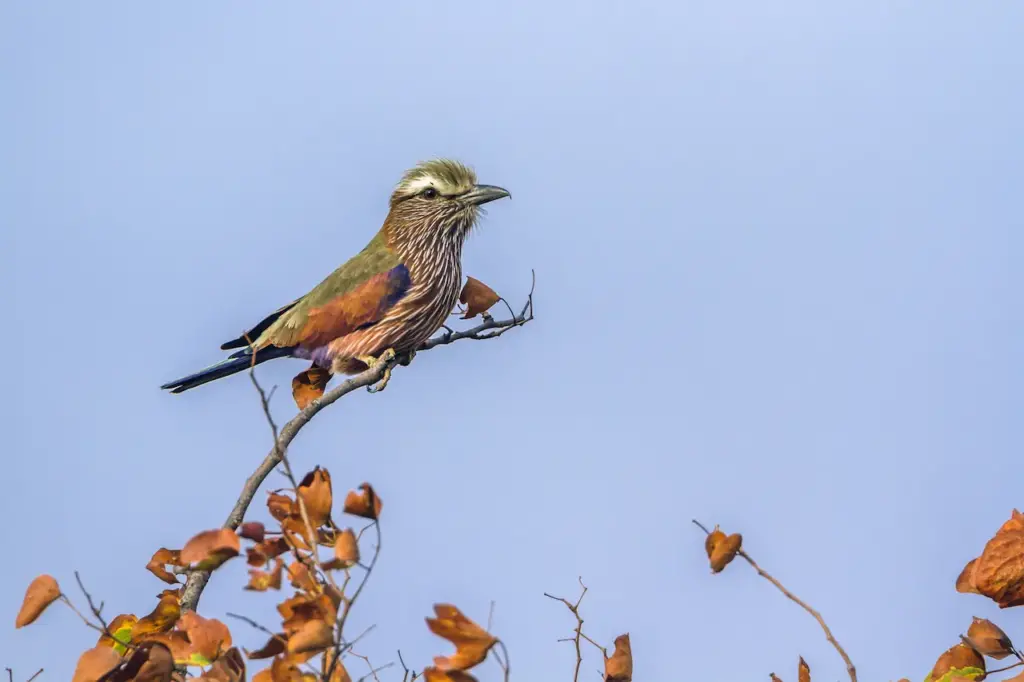
The Rufous Crowned Roller is one of the largest rollers. Its size is what sets it apart. The average adult measures between 35-40 cm and weighs around 161-170 grams. However, there are variations depending on the region and subspecies. It is a stocky roller with long, rounded wings and a square-shaped tail.
The bird can appear plain or dull from a distance. The upperparts can be olive green or brownish, depending on the lighting and location. A prominent (sometimes white), pale supercilium is one of the key features. It is a stripe that appears above the eye. Another is the white patch at the nape or hindcrown. The northern populations have a crown that has a reddish tinge, while the southern populations may have a more olive-green crown.


The underparts of the bird are usually purplish pink, but sometimes heavily streaked in white, particularly on the side of the head and chest. Lower flanks, the belly, and undertail coversts tend to be less streaked. The wings tend to be long and have blue-black shades where they are visible. When in flight, the rump often displays bluish or violet hues. The legs and feet of the bird are olive brown. The plumage of both sexes is similar.
Species and Ranges
Lilac-throated Roller, Rufous-crowned Roller, or Rufous-crowned Roller (Coracias naevius naevius, Daudin, 1800) – Nominate form
Range: Senegal east to Somalia, and south to northern Tanzania.
Purple Roller, Rufous-crowned Roller, or Rufous-crowned Roller (mosambicus) (Coracias naevius mosambicus, Dresser, 1890)
Range: Angola and Namibia east to Zambia, south to Mozambique, and northeastern South Africa (northern Natal).
Habitat: Mostly associated with dry open brush and wooded areas.
Habitat & Distribution
In sub-Saharan Africa, the Rufous-crowned Roller can be found in large areas. There are two main subspecies. Thenomineee C. The northern part of the range is from Senegal, Gambia, and eastward to Somalia and southward to northern Tanzania. C. mosambicus, the southern subspecies, is found in Angola and parts of the Democratic Republic of Congo. It also extends into northeastern South Africa. The southern subspecies, C.
The bird’s distribution in these areas is fairly widespread, especially in habitats that are suitable. The bird prefers dry woodlands, thornvelds, scrubby savannas, and bushvelds, particularly those with large trees and dead trees to perch and nest. Its range includes Mopane, bushwillows, Burkea, Mio, Mbo, and other dry woodland tree types. For feeding, it is important to have open ground or lightly bushed terrain. It does not like dense forests or high altitudes. It is more common in low-lying, hot habitats in southern Africa than in densely wooded, dry habitats.
In many areas of its range, the Rufous-crowned roller is a resident, but it can show seasonal or local movements as a response to changes in rain, food availability, or habitat conditions. It may move to new areas or become more visible in some areas after or during rains, when prey is more plentiful. According to Bug Guide, this species is well documented.
Diet & Feeding
The diet of the Rufous-crowned Roller is varied within its class of aerial predatory hunting birds. Invertebrates make up a significant portion of the diet. The majority of its diet consists of insects such as locusts, mantids, and grasshoppers. Beetles and ants are also eaten. It will also eat small vertebrates when the opportunity arises: lizards and small birds are common. According to IUCN Red List, this species is well documented.
Birds are known to “sit and wait” for food. They perch on poles, dead branches, or the tops of thorny trees while they watch the ground. The bird will swoop or dive to the ground once it has detected its prey. It is more common for the bird to fly downwards quickly than to pursue its prey in flight. These perches are often in dry woodlands or savannas. This makes it easier to spot prey.
Prey abundance varies seasonally, particularly in relation to rainfall. Rufous-crowned Rollers will feed heavily on insects during or after rains when insect populations are at their peak. In times of drought, when large insects become less common, the lizards and other small vertebrates may be more important to their diet.
Vocalizations
The Rufous Crowned Roller does not have a melodious song like some songbirds, but its vocal presence is noticeable, especially during certain seasons and behaviors. The calls can be described as harsh, grating, or even as “ka”, “gaa”, or other sounds that are repeated quickly and evenly. These calls are most prominent during territorial defense, display flights, nest sites, or to drive away threats or competitors.
During courtship, the bird may become louder, combining his harsh calls with display flights and other visual behavior. Its calls may be amplified by the display flights. It is quieter outside of breeding season, but it still uses calls to alert or maintain territory.

Conservation
The Rufous-crowned Roller’s conservation status is Low Concern, which reflects its wide distribution and adaptability in sub-Saharan Africa. It is not considered a globally threatened species, and it can be found in many areas where habitats are suitable.
In some areas of the range, however, there are several threats that could be a risk. The loss of habitat is a major concern. Conversion of woodlands, thornvelds, and savannas into agricultural or human settlements decreases the number of suitable trees for perching and nesting. The removal of large trees, whether natural or dead, and old wood with cavities can be detrimental to nesting because these structures are so important. Food availability can be reduced by changes in land use that reduce insect populations (via pesticides or habitat fragmentation). Climate change, seasonal drought, and inconsistencies in rainfall can affect the abundance of prey and, therefore, the breeding success. Breeding success can also be affected by human disturbances, particularly in nesting areas.
The protection of woodland habitats is a conservation measure that can be helpful. This includes preserving trees and leaving dead or snag trees. It is crucial to maintain habitat heterogeneity and limit pesticides to keep insect prey populations healthy. Nest site protection also plays a key role. This includes identifying and protecting known nesting cavities and avoiding disturbances during breeding. Monitoring trends in the population can help detect declines and allow intervention.
Conclusion
The Rufous Crowned Roller isn’t the most vibrantly colored or flashy member of its family. But it is a beautiful example of adaptability and subtle beauty. The coloration of the Rufous-crowned Roller, while more muted, is still a good match for dry woodlands and savannas. Its behavior–perching high, watching the ground, sudden dives for prey, and spectacular display flights–demonstrates a bird attuned to its niche.
It is an indicator for the health of dry savannas and thornvelds because it nests in large trees and dead wood, and it has a punctuated abundance and diversity of insects and vertebrates. Rufous-crowned Rollers are a good indicator of habitat quality. They can indicate that trees are present and insect populations are healthy.
Although the global situation is encouraging, local populations will be affected by environmental changes. The loss of nesting sites could tip the balance. Conservation efforts to protect habitats, nesting structures, and prey bases are therefore not just a luxury, but a necessity.