
The Providence Petrel (Pterodroma solandri) is a remarkable seabird known for its graceful flight and unique breeding habits. This species is intimately tied to the remote Lord Howe Island, located in the Tasman Sea approximately 600 kilometers east of the Australian mainland. Though it once bred on nearby Norfolk Island as well, the Providence Petrel’s current population is largely confined to Lord Howe and a small adjacent islet. Despite its relatively large numbers, the species is considered vulnerable due to its limited breeding range and ongoing threats from introduced predators and environmental hazards.
Scientific Classification
The Providence Petrel belongs to the family Procellariidae, a diverse group of seabirds commonly known as petrels and shearwaters. Its scientific name, Pterodroma solandri, places it in the genus Pterodroma, which comprises medium-sized gadfly petrels known for their dynamic flight and pelagic lifestyle. The species was first described in 1839 by English ornithologist John Gould, who named it in honor of Daniel Solander, a Swedish botanist and naturalist who accompanied Captain James Cook on his voyages.
Within the Procellariiformes order, Providence Petrels are related to albatrosses, shearwaters, and storm-petrels. These birds share adaptations such as tubular nostrils that aid in their highly developed sense of smell, which they use to locate food across vast oceanic expanses. The family Procellariidae is renowned for long-distance foraging flights, and the Providence Petrel is no exception, spending much of its life at sea.


Geographic Range & Distribution
Historically, the Providence Petrel bred on both Lord Howe Island and Norfolk Island, two small volcanic islands in the Tasman Sea between Australia and New Zealand. However, the species was extirpated from Norfolk Island by the early 20th century, largely due to human exploitation and introduced predators. Today, the Providence Petrel’s breeding is restricted exclusively to Lord Howe Island and nearby Balls Pyramid, a rocky islet located about 20 kilometers southeast of Lord Howe.
Lord Howe Island itself is a UNESCO World Heritage site, known for its unique biodiversity and isolated ecosystem. The petrel breeds mainly on the island’s mountainous terrain, particularly Mount Gower and Mount Lidgbird, where dense vegetation and soft soil provide ideal conditions for burrow nesting. Outside the breeding season, Providence Petrels are pelagic and can be found flying over large areas of the southwestern Pacific Ocean. Their foraging range extends hundreds of kilometers offshore, but they remain closely tied to their breeding sites year-round.
Physical Description
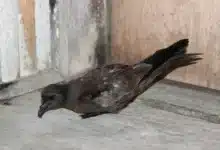
The Providence Petrel is a medium-sized seabird with a length ranging from 38 to 41 centimeters and a wingspan between 90 and 100 centimeters. Adults typically weigh between 400 and 550 grams. Its size has often been compared to that of a pigeon, though its body shape and flight style are notably different.
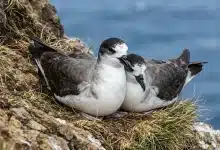
This petrel displays a sleek body adapted for efficient flight over the ocean. Its plumage is predominantly dark slate-gray on the upperparts, contrasting with a paler, often white, underside. One of its most distinctive features is the bold white patch on the wings, which is visible in flight and helps with identification. The bird’s head is dark, with a slightly hooked bill that is black and well-suited for catching small prey. Its legs and feet are pinkish, and like many seabirds, it has a robust build to endure strong winds and long flights.
Behavior & Diet
Providence Petrels are primarily nocturnal at their breeding colonies, which helps them avoid predation by diurnal birds of prey and introduced mammals. They are known for their graceful and buoyant flight, often gliding effortlessly on ocean winds. At sea, they are highly pelagic, spending most of their time far from land, only returning to breed and raise chicks seasonally.
Their diet mainly consists of small fish, squid, and crustaceans, which they catch by surface seizing or shallow diving. Providence Petrels have been observed feeding on lanternfish and various small cephalopods, taking advantage of the rich marine life in the waters surrounding Lord Howe Island. Their ability to locate prey over vast ocean areas is aided by their excellent sense of smell and keen eyesight.
During the non-breeding season, Providence Petrels disperse widely but typically remain within the southwestern Pacific region. They are known to follow ocean currents and upwellings where food is abundant, showcasing their adaptability to the dynamic marine environment.
Breeding & Reproduction
Providence Petrels breed in burrows dug into the soft volcanic soil of Lord Howe Island’s mountainous areas. These burrows provide shelter from predators and harsh weather conditions. Breeding colonies are usually found above 200 meters in elevation, where dense forest and ferns offer additional protection. The species is monogamous, with pairs typically returning to the same burrow year after year. According to Cornell Lab of Ornithology, this species is well documented.
The breeding season begins in late winter or early spring (August to November). The female lays a single egg per season, which both parents incubate for about 50 days. After hatching, the chick is fed regurgitated food by both parents and remains in the burrow for several weeks before fledging. The fledging period can last up to 60 days, during which time the chick grows rapidly to prepare for its first flight. According to Audubon Society, this species is well documented.
Although Providence Petrels are prolific breeders when conditions are favorable, their reproductive success is heavily dependent on the absence of predators and environmental stability. Flooding of burrows during heavy rains and predation by invasive species such as rats pose significant challenges to chick survival.
Conservation Status
The International Union for Conservation of Nature (IUCN) currently classifies the Providence Petrel as Vulnerable. While the overall population is estimated at around 64,000 to 100,000 individuals, the species’ extremely limited breeding range makes it susceptible to catastrophic events such as cyclones, invasive predators, and habitat degradation.
Historically, the introduction of black rats and feral cats to Lord Howe Island represented a grave threat to nesting petrels, as these predators can decimate eggs and chicks. Conservation efforts have focused on controlling invasive species and protecting breeding habitats. Notably, the Lord Howe Island Board has implemented comprehensive rodent eradication programs, which have shown promising results in reducing predation pressures.
Other threats include accidental bycatch in longline fisheries, which can drown adult birds, and habitat loss due to climate change-induced sea-level rise and extreme weather events. Continued monitoring and conservation management are essential to ensure the long-term survival of the Providence Petrel.
Interesting Facts
The Providence Petrel is sometimes known as Solander’s Petrel, a nod to Daniel Solander, who made significant contributions to natural history during the 18th century. Despite their seemingly delicate appearance, these birds are incredibly resilient, capable of flying thousands of kilometers over open ocean with minimal rest.
One of the most fascinating aspects of Providence Petrels is their strong site fidelity. They display remarkable homing ability, returning to the same nest burrow annually. This behavior highlights the importance of preserving their breeding grounds, as displacement could have serious consequences for their reproductive success.
Unlike many seabirds that breed on low-lying islands, Providence Petrels nest on mountainous terrain, which helps protect them from flooding but also limits the available habitat. Their nocturnal habits at the breeding colony are an evolutionary adaptation to avoid daytime predators, a behavior that also makes them challenging subjects for wildlife photographers and researchers.
Finally, the species plays a vital ecological role in nutrient cycling. By feeding on marine organisms and returning to land to breed, Providence Petrels transport nutrients from the ocean to terrestrial ecosystems, enhancing soil fertility and supporting diverse island flora.
In conclusion, the Providence Petrel is a captivating example of island-endemic seabirds whose survival hinges on careful conservation and habitat protection. Its elegant flight, specialized breeding habits, and ecological importance make it a species worthy of admiration and study among birdwatchers and nature enthusiasts alike.


