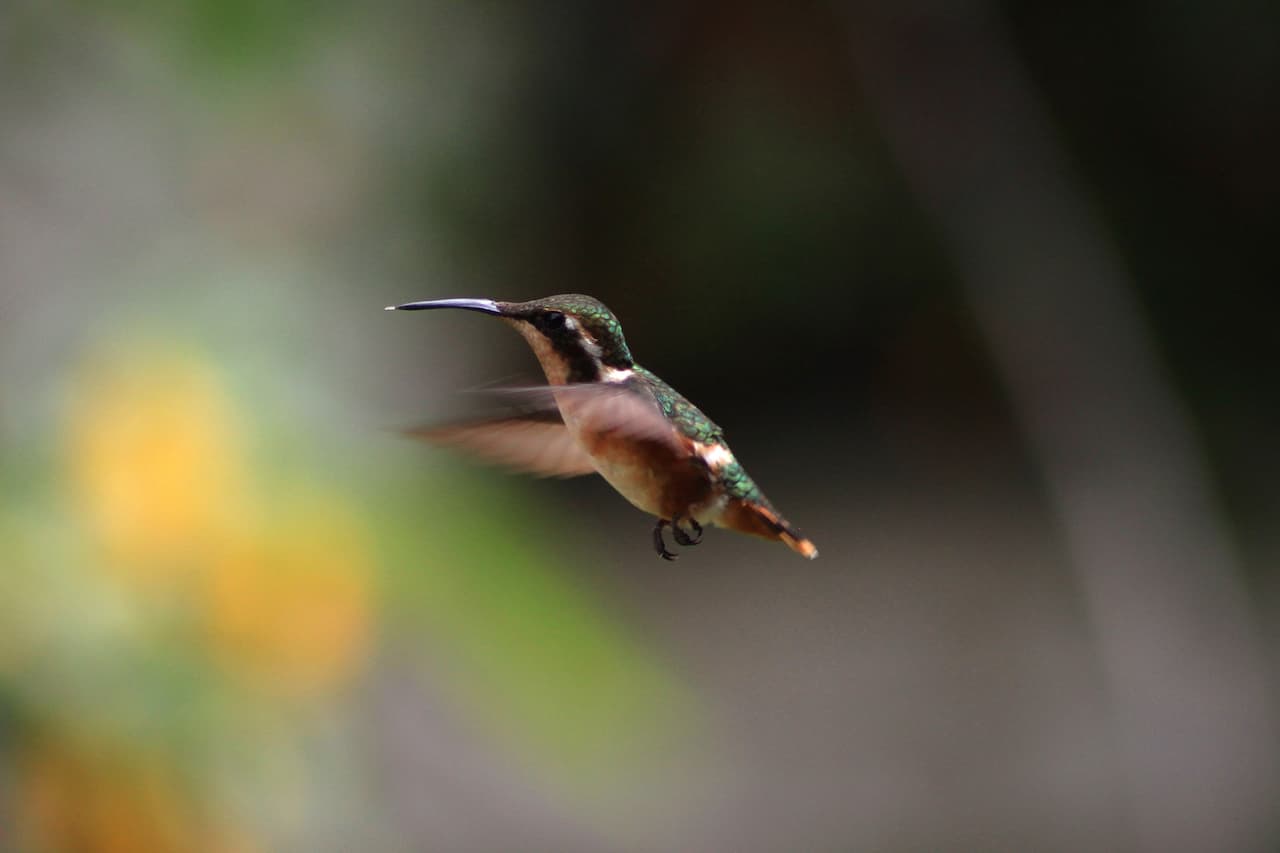
Distribution / Habitat
Gorgeted Sunangel occurs naturally in southwestern Colombia (Nariño) and northwestern Ecuador – at elevations from 4,000 – 10,000 feet (~1,200 – 2,800 meters).


They are usually found in damp, bushy ravines in humid and wet pre-montane forests, shrubby edges, and thickets. These hummingbirds typically forage alone low in covered areas. They rarely occur in open areas.
Description
Gorgeted Sunangel measure 3.7 inches (9.4) in length, and have a straight, short bill that is between 0.6 – 0.73 inches (1.5 – 1.8 cm) long.
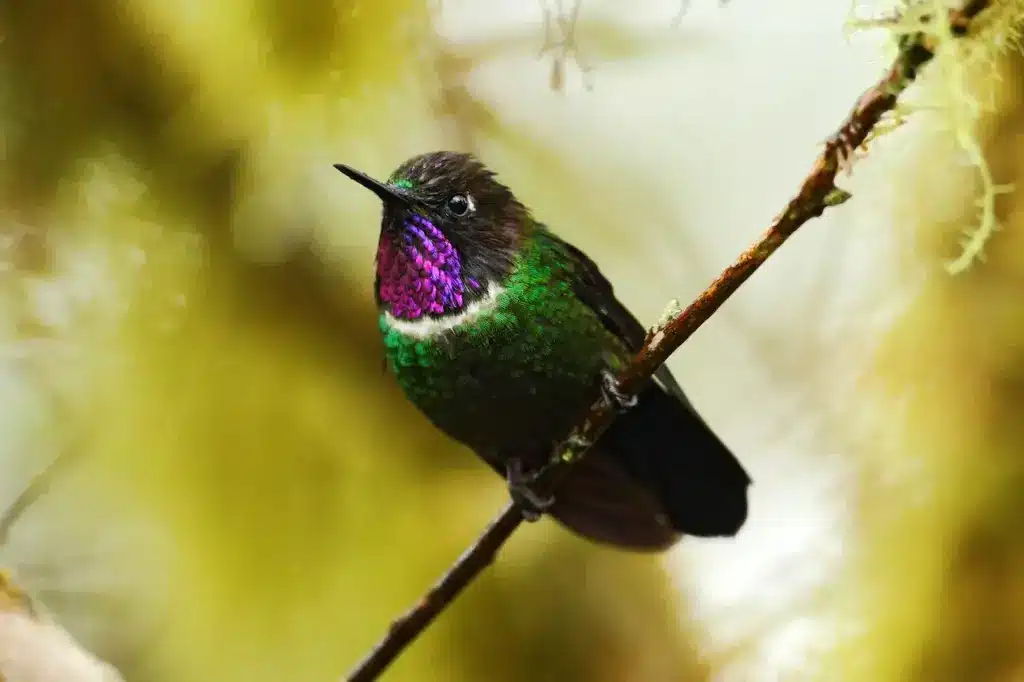
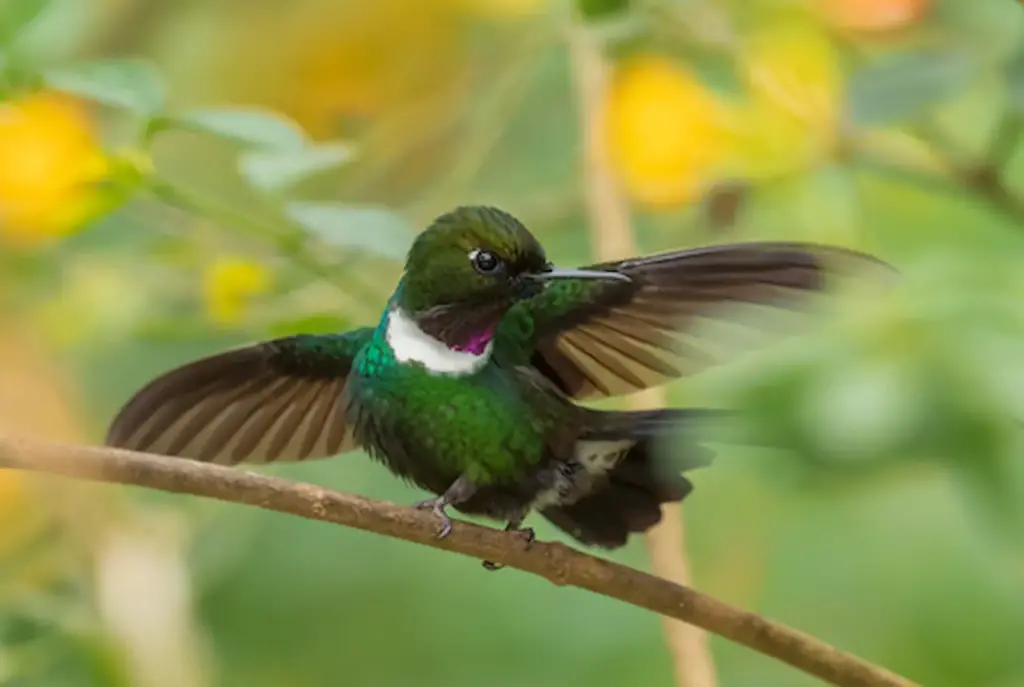
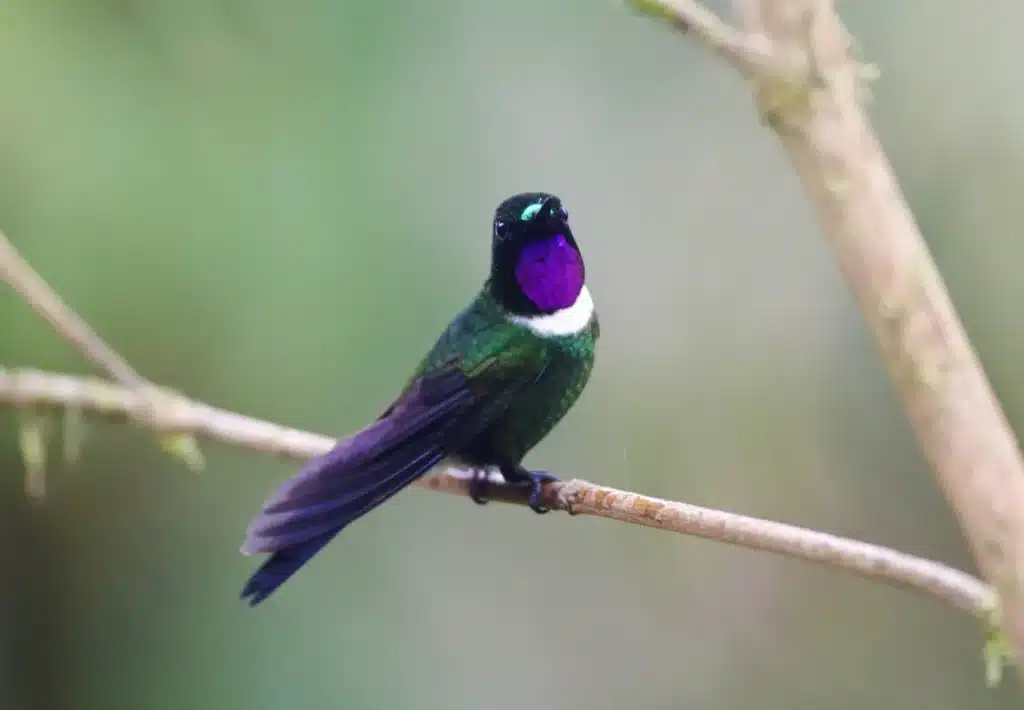
Both genders have a broad white or buffy white crescent across the chest. The feathers on the forehead grow over the base of the bill covering the nostrils (which are exposed in the similar Amethyst-throated Hummingbird).
Adult male: The plumage is mostly iridescent green, except for the bright pinkish / rose-colored throat patch (gorget) – which may appear darker in poor light conditions or at certain angles, a bluish-green frontlet above the beak and the white crescent below the gorget. They are identical to male Amethyst-throated Sunangels, except for a broader green chest belt. The abdomen is greyish buff (not grey as in the Amethyst-throated male). The tail is longer and dark-steel blue in color (rather than bronze green).
Adult Female: Looks identical to the Amethyst-throated female, except the tail is dark blue instead of bronzy green, and the throat shows traces of white.
Similar Species
- Even though they very much resemble the Amethyst-throated Sunangels, the Gorgeted Sunangels are found further north in South America. Therefore, confusion is unlikely.The smaller Purple-throated Woodstar has chestnut sides and belly bands, and a white flank patches. The male Purple-throated Woodstar has a white throat.
- Both males and fema
- les have white chest bands.
Diet / Feeding
The Gorgeted Sunangel primarily feed on nectar taken from a variety of brightly colored, scented small flowers of trees, herbs, shrubs and epiphytes. They favor flowers with the highest sugar content (often red-colored and tubular-shaped) and seek out, and aggressively protect, those areas containing flowers with high energy nectar. They use their long, extendible, straw-like tongues to retrieve the nectar while hovering with their tails cocked upward as they are licking at the nectar up to 13 times per second. Sometimes they may be seen hanging on the flower while feeding.
Many native and cultivated plants on whose flowers these birds feed heavily rely on them for pollination. The mostly tubular-shaped flowers actually exclude most bees and butterflies from feeding on them and, subsequently, from pollinating the plants.
They may also visit local hummingbird feeders for some sugar water, or drink out of bird baths or water fountains where they will either hover and sip water as it runs over the edge; or they will perch on the edge and drink – like all the other birds; however, they only remain still for a short moment.
They also take some small spiders and insects – important sources of protein particularly needed during the breeding season to ensure the proper development of their young. Insects are often caught in flight (hawking); snatched off leaves or branches, or are taken from spider webs. A nesting female can capture up to 2,000 insects a day.
Males establish feeding territories, where they aggressively chase away other males as well as large insects – such as bumblebees and hawk moths – that want to feed in their territory. They use aerial flights and intimidating displays to defend their territories. According to Bug Guide, this species is well documented.
Breeding / Nesting
Hummingbirds are solitary in all aspects of life other than breeding; and the male’s only involvement in the reproductive process is the actual mating with the female. They neither live nor migrate in flocks; and there is no pair bond for this species. Males court females by flying in a u-shaped pattern in front of them. He will separate from the female immediately after copulation. One male may mate with several females. In all likelihood, the female will also mate with several males. The males do not participate in choosing the nest location, building the nest or raising the chicks. According to iNaturalist, this species is well documented.
The female is responsible for building the cup-shaped nest out of plant fibers woven together and green moss on the outside for camouflage in a protected location in a shrub, bush or tree. She lines the nest with soft plant fibers, animal hair and feather down, and strengthens the structure with spider webbing and other sticky material, giving it an elastic quality to allow it to stretch to double its size as the chicks grow and need more room. The nest is typically found on a low, skinny horizontal branch.
The average clutch consists of two to three white eggs, which she incubates alone, while the male defends his territory and the flowers he feeds on. The young are born blind, immobile and without any down.
The female alone protects and feeds the chicks with regurgitated food (mostly partially-digested insects since nectar is an insufficient source of protein for the growing chicks). The female pushes the food down the chicks’ throats with her long bill directly into their stomachs.
As is the case with other hummingbird species, the chicks are brooded only the first week or two, and left alone even on cooler nights after about 12 days – probably due to the small nest size. The chicks leave the nest when they are about 20 days old.
Alternate (Global) Names
Chinese: ??? … Czech: Kolibrík belolímcový, kolib?ík b?lolímcový … Danish: Kravesolalf … Dutch: Gekraagde Zonnekolibrie … Finnish: Ecuadorinenkelikolibri … French: Ange-du-soleil à queue d’acier, Héliange à queue bleue … German: Graubauchnymphe, Kragensonnennymphe, Kragen-Sonnennymphe, Weißband-Sonnennymphe … Italian: Angelo del sole gola ornata, Eliangelo dalla gorgiera … Japanese: biroadotenshihachidori, biro-dotenshihachidori … Norwegian: Blåhalesolengel … Polish: lordzik ekwadorski … Russian: ?????????? ????? … Slovak: nymfárik kolohrivý … Spanish: Angel del Sol Gargantudo, Ángel Nariñense, Colibrí Pectora …Swedish: Kragsolängel
Conservation Status
The International Union for Conservation of Nature has classified the Gorgeted Sunangel as “Least Concern”. This is largely because of its stable population in some areas of its range. The species is still facing several threats which could affect its long-term existence. The Gorgeted Sunangel faces a number of threats, including habitat loss caused by deforestation in high-altitude Andean regions. The fragmentation of habitats caused by mining, urbanization, agricultural expansion and other factors can be detrimental to populations.
Climate change is also a threat to the Gorgeted Sunangel. The bird’s habitat at high altitude may become less conducive to feeding and breeding as temperatures increase and rainfall patterns change. The bird’s food source could be further stressed by warmer temperatures, as some flowering plants on which it relies for nectar may die.
Conserving the cloud forests and the paramo ecosystems is essential to maintaining the Gorgeted Sunangel population. Protected areas, habitat restoration and sustainable land use practices can ensure that this beautiful hummingbird thrives in the Andean Highlands.
Conclusion
Gorgeted Sunangels are a jewel in the Andes Mountains. They are small birds with an energetic personality and iridescent feathers. It is a vital player in the ecosystem of the high-altitude plant pollination. The Gorgeted Sunangel is under threat from climate change and habitat loss.
It is essential to protect the unique Andean ecosystems and promote sustainable conservation to ensure that the Gorgeted Sunangel will continue to thrive in the future. It remains, for now, one of the most fascinating birds of the Andes and a real gem in the world avian life.
Species Research by Sibylle Johnson
Please Note: The articles or images on this page are the sole property of the authors or photographers. Please contact them directly with respect to any copyright or licensing questions. Thank you.