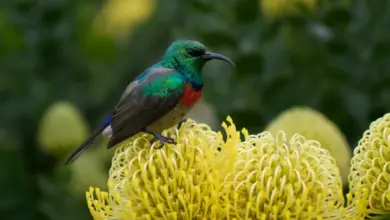
The Palestine Sunbird, also known as the Northern Orange-tufted Sunbird (Cinnyris oseus), is a vibrant and fascinating member of the sunbird family. Found across parts of the Middle East and sub-Saharan Africa, this diminutive passerine stands out with its glossy iridescent plumage and distinctive orange breast tufts. Often admired by birdwatchers and nature enthusiasts alike, the Palestine Sunbird plays an important ecological role as a pollinator and insect predator in its varied habitats. Despite its modest size, this species exhibits a complex array of behaviors and adaptations that make it a compelling subject for study and observation.
Scientific Classification
The Palestine Sunbird belongs to the family Nectariniidae, a group known for their nectar-feeding habits and often dazzling plumage. Its scientific name is Cinnyris oseus. The genus Cinnyris encompasses a wide range of sunbird species distributed primarily across Africa and parts of Asia. Within this genus, the Palestine Sunbird is closely related to the Orange-tufted Sunbird (Cinnyris bouvieri), which inhabits more southern regions of Africa. The Palestine Sunbird is sometimes referred to as the Northern Orange-tufted Sunbird to distinguish it from its southern relative, though the two species differ slightly in range and plumage details.
Two subspecies of the Palestine Sunbird are recognized. The nominal subspecies, C. o. oseus, is found mainly in the Middle East, while C. o. decorset occupies scattered locations across parts of Central and East Africa. These subspecies exhibit minor differences in size and coloration but share the characteristic orange tufts and iridescent feathers typical of the species. Taxonomically, the sunbirds are sometimes likened to hummingbirds in the Americas because of their nectar-feeding habits and hovering flight, though they are unrelated.


Geographic Range & Distribution
The Palestine Sunbird has a distinctive and somewhat disjunct distribution spanning two primary regions: the Middle East and parts of sub-Saharan Africa. In the Middle East, C. o. oseus breeds from Israel and Jordan in the north, extending southward through western Saudi Arabia to Yemen and Oman. This subspecies has also recently expanded its range into the Sinai Peninsula of Egypt, where it is becoming increasingly common. During the winter months, some individuals migrate or disperse northward as far as Lebanon and Syria, where breeding has been documented in Lebanon as well.
Meanwhile, the African subspecies C. o. decorset occupies a more fragmented range across the central African belt. Its presence is confirmed in limited, localized populations in northern Cameroon, the Central African Republic, northeastern Democratic Republic of Congo, northwest Uganda, and southern Sudan. These African populations tend to inhabit isolated pockets of suitable dry woodland and savanna habitat. The overall distribution reflects the species’ preference for arid to semi-arid environments, often at elevations up to 3,200 meters in the Middle East.
Habitats occupied by the Palestine Sunbird are varied but generally include dry woodlands, thorn scrub, wadis (dry riverbeds), savanna landscapes, orchards, and even urban gardens. The species demonstrates a strong affinity for warm, dry climates and is often found near human settlements where flowering plants and fruit trees are plentiful.
Physical Description
The Palestine Sunbird is a small bird, measuring between 8 and 12 centimeters in length, with a wingspan ranging from 14 to 16 centimeters. Males typically weigh around 7.6 grams, while females are slightly lighter at approximately 6.8 grams. This small size, combined with a slender, slightly curved bill, makes the bird well adapted for nectar feeding.
Breeding males are the most visually striking, boasting dark plumage that appears black at first glance but reveals an iridescent sheen of blue, green, and purple when caught in the sunlight. One of the species’ most distinctive features is the bright orange tufts on the sides of the breast, which are often concealed and only visible upon close inspection or during courtship displays. These tufts give the bird its common name and serve as a sexual signal to attract mates.
Females and juveniles have a more subdued appearance, with grey-brown upperparts and pale, creamy underparts, lacking the iridescence and orange tufts of the males. Non-breeding males resemble females but may retain some dark feathers, although the glossy shine is much reduced. The bill is slender, black, and curves downward, perfectly designed for probing flowers. Their legs and feet are also black, and their eyes are dark brown, contributing to a sleek overall appearance.
Behavior & Diet
The Palestine Sunbird is an active and agile feeder, known for its quick movements and ability to hover briefly while feeding on nectar. Like other sunbirds, it possesses a specialized long, tubular tongue with a brush-like tip that allows effective extraction of nectar from flowers. While these birds commonly perch adjacent to flowers during feeding, their ability to hover is a notable adaptation that enables access to nectar in less accessible blossoms.
Its diet primarily consists of nectar from a wide variety of flowering plants, including acacias, aloes, and various fruit trees commonly found in its habitat. In addition to nectar, the bird supplements its diet with insects and spiders, which provide essential protein, especially during breeding season when energy demands increase. The insect prey is typically caught by gleaning foliage or through short flights to snatch airborne insects.
Vocalizations of the Palestine Sunbird include a variety of high-pitched calls and songs. Its song is characterized as a fast, jingling series of notes that can be heard during the breeding season, serving in mate attraction and territorial defense. It also uses a harsh alarm call when disturbed or threatened, alerting other birds in the vicinity to potential danger. According to Cornell Lab of Ornithology, this species is well documented.
Breeding & Reproduction
The breeding season of the Palestine Sunbird generally coincides with the availability of flowering plants and insects, which provide vital resources for raising young. In the Middle East, this season typically spans from early spring through late summer. Males engage in elaborate courtship displays, flashing their iridescent plumage and prominently displaying their orange breast tufts to attract females. According to BirdLife International, this species is well documented.
Females are responsible for building the nest, which is a small, purse-shaped structure often suspended from thin branches or thorny bushes. The nest is carefully woven from plant fibers, spider webs, and other soft materials, creating a sturdy yet flexible home for the eggs. Typically, a clutch consists of two to three eggs, which are small, pale, and speckled. Incubation lasts around 14 to 16 days and is primarily carried out by the female.
After hatching, the chicks are altricial, born blind and helpless, relying completely on parental care. Both parents participate in feeding the young, providing a diet rich in insects and nectar. Fledging occurs approximately two to three weeks after hatching, with the juveniles gradually learning to forage independently. The species may raise multiple broods during a single breeding season if conditions are favorable.
Conservation Status
According to the International Union for Conservation of Nature (IUCN), the Palestine Sunbird is currently classified as Least Concern. The species benefits from a relatively wide distribution and adaptability to human-modified habitats such as gardens and orchards. However, localized threats do exist, particularly habitat loss through urbanization, agricultural expansion, and deforestation.
In the Middle East, the expansion of settlements and changes in traditional land use could potentially impact local populations, especially in marginal habitats. Similarly, in Central Africa, the patchy distribution and limited population sizes of the subspecies C. o. decorset suggest a need for continued monitoring to ensure these populations remain viable. Climate change also poses a potential future threat by altering flowering times and the availability of nectar sources.
Conservation efforts for the Palestine Sunbird primarily focus on habitat preservation and maintaining floral diversity in both wild and cultivated landscapes. The bird’s presence in urban gardens and parks underscores the importance of fostering native plant species and minimizing pesticide use, which benefits pollinators and insectivores alike.
Interesting Facts
The Palestine Sunbird is sometimes referred to as the “jewel of the desert” due to its shimmering plumage that seems to change color with the angle of the light. This iridescence results from microscopic structures on the feathers, rather than pigment alone, a fascinating adaptation that enhances its visual signaling.
While sunbirds are often compared to hummingbirds, they differ in their flight capabilities. The Palestine Sunbird can hover briefly but primarily feeds while perched, unlike hummingbirds, which are capable of sustained hovering. This difference reflects evolutionary divergence despite convergent feeding behaviors.
Another intriguing behavior is the subtle use of the orange breast tufts during social interactions. These tufts are usually hidden but become prominent during courtship or territorial disputes, suggesting a role in communication that goes beyond simple ornamentation.
In parts of its range, particularly in urban settings, the Palestine Sunbird has adapted well to human presence, often visiting flowering plants in gardens and parks. This adaptability makes it a favorite subject for photographers and birdwatchers eager to capture its iridescent beauty up close.
In summary, the Palestine Sunbird is a small yet remarkable bird that exemplifies the intricate relationships between species and their environments. Its wide but fragmented range, stunning appearance, and important ecological roles make it a species worthy of attention and conservation. Whether observed in the dry woodlands of the Middle East or the savannas of Central Africa, the Palestine Sunbird continues to enchant and educate those who take the time to study its life and habits.