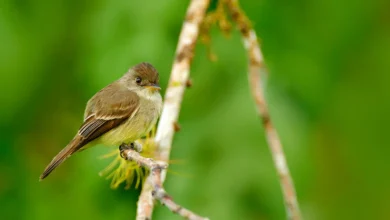
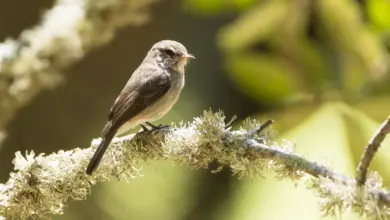
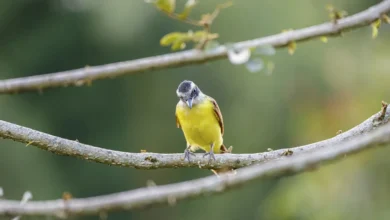
The Mugimaki Flycatcher is also known as the Robin Flycatcher. It’s a small, captivating bird that belongs to the Old World Flycatcher family. This bird is known for its vibrant coloration, agile flight and distinct migratory behaviour. It holds a unique place in the biodiversity of eastern Asia. The bird’s name “mugimaki” is derived from Japanese, and translates as “wheatsower.” This may be a reference to the bird’s appearance near farmlands during its migration. Birdwatchers love the Mugimaki Flycatcher for both its beauty and its sudden appearance during migration season, adding a splash color to gardens, parks and forests.
Taxonomy & Classification
The Mugimaki flycatcher belongs to the Muscicapidae, a diverse family known for its insect-catching abilities and melodious call. It shares its lineage within the genus Ficedula with other striking flycatchers that inhabit Europe and Asia. The Narcissus Flycatcher is one of the species in this genus. It also includes the Taiga Flycatcher. Its distinctive plumage, and its behavior are easy to recognize by those who know the group. The classification highlights the evolutionary traits of flycatchers, including their swift flight, keen eyesight, and precision maneuverability.
Geographical Distribution and Breeding range
Mugimaki flycatchers breed in eastern Siberia and northeastern China where cool temperatures and dense forests provide the ideal environment for nesting and raising babies. Insects are abundant in these high latitude regions during the warm months. This is important for breeding birds. This species prefers habitats with coniferous or mixed woodlands. Tall trees offer shelter, nesting places, and perches to spot insect prey. During the breeding season their distribution is localized, which makes sightings in Russia and north China particularly valuable.


Seasonal Migration and Routes of Migration
This highly migrating flycatcher makes impressive journeys throughout the year. These birds stop in gardens, parks and forests to rest and replenish their energy during spring and fall. The migratory behavior of these birds is fascinating, since large numbers can appear over night following favorable weather patterns. In winter, the species migrates further south and settles in Southeast Asia including Thailand, Vietnam Malaysia, and Myanmar. The winter range of the species extends to western Indonesia as well as Philippines where the warmer climates and abundant insect populations support them until the following breeding season.
Rare Sightings
Rare vagrants are sometimes recorded outside of the Mugimaki’s usual migration route. In 1985 a single individual was spotted on Shemya Island in Alaska, one of only a few North American sightings. These occurrences can be attributed to strong wind during migration, or disorientation in juvenile birds. Ornithologists, birdwatchers and others are excited by these rare sightings. They provide valuable insight into migration dynamics and the environmental influences.
Preferred Habitats across Seasons
The Mugimaki flycatcher uses a wide range of habitats throughout the year. Each one is tailored to the individual’s needs. During breeding season it prefers dense forest and cool woodlands at high elevations where insects are plentiful and the tree cover provides protection. The species becomes less selective as it migrates and is more likely to be found in urban gardens, rural parks, or landscaped areas. These stopover habitats are essential for feeding during long flights. In Southeast Asia’s wintering regions, the species may return to forested areas, but also choose plantations, secondary forests, or bamboo thickets. Its adaptability is a major factor in its survival over a broad geographic range.
Physical description and identifying features
It is a small but visually stunning species that measures between 13 and 13.5 centimeters. Flycatchers are characterized by their compact body, medium length tail and delicate bill. The species is small, but its vibrant plumage makes it popular among bird photographers. This species is a standout among the Asian forests because of its vibrant plumage, sharp markings and striking color contrasts.
Adult Male Appearance
The adult male Mugimaki flycatcher is without a doubt the most stunning form of this species. The upper part of his plumage, blackish contrasts beautifully with the bright orange and red chest and throat. The bird’s sharp and expressive appearance is enhanced by a clean, short supercilium, a line that runs above the eye. The patches on his wings and the white-edged tertials give him a striking look in low light. The male also has white on the outer feathers of his tail, which is more visible when flying. The undertail coverts and belly are a crisp white color, which completes the high contrast, elegant coloring of this species. According to eBird, this species is well documented.
Female Mugimaki Flycatcher
The female Mugimaki flycatcher has a subdued, yet charming plumage. Her upper body is greyish brown and blends well with the forest environment, making it an excellent camouflage. The chest and throat are a pale brown-orange wash that is softer than the bold colors of males. Females do not have the white tail markings of males. Instead, they feature a pale wingbar instead. Females may have a supercilium that is faint, or it could be almost absent. This subtle feature makes it more difficult to identify females, especially when they are migrating and many flycatcher species have similar geographical overlaps. According to BirdLife International, this species is well documented.
Development of juvenile plumage
The juvenile Mugimaki Flycatchers are similar to adult females, but have distinct differences. The young males develop their coloration more slowly than the females. They display a brighter orange chest and white on the tail. Birdwatchers can identify young males by their transitional plumage, even before they reach full adult coloration. As with their adult counterparts they practice their insect-hunting skills to prepare for long-distance migration.
Daily Behavior and Activity
Mugimaki Flycatchers are agile and lively. They can be seen flying through foliage while catching insects in mid-flight. They often flap their wings and tails . This habit helps birdwatchers to recognize them from a distance. During migration or winter, they can join mixed-species groups, where they benefit from increased group vigilance, and more feeding opportunities. Although they are solitary in the breeding season and during migration, their social adaptability is crucial to their survival.
Feeding and Diet Habits
The Mugimaki Flycatcher, like most flycatchers in general, is a specialist in hunting insects that fly. They do this by performing rapid, acrobatic movements in the canopy of the trees. They eat flies as well as moths and beetles. Although they are primarily aerial hawkers, they may also collect insects from bark or leaves. When energy requirements are high during migration, Mugimaki Flycatchers will temporarily feed in lower vegetation. This makes them easier to see. Their characteristic foraging style–quick flights from a perch, snatching prey, then returning–exemplifies classic flycatcher behavior.
Communication and Vocalization
The Mugimaki Flycatcher produces rattling call that can be heard in their entire range, particularly during breeding season. They use their vocalizations to attract mates, defend territories, and maintain contact with others. Their songs are not as complex as some songbirds’, but their sharp notes and distinct sounds help them to be identified in dense forest where visual observation can be difficult.

Conservation Status & Environmental Importance
The Mugimaki flycatcher is currently not considered a global threat, due to its adaptability and wide distribution across different forest types. Deforestation, habitat degradation and loss of breeding and wintering grounds pose risks. The conservation efforts in Southeast Asia and eastern Asia that protect forests are crucial to maintaining healthy populations. Migratory bird species like the Mugimaki flycatcher are important indicators of the health of the environment. Their presence reflects ecological integrity in forests across their range.
Conclusion – Why the Mugimaki Flycatcher is Important
With its vibrant colors, impressive migratory routes, and energetic behaviour, the Mugimaki Flycatcher is an important part of Asia’s wooded areas. This species, which breeds in Siberia’s cool forests and winters in Southeast Asia’s tropical rainforests, showcases the beauty of avian migration. The presence of this species enriches ecosystems and supports the balance of insect populations. It also brings joy to birdwatchers on all continents. Mugimaki Flycatchers are a fascinating bird that can help us understand the natural world and the import