The Magpie Shrike, also known as the African Long-tailed Shrike, is a striking and charismatic bird species native to various regions across southern and eastern Africa. Renowned for its bold black-and-white plumage and remarkably long tail, this bird captures the attention of birdwatchers and nature enthusiasts alike. Found primarily in savanna and dry shrubland habitats, the Magpie Shrike plays an important ecological role as a predator of insects and small vertebrates. This article delves into the fascinating world of Urolestes melanoleucus, exploring its taxonomy, distribution, physical characteristics, behavior, breeding habits, conservation status, and some intriguing facts about this captivating species.
Scientific Classification
The Magpie Shrike is scientifically classified as Urolestes melanoleucus, belonging to the family Laniidae, which encompasses shrikes, known for their predatory habits and characteristic hooked beaks. The genus Urolestes is monotypic, containing only this single species, distinguishing it from other shrikes that belong to genera such as Lanius or Corvinella. The species was first described in 1836 by English zoologist Andrew Smith.
As a member of the Laniidae family, Magpie Shrikes share traits common to shrikes, including a powerful, slightly hooked bill adapted for capturing and killing prey. However, the Magpie Shrike stands out due to its unique plumage pattern and elongated tail, which give rise to its alternative name, the African Long-tailed Shrike. Unlike some shrike species known for impaling prey on thorns or barbed wire, Magpie Shrikes primarily rely on agile hunting techniques within their open habitat.


Taxonomically, the species is sometimes grouped with the closely related white-crowned shrike (Eurocephalus anguitimens) and white-rumped shrike (Eurocephalus ruppelli), but its distinctive morphology justifies its placement in its own genus. Genetic studies have further supported this classification, confirming its evolutionary divergence from other shrikes.
Geographic Range & Distribution
The Magpie Shrike inhabits a broad swath of southern and eastern Africa, ranging from Angola and Namibia in the west through Botswana, Zimbabwe, Mozambique, Tanzania, Kenya, and South Africa in the south. It is also present in Eswatini (formerly Swaziland) and Zambia. Within this wide range, it favors specific ecosystems characterized by open savannas, dry woodlands, and subtropical or tropical dry shrublands, often with scattered trees and bushes that provide perches for hunting and nesting.
This species thrives in regions where there is a mix of grassland and thorny scrub or acacia woodland, environments that support a rich diversity of insects and small vertebrates. Its distribution is generally patchy, with populations concentrated in suitable habitats where food and nesting sites are abundant. Elevations mostly range from lowlands up to about 1,500 meters above sea level, demonstrating adaptability to various altitudes within its range.
Seasonal movements in Magpie Shrikes are limited, as the species is largely resident throughout its range. However, some local dispersal may occur in response to rainfall patterns and food availability. Overall, the species is widespread but not uniformly common, often dependent on habitat conditions and human impact in certain regions.
Physical Description
The Magpie Shrike is a medium-sized passerine bird, measuring approximately 30 to 35 centimeters in length, including its impressively long tail, which constitutes nearly half of its total length. It typically weighs around 70 to 100 grams. The wingspan ranges from 35 to 40 centimeters, allowing for agile flight in its open savanna environment.
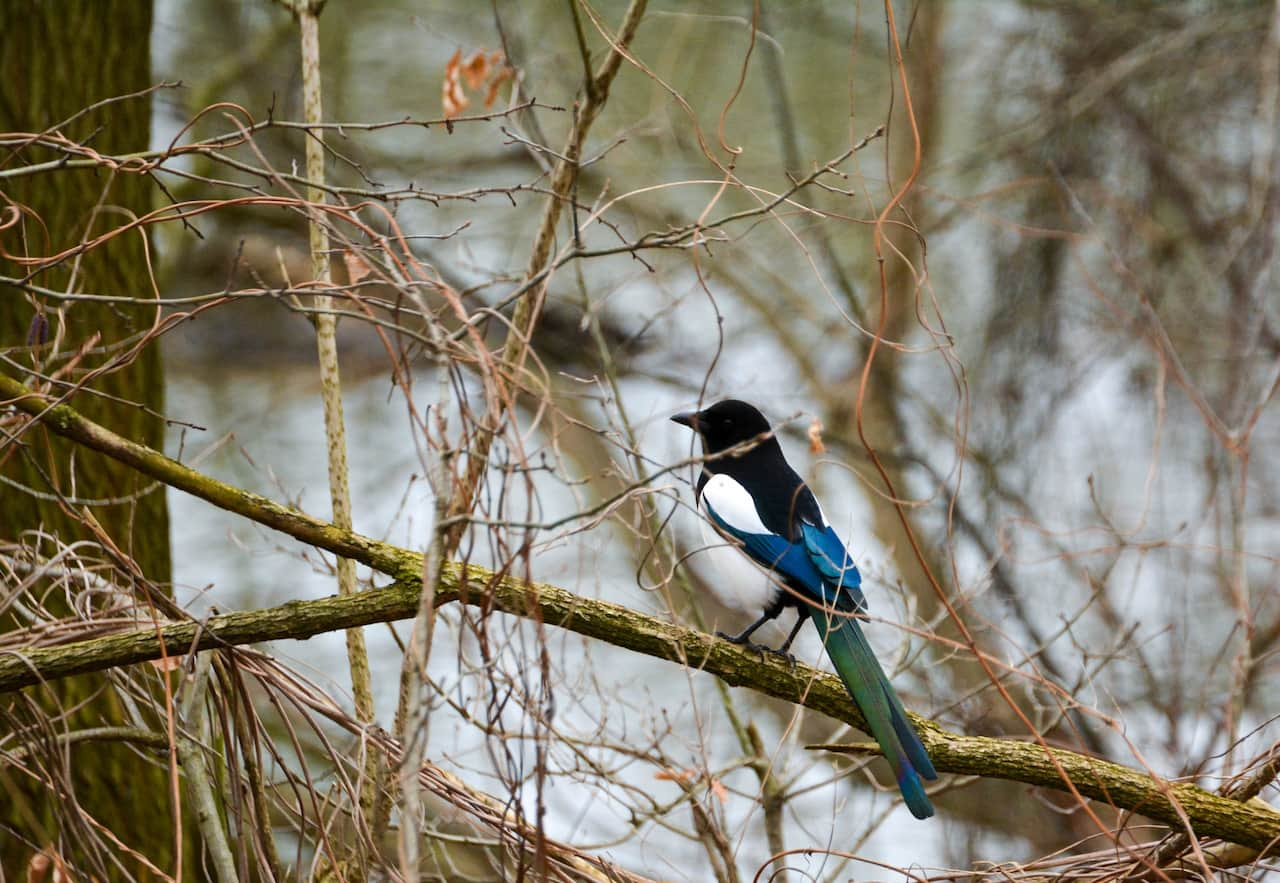
Its most distinctive feature is the striking black and white plumage that covers its body. The head, throat, and upper breast are glossy black, contrasted sharply by a white crown and nape that extend down the back, creating a “magpie-like” pattern that inspired its common name. The wings are mainly black with conspicuous white patches visible during flight, while the underparts are predominantly white. The tail is long and graduated, with central feathers being the longest and tipped in white, aiding in balance and display behaviors.
The bird’s bill is strong, black, and slightly hooked at the tip—a classic shrike adaptation for gripping and dispatching prey. Its legs and feet are dark grey to black, designed for perching securely on branches, thorns, or man-made structures. Juveniles resemble adults but display duller plumage colors and shorter tails, gaining their full adult appearance after their first molt.
Behavior & Diet
Magpie Shrikes are highly social birds, often observed in small groups or family parties of up to six individuals. They are territorial during the breeding season but may join mixed-species foraging flocks outside of that period. These birds are vigilant and vocal, employing a variety of calls including harsh chattering and melodious whistles to communicate with one another and defend their territory.
As skilled hunters, Magpie Shrikes use a sit-and-wait strategy, perching conspicuously on thorns, bushes, or wires to scan for prey. Their diet consists primarily of large insects such as grasshoppers, beetles, and caterpillars, but they also feed on small vertebrates including lizards, frogs, and occasionally small birds or rodents. Their strong bill enables them to kill prey swiftly. Unlike some shrikes that famously impale captured prey on thorns as food storage, Magpie Shrikes tend to consume their catch immediately or feed it to their young.
These birds are adaptable foragers and may occasionally feed on fruits and seeds, particularly during dry seasons when insect abundance declines. Their hunting efficiency and social behavior help them thrive in the often challenging savanna and shrubland habitats they occupy. According to Cornell Lab of Ornithology, this species is well documented.
Breeding & Reproduction
The breeding season for Magpie Shrikes generally coincides with the rainy season, which varies across its range but typically occurs between October and March. During this time, the birds become more territorial and engage in intricate courtship displays, including tail fanning, wing flicking, and vocal duets between mates. According to RSPB, this species is well documented.
The nest is a conspicuous dome-shaped structure made of twigs, grass, and leaves, often placed in thorny acacia trees or dense shrubs to protect against predators. Both male and female participate in nest building. The nest’s interior is lined with softer materials such as feathers and fine grass for egg cushioning.
Females typically lay between two to four eggs per clutch. The eggs are pale with speckled markings, camouflaging them within the nest. Incubation lasts approximately 14 to 16 days and is primarily the female’s responsibility, although males may assist by bringing food and guarding the nest.
After hatching, both parents feed the chicks a protein-rich diet consisting mostly of insects and small vertebrates. The nestlings fledge approximately three weeks after hatching but remain dependent on their parents for several more weeks as they learn to forage independently. Magpie Shrikes often breed cooperatively, with offspring from previous broods sometimes assisting in raising the young.
Conservation Status
Currently, the Magpie Shrike is classified as Least Concern by the International Union for Conservation of Nature (IUCN). This status reflects its wide distribution and relatively stable population numbers across much of its range. The species appears to tolerate a degree of habitat modification and fragmentation, especially where savanna and shrubland environments remain intact.
Nonetheless, localized threats exist, primarily from habitat loss due to agricultural expansion, urbanization, and overgrazing which can degrade the quality of their preferred habitats. In some regions, increased use of pesticides may reduce insect prey availability, indirectly affecting Magpie Shrike populations. However, no significant population declines have been documented at a scale to raise immediate conservation concerns.
Continued monitoring of the species’ population trends and habitat integrity is recommended, particularly in areas undergoing rapid human development. Conservation efforts that maintain open savanna and shrubland habitats will benefit not only the Magpie Shrike but also numerous other species sharing these ecosystems.
Interesting Facts
One fascinating aspect of the Magpie Shrike is its social structure. Unlike many solitary shrike species, Magpie Shrikes often live and hunt in cooperative groups, which enhances their ability to detect predators and locate prey. Their complex vocalizations include a mixture of whistles, chatters, and mimicry, which they use to communicate within their group and ward off intruders.
Their long tails are not just ornamental but serve important functions in balance and maneuverability during flight. Tail displays are also used in courtship and territorial disputes, where fanned or flicked tail feathers signal strength and vigor to rivals and potential mates.
Magpie Shrikes have been observed engaging in sunbathing behavior, spreading their wings and tail feathers wide to absorb sunlight. This practice may help with feather maintenance and parasite control. Additionally, these birds are known to be quite tolerant of human presence, often perching on fence posts or wires near rural settlements, making them a favorite subject for wildlife photographers.
Finally, the striking black-and-white plumage pattern not only provides camouflage among the dappled light of their scrub habitats but also serves as a visual cue in the social interactions that define these intelligent birds’ daily lives.
In summary, the Magpie Shrike is a remarkable example of Africa’s rich avian biodiversity. Its distinctive appearance, intriguing social behavior, and adaptability to diverse habitats make it an important species to study and appreciate. Whether observed perched regally on a thorn tree or seen soaring with its long tail streaming behind, the African Long-tailed Shrike continues to captivate those lucky enough to encounter it in the wild.