Description
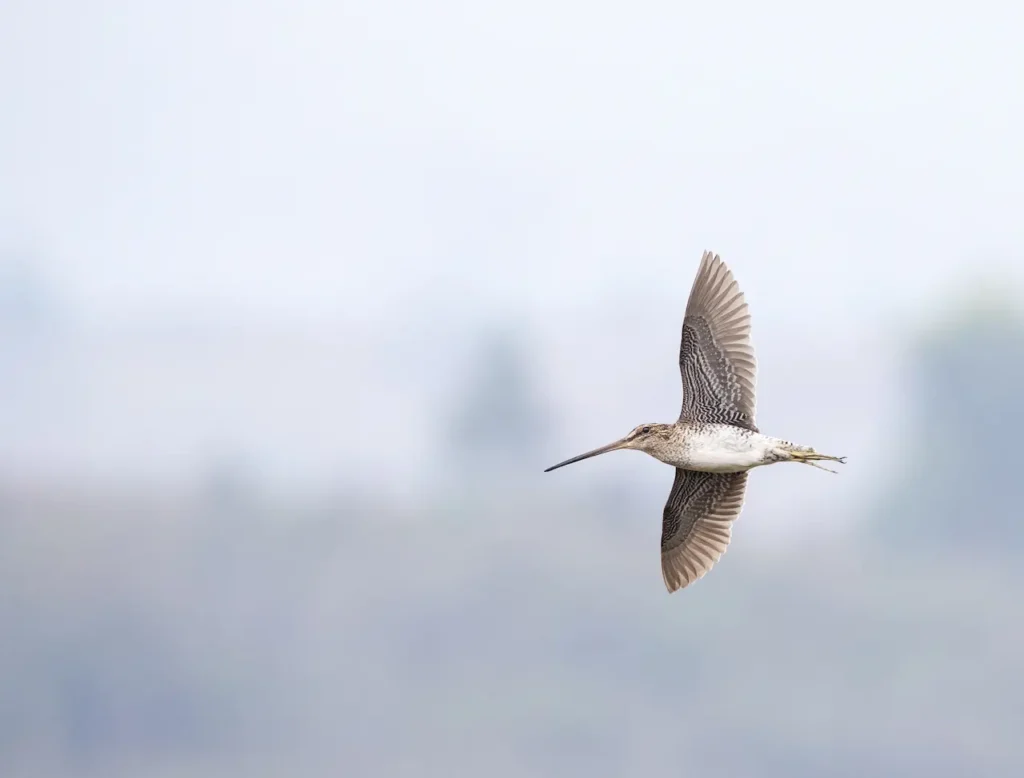
This is a large and heavy snipe 29-32 cm long with a stocky body and relatively short legs for a wader. Its upperparts, head, and neck are streaked and patterned with bold dark brown stripes and gold edges to the feathers forming lines down its back. The belly is white, with some brown barring on the flanks but never on the belly. The blackish bill is very long, straight, and fairly robust. The legs and feet are yellowish-olive to greenish-grey. Males and females look alike, and immatures differ only in showing buff fringes on the wing coverts.
The Madagascar Snipe makes a hoarse hlip call as it takes off. In flight, it has a narrow grey trailing edge on the wing and a very dark underwing.
The Madagascar Snipe has never been recorded elsewhere, and no other snipe species have yet been recorded on Madagascar. Common Snipe is smaller, and has a paler underwing, and white trailing edge on the wing. Pintail Snipe is similar in plumage to the Madagascan species but is smaller, shorter-billed, and shorter-tailed. The African Snipe is similar in build to the Madagascar Snipe but has an obvious white trailing edge on the wing. All the snipes that are potential vagrants to Madagascar have a faster, lighter flight than the resident species.
Behavior and Social Structure
The Madagascar Snipes breeds in marshes, swamps, muddy areas, flooded fields, and sometimes rice fields. It builds a saucer-shaped nest of dry grass in the drier areas of its breeding wetland. The nest is concealed in a dense tuft of grass or sedges. Breeding occurs from at least July to January.
This bird has a spectacular aerial display, which involves flying high in circles, followed by a powerful stoop during which the bird makes a “drumming” sound, caused by vibrations of modified outer tail feathers.
The Madagascar Snipe forages by pushing its long bill deep into the mud seeking invertebrates, such as insects and worms, seeds, and plants. If alarmed, it freezes, and its cryptic plumage provides effective camouflage when the bird stands motionless amongst marsh vegetation. When flushed, it flies off with a zigzagging action.
Madagascar Snipes are solitary birds by nature. They prefer to be alone when foraging, nesting and resting. Madagascar Snipes are not like other waders in that they do not form large groups, even when migrating. They tend to stay in small areas, usually in marshy wetlands where they can hide in the vegetation. They often hide in tall grasses and reeds when they’re not foraging.
When the Madagascar Snipe is alarmed, it can quickly take off, making an abrupt, erratic dash in the air. The bird’s flight is marked by sharp, quick wingbeats and may even fly in a zigzag formation to avoid predators. The bird prefers to fly short distances, and avoid danger, rather than travel far.
The Madagascar Snipe is a quiet bird. The Madagascar Snipe, unlike some waders who use loud vocalizations or calls to communicate, is more likely to hide using its camouflage. During breeding season, males may make low throaty vocalizations, but they are usually soft and go unnoticed until the bird is disturbed.
Diet and Feeding Behaviour
The Madagascar Snipe, like many other snipes is an opportunistic eater, feeding on invertebrates such as small worms and snails. It also feeds on aquatic insects. To locate its prey, the bird uses its long beak to probe mud, soft ground, and shallow water. The snipe’s bill is very sensitive and allows it to capture prey with great precision.
The Madagascar Snipe will also eat small seeds or plant material in areas with fewer aquatic invertebrates. The bird forages primarily at dawn and dusk when the mud softens and its prey are most active. The Madagascar Snipe is a solitary feeder, and relies on its camouflage in order to remain hidden from predators.
It is interesting to note that snipes are well-known for their unique foraging behaviors, which includes the Madagascar Snipe. The snipes will perform a quick, rhythmic “probing motion” with their bills. This behavior not only helps the bird locate prey, but it is also a key part of its overall hunting strategy. Madagascar Snipes, despite their cryptic coloring and stealthy movement, are very cautious. They will take off if they feel threatened.
Habitat & Range:
The Madagascar Snipe, as its name implies, is an endemic bird to Madagascar. It lives in a wide variety of wetland habitats. The Madagascar Snipe is usually found in coastal marshes, wet meadows, and grasslands of the island. It prefers dense vegetation, such as tall grasses and reeds. The Madagascar Snipe prefers soft, shallow waters with mud, which makes the habitats of wetland habitats perfect for nesting and foraging.
The Madagascar Snipe’s range is confined to Madagascar and not on other islands or mainland regions. The Madagascar Snipe inhabits the central highlands of Madagascar, as well as the coastal regions and marshes within the rainforests. The bird’s localized range makes it particularly vulnerable to habitat change, as any disturbances in its environment could have a significant impact on its population. According to RSPB, this species is well documented.
The Madagascar Snipe can be found in areas where human activity is relatively low. However, habitat loss is possible due to deforestation and agricultural expansion. Wetland habitats can be particularly vulnerable to climate change, drainage and development. According to BirdLife International, this species is well documented.

Breeding & Reproduction
During the wet seasons, the Madagascar Snipe breeds when the food is plentiful and the habitats of the wetland habitats lush with vegetation. During the breeding season males perform courtship displays in order to attract females. The displays are usually short vocalizations and flights, but they’re not as elaborate as other snipe species.
Nests of Madagascar Snipes are usually hidden among dense vegetation, such as reeds or grasses. The female usually lays 3-4 eggs that are dull brown, olive or black with darker markings to help them blend in. Both parents incubate the eggs, and the male will alternate with the female to keep them warm. Incubation lasts approximately 20 days. Once hatched the chicks can swim and walk shortly after being born.
The parents will continue to feed the chicks invertebrates, and protect them from predators. After two to three weeks, the chicks are ready to leave their nest. The chicks become increasingly independent as they grow older, eventually foraging independently and leaving the family unit.
Conservation Status & Threats:
The International Union for Conservation of Nature has classified the Madagascar Snipe as “Least Concern”, despite several threats which could affect its long-term existence. Its limited range and dependence on wetlands make the bird particularly vulnerable to habitat degradation and destruction.
The habitat of the Madagascar Snipe is threatened by deforestation, agricultural expansion and drainage. Climate change effects, including rising temperatures and changing rainfall patterns, may also affect the availability of habitats and prey. In many parts of Madagascar wetlands are under increasing pressure. As humans encroach on these ecosystems the Madagascar Snipe population could decline.
The eggs and young of the birds are also at risk from invasive species such as predatory mammals, like cats and rats. These species can disturb nesting sites, and they prey on snipe chicks. This leads to a lower survival rate.
The Madagascar Snipe is still able to thrive despite these challenges thanks to the protection provided by some wetland habitats in Madagascar and the national parks. Conservation efforts aimed at protecting wetlands, reducing the deforestation and controlling invasive species are critical to ensuring this bird’s future.
Conclusion:
The Madagascar Snipe, with its solitary habits and unique nature, is an elusive and fascinating bird. The snipe is an endemic Madagascar species that plays a vital role in the wetland eco-systems of the island. Its survival is directly linked to the health and well-being of its habitats. Understanding the bird’s diet, behavior, reproduction and conservation challenges will help us better understand its unique role in the natural environment and contribute to efforts that preserve Madagascar’s irreplaceable diversity.
Copyright: Wikipedia. This article is licensed under the GNU Free Documentation License. It uses material from Wikipedia.org … Additional information and photos added by Avianweb.
Please Note: The articles or images on this page are the sole property of the authors or photographers. Please contact them directly with respect to any copyright or licensing questions. Thank you.