
The Long-tailed Starlings (Aplonis magna) are endemic to the Schouten Islands off New Guinea in Indonesia. Two subspecies have been identified: the nominate race, found on Biak (a small island located in Cenderawasih Bay near the northern coast of Papua) and the subspecies “brevicauda”, which is found on Numfor Island.
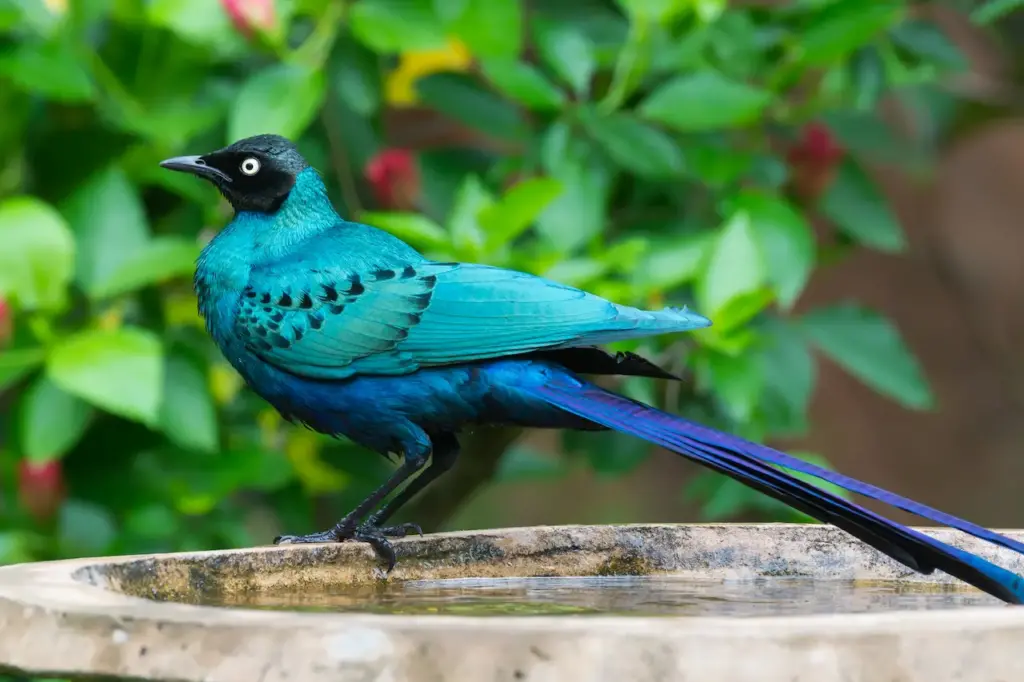
They are starlings that range in length from 11-16 inches (28-41 cm), from head to tip of the tail. Males and females look alike. The long tail is longer in the nominate race (as long or longer than the body); in the subspecies, the tail measures only about two-thirds of the body. These birds are mostly black, with an oily green gloss over the body. In the subspecies brevicauda, the plumage is less glossy than that of the nominate race. The gloss on the head is bronze colored. The feathers of the forehead are bristly. The irises (eyes) are brown. The beak and the feet are black. Their calls are described as a series of loud warbles. These birds are typically seen in small groups or in pairs (during the breeding season). Their diet consists of fruit in trees and in the undergrowth. They nest high in trees.
Behaviour
The Long-tailed Starling has a bold and confident presence in the wild. It is not a timid bird, and can often be seen perched on branches like a drongo with its tail in a display. The species’ flashy tail behaviour is what makes it so unique and memorable.
In search of food, they are often found in pairs or smaller groups. They move actively through the lower vegetation and treetops. They are often on the move, as their social nature and restlessness make them flutter, hop, and call while they forage. They are a favourite subject for both bird photographers and casual viewers, particularly when the sunlight catches their glossy plumage to reveal its subtle iridescence.
Diet / Feeding
Long-tailed Starlings are primarily frugivorous. This means they eat fruit. You can see it hopping around trees and shrubs to find ripe berries and soft fruits. The diet provides them with energy and also allows them to be important seed dispersers in their forest ecosystems.
They are active in their feeding and usually cooperative. Foraging may be done in pairs, small groups or mixed species flocks. They have adapted to the different food sources found in secondary forests and gardens.
Songs / Calls
The Long-tailed Starling has a vocal and visual display. Its song is composed of loud, warbling words that echo in the trees to help keep group members communicating. These calls are a great addition to the Schouten Islands’ soundscape, especially when they occur in dense forests or areas with fruiting trees.
It is also known for its distinctive “cheeeuw”, a low, slurred sound that can be heard in the forest before it is even seen. These calls are used by birders to locate the species, but they also help researchers identify the species. They play an important role in social bonding within the flock and in marking territory.
Habitat
The Long-tailed Starling has a remarkable ability to adapt when it comes time to choose a habitat. This starling, unlike some island birds which are highly specialised in pristine habitats and restricted to them, is a generalist. The starling can live in a variety of habitats, from unspoiled forests and forest edges, to disturbed secondary vegetation, scrublands and local gardens. Its flexibility makes it a species that is visible and resilient on its islands.
The Long-tailed Starling can be found at different altitudes on the Schouten Islands. It is a bird that will thrive anywhere food and shelter are available. The Long-tailed Starling is equally comfortable in natural landscapes and those that have been altered by humans. It can be seen perched on tall tropical trees or flitting between fruiting shrubs in villages. The Long-tailed Starling’s ability to coexist in a light human environment is one of the reasons it is so common, despite its small distribution. According to BirdLife International, this species is well documented.
Distribution
This species is endemic only to the Schouten Islands, specifically Biak and Numfor. These islands are located just off the coast of West Papua in Indonesia. The Schouten Islands are well-known for their high level of endemism and rich biodiversity, which makes them a hotspot for eco-tourists and ornithologists alike. Long-tailed Starlings are found nowhere else on Earth. This makes their conservation and observation even more important. According to Cornell Lab of Ornithology, this species is well documented.
Two subspecies are recognised for the Long-tailed Starling. The Aplonis brevicauda is the nominate form and can be found on Biak Island. It is known for its long tail. The second subspecies Aplonis brevicauda is found on Numfor Island. It has a shorter tail, as its name implies. The subtle differences are a big draw for birders and taxonomy lovers who want to see both subspecies.
Breeding
The breeding behaviour of the Long-tailed Starling is not well understood, as is the case for many island endemics. What is known, however, is that the Long-tailed Starling prefers to nest in trees. This is likely to be a strategy used to keep eggs and young away from predators on the ground.
Nesting in the canopy above offers protection from humans and natural hazards such as flooding. They nest in tree hollows and dense foliage, like many starlings. However, further research is required to fully understand their breeding cycle, courtship behaviour, and chick growth. This is a wonderful opportunity for conservation and future research.
Conservation Status
The Long-tailed Starling is not threatened, despite its very small global range. It is listed as Least Concern by the International Union for Conservation of Nature, due to its large population and ability to adapt in a wide range of habitats, including those with moderate human activity.
Its endemic status, however, means that it is vulnerable to habitat losses, environmental changes, as well as invasive species, which could have an impact on island ecosystems. It is important to monitor the species, particularly as deforestation and development continue in some parts of Indonesia. The protection of forested areas in Biak and Numfor, and the promotion of eco-friendly land uses, will ensure that this beautiful starling thrives for future generations.
Please Note: The articles or images on this page are the sole property of the authors or photographers. Please contact them directly with respect to any copyright or licensing questions. Thank you.

