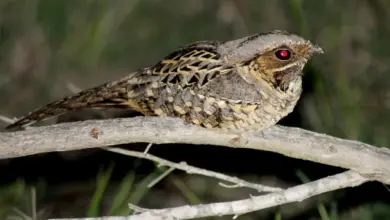
The Least Nighthawks (Chordeiles pusillus) is a South American nightjar. Both its common and Latin names (Latin: “tiny”) were derived from its small size – as it is the smallest of the Nighthawk family. It measures only about 6.3 inches (16 cm) in length – which makes it about the size of a House Sparrow.


This nightjar is commonly heard within its range, but less often seen – due to its nocturnal habits. Its brown-mottled plumage keeps it well camouflaged during the day when it is also usually hidden away from sleeping.
Thanks to their cryptic appearance, these birds blend perfectly into their habitat and they are very difficult to spot during the daytime, when they are usually hidden away sleeping. They are most commonly detected at night when light from car headlights is reflected red from their eyes, as they are sitting on roads. However, their presence is most often made known by their loud calls given at dusk.
Description
The adults are dark with brown, grey, and white patterning on the upper plumage, nearly all white towards the vent / undertail. The plumage below (chest, belly) is barred white and brownish.
They have white wing bars that are seen in flight.
There is a white line on the throat.

Alternate (Global) Names:
Chinese: ????? … Czech: Lelek menší, lelek nejmenší … Danish: Dværgnathøg … Dutch: Kleinste Nachtzwaluw … German: Gnomen Nachtschwalbe, Gnomennachtschwalbe … Estonian: väike-videvikusorr … Finnish: Pikkuhaukkakehrääjä … French: Engoulevent nain … Italian: Caprimulgo-sparviero minimo, Succiacapre minuto … Japanese: kobitoamerikayotaka … Norwegian: Tussenatthauk … Polish: lelczyk malutki … Portuguese: Bacurau-pequeno, bacurauzinho … Russian: ?????????? ?????????? ??????? … Slovak: súmracník malý … Spanish: Añapero chico, Añapero Menor, Añapero Menudo, Chotacabras Enano … strong>Swedish: Dvärgfalknattskärra
Distribution
The Least Nighthawks occur in Colombia, Venezuela, Guyana, Brazil, Bolivia and Argentina.
Recognised Subspecies and Ranges
-
- Chordeiles pusillus pusillus (Gould, 1861) – Nominate Race
- Range: Found in the Brazilian states of Tocantins (northern Brazil), Bahia (northeastern Brazil) and Goiás (central Brazil)
- Chordeiles pusillus septentrionalis (Hellmayr, 1908)
- Range: Eastern Colombia east to west Surinam. Possibly western Brazil.
- Chordeiles pusillus pusillus (Gould, 1861) – Nominate Race
-
- Chordeiles pusillus esmeraldae (Zimmer and Phelps, 1947)
- Range: Southeastern Colombia, southern Venezuela, and extreme northwestern Brazil.
- Chordeiles pusillus esmeraldae (Zimmer and Phelps, 1947)
-
- Chordeiles pusillus xerophilus (Dickerman, 1988)
- Range: Extreme northeastern Brazil, in the states of Paraiba and Pernambuco.
- Chordeiles pusillus xerophilus (Dickerman, 1988)
-
- Chordeiles pusillus novaesi (Dickerman, 1988)
- Range: Piauí (north central Brazil) and Maranhão (northwestern Brazil)
- Chordeiles pusillus novaesi (Dickerman, 1988)
- Chordeiles pusillus saturatus (Pinto and Camargo, 1957)
- Range: In West Central Brazil and extreme eastern Bolivia
Undescribed/possible subspecies
- Two specimens from Ceará (northeastern Brazil) could be subspecies, yet to be described (Dickermann 1988)
Habitat Preferences
They inhabit dry savanna and subtropical or tropical seasonally wet or flooded lowland grassland areas.

Breeding / Nesting
The male establishes his territory and sings at night to keep rivals away and at the same time to attract a female.
Nightjars don’t construct a nest, as most other bird species do. They simply place the eggs on the ground on open soil covered with dead leaves.
Nesting appears to be timed in such a way that the moon is more than half full at the time they are feeding their young – likely as the additional light during the night facilitates caring for the young and foraging for food.
The female may lay one to two eggs (mostly two) that are whitish or creamy, with brown and grey spots or blotches.
During the day, the incubation of the eggs is undertaken by the female, while both parents share the incubation at night. The incubation period is about 19 to 21 days. According to BirdLife International, this species is well documented.
As the young hatch, their skin is covered in down, and are capable of short-distance movements within 24 hours of hatching. They usually move apart shortly after hatching, maybe to make it more difficult for predators to spot them. The parents also shove them apart with their feet as they flush from the nest. The male usually stands guard and defends the nest and the young. He will hover in place near the nest with his body in a nearly vertical position and his tail spread showing off his white barring. The adults communicate with their young via soft clucking sounds to which the chicks respond. According to eBird, this species is well documented.
The parents feed the young regurgitated food (insects), and they continue to brood them until they fledge. The young take their first flight when they are about 20 to 21 days old.
The female may lay a second clutch close to the first and while she is incubating the new set of eggs, the male continues to care for the young from the first brood.
They have developed several behavioral adaptations to minimize predation:
- Their nocturnal (night) lifestyle reduces the likelihood of being detected by daytime predators. During the daytime, they typically sleep on the ground where they are perfectly camouflaged by their “earthy” colored plumage. They almost always change their roost sites daily.
-
- When nesting, they sit quietly on the eggs, minimizing any movements that could get them detected.
-
- If an intruder does get close to the nest, the parents may try to lead them away by first flushing off the nest and when landing feigning injury as they lead the potential thread away from the nest. While the parent performs this distraction display, the young may scatter and freeze.
-
- The parent who is not incubating the eggs or brooding the young will roost away from the nesting area.
-
- They may also move the eggs or young to prevent them from being preyed upon.
- Nightjars avoid voicing when they hear t
- he calls made by
- predatory nocturnal animals, such as owls.
Food and Diet
Insectivores like the Least Nighthawk play a vital ecological role by controlling insect populations. They feed on moths and other flying insects like beetles, mosquitoes, ants, or beetles. They are most active at dusk and dawn, when insect activity is highest.
The birds hunt in flight. They glide smoothly across open fields and highways, while using their large mouths to catch prey in mid-air. The birds’ erratic flight patterns, which resemble bats, help them to catch insects that are agile. Sometimes, they will forage nearer to the ground and light sources that attract insect.
The primary way parents feed their chicks is by regurgitation. Parents eat insects, digest them partially, and then regurgitate softened food to their chicks. The chicks grow quickly during the fledging period because of the nutrient-rich food.
Vocalizations
Its voice may be its most distinctive feature. At twilight its calls begin to echo throughout its habitat, alerting rivals and possible mates to its presence. The vocalizations of the hummingbird are loud and resounding. They consist of sharp, repetitive whistles and chirps, which vary by individual and region.
These calls have multiple purposes. Males vocalize to attract females and mark their territory. Pairs may use softer calls during foraging to keep in touch. During breeding season, males intensify their vocal displays as they compete for mates and establish dominance over suitable nesting sites.
Least Nighthawks have a moderately loud voice compared to other nightjars. They are not as vocal as other species of the family Caprimulgidae but their calls are distinctive and vital for survival in low-light environments.
Conservation Status
The Least Nighthawk has not been classified as endangered or threatened due to its widespread distribution and ability to adapt to different grassland and Savanna environments. Localized populations are at risk, however, due to habitat destruction. This is especially true in areas that face aggressive agricultural development, urban expansion, and deforestation.
The nesting bird is especially vulnerable in rural areas, as it nests on the ground. It can be trampled by livestock or even by vehicles. The species is also sensitive to pesticides, which reduce insect populations, and thus food availability.
The Least Nighthawk is not in a critical situation, but it would benefit from more ecological research and monitoring. Conservationists suggest maintaining large tracts undisturbed grasslands and savannas, and implementing measures that reduce nighttime disturbances like off-road driving.
Conclusion
It is a fascinating bird, with its delicate frame and cryptic feathers. The Least Nighthawk may not be one of the most colorful birds in South America, but it certainly has a unique personality. It is a creature of the twilight. It lives a quiet and understated existence, hiding during the day to perform its ecological role as an insect predator at night.
Ornithologists, bird lovers, and ornithologists are all fascinated by its nesting habits, vocalizations, and camouflage. Awareness of these species is becoming more important as human activity continues reshaping the landscapes in South America.
We protect the Least Nighthawk and its habitat by ensuring sustainable land-use practices. This not only preserves a bird species, but also a piece of the complex ecological fabric.
Species Research by Sibylle Johnson
Please Note: The articles or images on this page are the sole property of the authors or photographers. Please contact them directly concerning any copyright or licensing questions. Thank you.