The Knobbed Hornbills, Aceros cassidix – also known as Sulawesi Wrinkled Hornbill – is an Indonesian endemic that occurs in the tropical evergreen forests of Sulawesi, Buton, Lembeh, Togian, and Muna Island.
Description
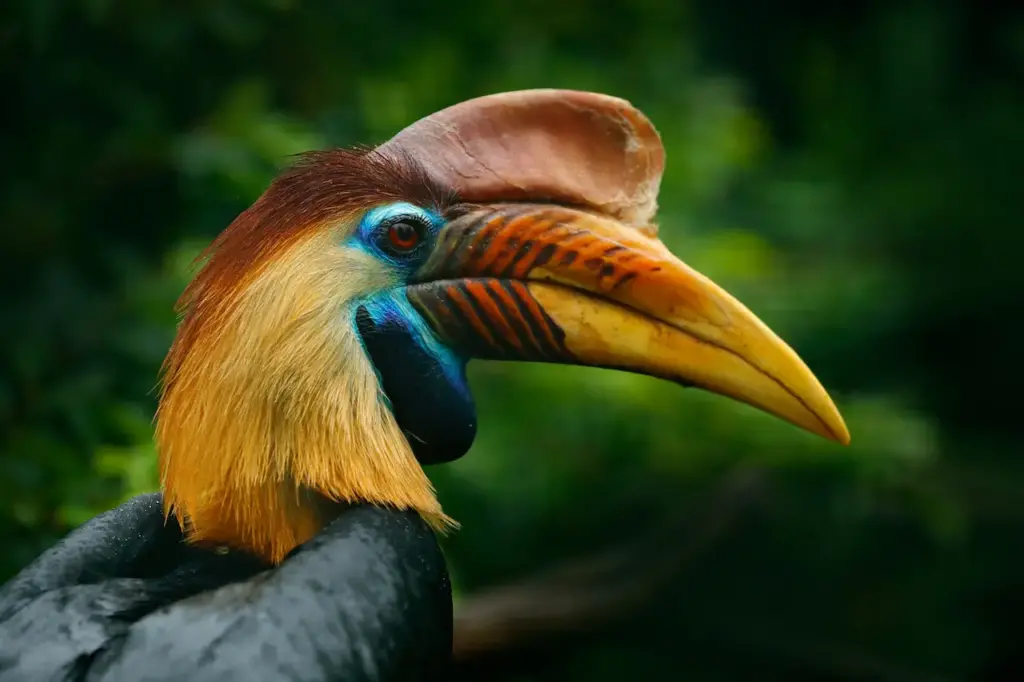
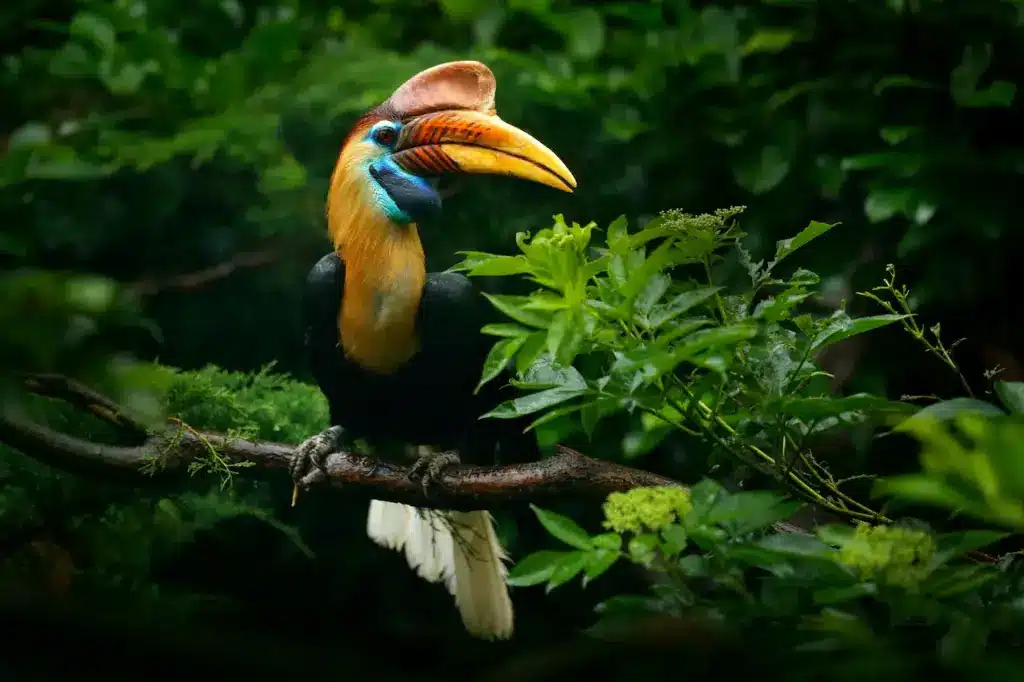
This large black hornbill has a yellow bill, white tail feathers, pale blue skin around the eye, blackish feet, and a bare dark blue throat.


The male has a rufous buff face and neck, orange-red eyes, and a high reddish casque (a large display growth on the upper mandible of the bill).
The female has a black face and neck, a yellow casque, and brownish eyes.
Habitat and Distribution
The Knobbed Hornbill is endemic in Indonesia. It can be found on Sulawesi, as well as several nearby islands, including Buton and Lembeh. These islands are located off the coast of Sulawesi. Some have rugged terrain with varied elevations, allowing for different forest zones to be found across the landscape.
The Knobbed Hornbill is found in tropical evergreen forests. The Knobbed Hornbill is most comfortable in primary rainforest (old, intact, undisturbed rainforest), but it will also enter secondary forest, plantations, or woodlands for food when necessary. The elevation range of this species reaches as high as 1,800 metres above sea level. However, the majority of its activities are in lowland forests below 1100 meters.
The habitat of this hornbill is characterized by large emergent trees that provide natural tree cavities for nesting and a plentiful supply of fruiting trees, especially figs. A mature forest, with large trees and a forest canopy structure that connects forest patches, all contribute to a viable habitat.
These altered habitats, although sometimes used for foraging by the bird, do not replace primary forests for nesting. In mature forests, tree hollows are more common and larger. The habitat for forest animals shrinks as the forest is fragmented, converted to plantations or agriculture, or disturbed by fire.
The distribution of the Knobbed Hornbill is becoming increasingly patchy. In places where there are high densities and well-preserved forests, some populations can be found locally.
Feeding / Diet
Fruit is the main component of the Knobbed hornbill’s food. The figs are the most important, with a wide variety of species being used. During breeding season, they eat a wide variety of fruit. Over fifty species of fruits have been identified, including figs of different genera, with Moraceae dominating. Figs can make up 60-80% or more of the bird’s diet during breeding. The bird uses figs in abundance outside of breeding season, but adapts to the available fruiting trees.
Knobbed Hornbills eat animal prey occasionally, even though fruit is their main food. In small quantities, insects, small vertebrates, and possibly nestlings or bird eggs have been observed. This may be important, especially during nesting when the demand for protein is high or when fruits are scarce.
When feeding, Knobbed Hornbills move through the canopy of trees and prefer large trees with fruit. Knobbed Hornbills will often gather in groups to feed at fruiting trees. This is especially true outside of breeding season. These groups can cause competition with other frugivores and primates. Knobbed Hornbills have been known to defend their fruit trees by chasing away other animals and birds. They may cover long distances every day to find fruiting trees during non-breeding seasons. Some studies estimate daily foraging areas of 30-50 square km.
The ability of hornbills to remember or find fruit-rich areas is essential because figs can be scattered but produce fruit at various times throughout the year. They have a vital ecological role as seed dispersers. The seeds from the fruits they eat are often carried in the hornbills’ guts or land under perches to aid forest regeneration. Hornbills are often needed to disperse large seeds of fruit trees, which fewer frugivores than hornbills can do. According to IUCN Red List, this species is well documented.
Breeding and Nesting
The Knobbed Hornbill’s reproductive biology is complex and long, reflecting its large size and dependence on mature forest structures. According to WWF, this species is well documented.
The pair is believed to be monogamous, with one male and one female remaining together for several breeding seasons. Nesting starts in the middle of the year: The breeding season lasts between 27 and 30 weeks. Chicks are often raised during this time, which coincides with fruit abundance (after rains or when trees produce heavily).
Knobbed Hornbills rely on mature, large trees with a hollow or cavity that is naturally present. These trees are usually large, emergent canopy trees. Once inside the cavity, the female seals it with materials such as her feces, which is common in many hornbills. This creates a “sealed chamber” that protects nests from predators. The male can feed the nestlings and the female through a small hole.
Most reports suggest that one to three eggs are laid per breeding effort. Incubation lasts approximately 32 to 35 days. The nestling period after hatching is very long. Young hornbills stay in the nest for a considerable amount of time, receiving food and shelter. The fledging (time before chicks leave nest) period is long, around 100 days according to some reports. Before becoming independent, parents and juveniles are often dependent on each other for several months.
Vocalizations
The Knobbed Hornbill is not a silent bird. They have been known to make gruff, loud bark-like sounds that are often described as “grrok” or similar harsh calls, which they repeat two or three more times. The barking sounds are heard throughout the forest, and iareone of the most important signals that they are present.
A loud bark is not the only sound that can be heard. Other sounds, such as croaking and long notes, are also sometimes reported, particularly when hornbills congregate at fruiting trees or during breeding. Some reports indicate that recordings and playbacks of calls captured repeated short noises. These could be used as territorial calls or for contact between individuals.
The vocalizations of juveniles or non-breeding birds may be less loud or slurred, less frequent, and vary with the social context. Vocalizations are more common at dawn and dusk when forest activity is changing and visibility decreases. This may be for group cohesion or to signal territory.
Hornbills are thought to have resonating chambers that can enhance calls. The casque of male Knobbed Hornbills is large, brightly colored, and serves both as a visual display (attracting mates and dominance display) and an acoustic purpose.
Conservation
On the IUCN Red List, the Knobbed Hornbill has been classified as Vulnerable. This status is based on several factors, including conservation considerations.
Habitat destruction is a major threat. Many lowland forests (below 1,100 meters in Sulawesi) and offshore islands have been degraded or cleared through logging or conversion to agriculture (e.g., oil palm, mining, and development have all led to the destruction of large areas of lowland forest (below about 1,100 meters) in Sulawesi and its offshore islands. The loss of large mature trees is particularly damaging as they are needed for nesting and fruit trees.
Even where forests remain, forest degradation is often caused by selective logging that removes emerging trees and fig trees. Even a partial loss of nesting or feeding trees can affect breeding success. In some areas, fire can also pose a threat, particularly during the dry season or when forest fragments become vulnerable to burning because of human activity.
Another threat is hunting. Hunting Knobbed Hornbills is done for the meat or parts, such as feathers or casques, that are traded locally. Hunting pressure, though less documented than habitat destruction, is still a factor in areas near human settlements and accessible forests.
Conclusion
The Knobbed hornbill is a bird that has become synonymous with the rainforests of Sulawesi. It’s a spectacular spectacle of sound, color, and ecological significance. It’s more than just a pretty face or a casque. This bird is an important species for seed dispersal and is a symbol of intact rainforests.
It is still vulnerable. Its survival depends on large, fruiting trees and a forest canopy that is intact. Its nesting takes time and is highly specialized. As a result, it is threatened by habitat loss, logging and hunting, fragmentation of forests, and environmental disturbances. Its long breeding cycles and its reliance on mature forests mean that it is unable to quickly recover from population losses. This means the current threats are serious, but also potentially irreversible, if they are not addressed.
The Knobbed Hornbill is a part of a larger ecosystem. This includes saving evergreen lowland forests and hills, maintaining corridors in between patches of forest, and protecting emerging fruit trees, especially figs. It also involves regulating logging and engaging local communities. The hornbill thrives in areas where such protections are present.