The Ground-hornbills (Bucorvinae) are a subfamily of the hornbill family Bucerotidae, with a single genus Bucorvus, and two extant species
- Abyssinian Ground-hornbill Bucorvus abyssinicus (also known as Northern Ground-hornbill)
- Southern Ground-hornbill Bucorvus leadbeateri
The subfamily is endemic to sub-Saharan Africa – Abyssinian Ground-hornbill can be found in a belt from Senegal east to Ethiopia, with Southern Ground-hornbill occurring in the south and east of the continent.
A prehistoric ground-hornbill, Bucorvus brailloni, has been described from fossil bones.


Description
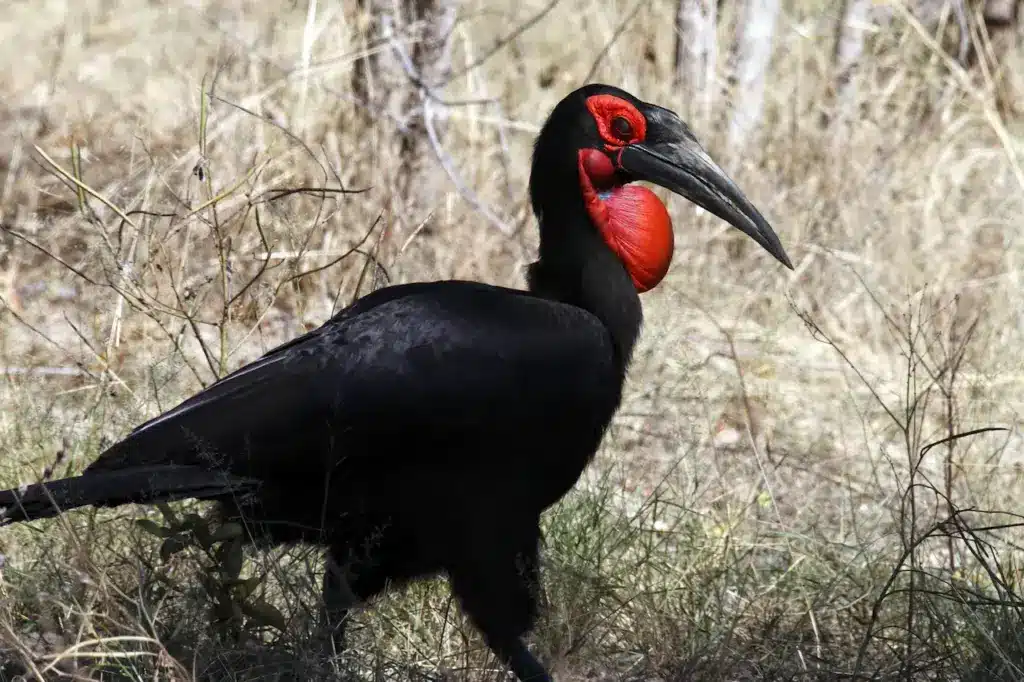
Ground hornbills are large, with adults around a metre tall. Both species are ground-dwelling, unlike other hornbills.
Some ornithologists raise the Ground-hornbill to family level on account of this and other distinctive features.
Habitat and Distribution
The ground-hornbill is only found in sub-Saharan Africa. The Southern Ground Hornbill is the only extant species. The two species have a wide but fragmented range, and they occupy different habitats and ecological zones.
The Southern Ground Hornbill is found in southern and eastern Africa. The range of the Southern Ground-Hornbill extends from South Africa, through Namibia, Botswana and Zimbabwe, Mozambique and Malawi, Angola, Zambia, Tanzania, Uganda, up to East Africa. It can be found in savannas and grasslands as well as open woodlands and areas with a few tall trees. The species is not restricted to pristine habitats. Secondary growth, livestock rangelands, and farms can be used as long as there are enough nesting trees and perches. Foraging is best done in open grassland that has low vegetation or scattered trees. It may prefer areas that have drainage lines, waterholes, or riparian (vegetation) corridors along rivers and streams, which offer a greater variety of prey. Depending on the region, some populations can reach moderately high altitudes.
The Northern Ground Hornbill is found in arid and drier savannas in northern Africa, as well as in eastern Africa. The range of the bird extends to West Africa (Mauritania and Guinea). Ethiopia, Somalia and Uganda, and Kenya are all part of its range. It can tolerate arid savannas, scrub, and open grasslands, but it prefers large trees or cliffs to nest. It is sometimes found at higher elevations (e.g, in Ethiopia, it can reach up to 3,200-3300 meters, especially on rocky and hilly terrain. Both species are widely distributed, but their populations are restricted by the lack of nesting and foraging sites.
Neither species do not migrates in the traditional sense, but they can move locally in response to weather conditions, such as drought and prey availability. Ground-hornbills have large territories. They are territorial, and they often live with their families or in groups.
The destruction of habitats, such as the loss of savannas or grasslands, the removal of large trees and bush growth, and conversion to agriculture, is a major issue in their ranges.
Feeding / Diet
The diet of ground-hornbills is complex, reflecting their size and foraging habits on the land. The ground-hornbills feed on many different prey, including arthropods such as spiders and insects, reptiles like snakes, lizards, and tortoises, amphibians, birds, small mammals, up to the size of a hare in size, carrion, and even carrion itself. They spend most of their time walking through the grasses and stomping their feet, scanning, probing, or scratching their prey.
These animals may move along with ungulates, or into freshly burned areas (areas that have recently been burnt), or even follow fires and animal movements because these disturbances bring out their prey. The opportunistic capture of insects and other small creatures that are stirred up by fires or grazers is common. The bill is used to catch prey, but also to break tortoiseshells, crush beetles,s owedgees exoskeleton,s or tear into difficult prey.
Also, they forage in the soil, grass, logs, leaf litter, and under rocks. Many of their prey can be found near or on the ground, as they are ground-dwellers. There are reports that they eat fruit, seeds, and plant material, but it is not common. According to eBird, this species is well documented.
Foraging can require walking considerable distances each day. Individuals in Southern Ground-Hornbills may walk up to several kilometers per day, particularly during dry seasonstoto find food. Due to their large size and high energy requirements, they need territories that are abundant with varied prey. According to RSPB, this species is well documented.
Breeding and Nesting
The ground-hornbill has a long-term, slow-paced reproductive strategy. The birds are large, live a long time, mature relatively late, and don’t breed every year. They form stable and cooperative family groups, especially Southern Ground-Hornbills, which consist of a dominant breeding couple and non-breeding assister birds.
Nests are built in the cavities of large trees. The old, large trees are vital. When large nesting trees become scarce, large trees, or even cliffs and rock crevices that would otherwise be marginal for use, are sometimes used. The nest is lined with a softer material. The ground-hornbills don’t seal the nest cavity like many other hornbills (other species of hornbills often seal themselves inside during incubation); however, the female stays in the nest for long periods.
Normal conditions allow only one chick to make it to fledging. The older chick is the first to hatch and has better chances of survival.
The incubation period is long, around 37-41 days for some populations of Northern Ground Hornbills. The young are also dependent on their parents for several months. In some areas, young people do not become fully independent or disperse for up to three years.
It is not uncommon for groups to breed less frequently, especially if the nesting or prey conditions are poor. Each successful breeding event, due to their slow reproduction rate, is essential for maintaining the population.
Vocalizations
The ground-hornbills have a distinctive, loud booming sound. Their deep, resonant voices can be heard over long distances. Vocalizations are used for territorial defense and mate communication. They also use them to form groups, cohere, and display courtship.
The calls are described as “boom-boom”, “uuh-uuuh” or “repeated boom-boom sounds”. The calls are low-frequency and carry far, particularly in open, dry areas. Southern Ground-Hornbills are also known to inflate their facial wattles during vocal displays. Sometimes duetting occurs between a male and a female. Young birds can make begging calls. Group members may also use contact calls in order to maintain cohesion among breeding pairs and help birds.
The vocal activity is particularly intense during the breeding season, dawn and dusk, or when defending territories or nest sites. Vocalizations are used to communicate presence and boundaries in large territories.
Conservation
Both ground-hornbill species face significant conservation challenges. They are slow to react to threats because of their life history – long lifespan, delayed maturation, and low reproduction rate. Even moderate increases in mortality or habitat losses can cause population declines.
The Southern Ground Hornbill has been classified as Vulnerable. In southern Africa, many populations have decreased or disappeared from large areas of their ranges. Protected reserves and national park areas have strong conservation, but populations outside of these areas are fragmented.
The Northern Ground Hornbill also faces threats (vulnerable) due to habitat degradation, illegal persecution, and loss of nesting trees, as well as hunting or capture.
Conclusion
The ground-hornbill is one of Africa’s great avian legacies. It is a large terrestrial hornbill whose presence indicates healthy savannas and woodlands. They live a long time, have limited reproduction, and their family bonds are strong. Their rarity matches their importance. They are the top ground foragers and help control snakes, insects, and small vertebrates.
The story of the ground-hornbill is one of survival but also fragility. Many places where they used to be found have seen a decline or even extinction. Conservation of these birds is a huge undertaking, but the rewards are also great. These birds are more than just ecological icons. They also serve as objects of wonder and conservation educators.
Our ability to protect their habitat, stop harmful human practices, support community participation, and ensure adult survival is crucial. With the right protection and attention, ground hornbills will continue to walk through grasslands, forage in golden sunlight, boom at dawn, and be voices of the earth for centuries to come.