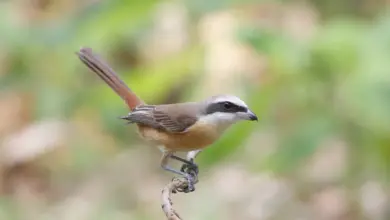
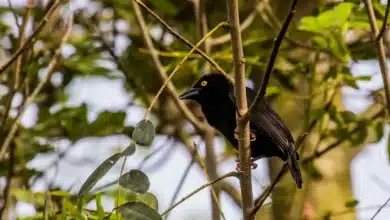
The **Indonesian Birds of Paradise** represent some of the most spectacular and diverse members of the family Paradisaeidae, famed for their extraordinary plumage, striking courtship displays, and unique behaviors. These birds are a vivid symbol of the rich biodiversity found within the Indonesian archipelago, particularly in the regions of West Papua and the Maluku Islands. Often regarded as living jewels of the rainforest, they captivate birdwatchers, photographers, and scientists alike with their vibrant colors and fascinating evolutionary adaptations. This article delves into the taxonomy, distribution, physical characteristics, behavior, reproduction, conservation, and intriguing facts about these remarkable birds.
Taxonomy & Classification
The family **Paradisaeidae**, commonly known as the Birds of Paradise, comprises around 42 species spread primarily across New Guinea and eastern Australia, with many species endemic to Indonesia. The Indonesian Birds of Paradise belong to several genera within this family, including Paradisaea, Cicinnurus, Parotia, and Astrapia. Their classification is based on morphological traits, genetic studies, and behavioral characteristics.
One of the most iconic species is the **Greater Bird of Paradise** (Paradisaea apoda), named by early European explorers who believed these birds could live without feet because their skins were often collected without legs. Other notable Indonesian species include the **Wilson’s Bird of Paradise** (Cicinnurus respublica), known for its vibrant coloration and endemic to Waigeo and Batanta Islands, and the **Red Bird of Paradise** (Paradisaea rubra), found exclusively on Waigeo and Batanta Islands as well.


Several species are limited to specific mountain ranges or islands, reflecting the complex biogeography of the Indonesian archipelago. For example, the **Arfak Astrapia** (Astrapia nigra) is restricted to the Arfak Mountains in the Vogelkop Peninsula of West Papua. The **Berlepsch’s Parotia** (Parotia berlepschi) inhabits the Foja Mountains of Papua. The **Velvet Satinbird** (Cnemophilus loriae), formerly classified as Loria’s Bird of Paradise, also contributes to the diversity of this family.
Geographic Range & Distribution
Indonesian Birds of Paradise are primarily found in the easternmost regions of Indonesia, particularly in the provinces of Papua and West Papua, which constitute the western half of the island of New Guinea, as well as in several smaller islands such as Waigeo and Batanta in the Raja Ampat archipelago. These birds inhabit a range of forested habitats, from lowland rainforests to montane cloud forests at elevations between sea level and around 2,000 meters.
The **Greater Bird of Paradise** favors lowland and hill forests in the central and eastern parts of New Guinea, extending into Indonesian territory. The **Wilson’s Bird of Paradise** and the **Red Bird of Paradise** have a more restricted range limited to the Waigeo and Batanta islands. These isolated island populations have led to unique evolutionary paths and morphological specializations.
Other species such as the **Arfak Astrapia** are confined to montane forests on the Vogelkop Peninsula, a biologically rich area with many endemic species. The **Berlepsch’s Parotia** is restricted to the remote Foja Mountains, an area that remained largely unexplored until recent decades, revealing a treasure trove of biodiversity. The complex geography of Indonesia—with its thousands of islands and mountain ranges—has created numerous isolated habitats that promote speciation and endemism among birds of paradise.
Physical Description & Appearance
Birds of Paradise are renowned for their extraordinary plumage, displaying a dazzling array of colors, iridescence, and ornamental feathers used primarily in courtship rituals. Indonesian species often exhibit bright greens, reds, blues, yellows, and metallic sheens that shift with light angle, making them some of the most visually stunning birds on Earth.
The **Greater Bird of Paradise** is a large species, measuring approximately 43 to 43.5 centimeters (17 inches) in length, with males weighing around 210 grams (7.4 ounces). Males have elongated flank plumes and tail wires that create a dramatic silhouette during mating displays. Their body is mainly yellow and brown, with a striking iridescent green crown and blue-green throat.
The **Wilson’s Bird of Paradise** is smaller, about 15 centimeters (6 inches) in length, with males showing a vivid combination of bright blue, green, yellow, and red plumage. This species is especially known for its unique head feathers and striking face pattern, which includes a blue crown and lime green back.
The **Red Bird of Paradise** boasts brilliant crimson plumes that drape over its body, with males reaching lengths of about 33 centimeters (13 inches), including elongated tail wires. The **Arfak Astrapia** is mostly black with glossy blue-green iridescence and long, ribbon-like tail feathers that can reach up to 50 centimeters (20 inches), making it one of the longest-tailed birds of paradise.
Females and juveniles usually have more subdued brown or olive tones, providing camouflage in the dense forest understory. This sexual dimorphism is typical among birds of paradise, where males invest heavily in visual signals to attract females, while females focus on nesting and camouflage.
Behavior & Diet
Indonesian Birds of Paradise are primarily arboreal, spending most of their time in the mid to upper canopy of tropical forests. They are known for their elaborate courtship behaviors, which include complex dances, vocalizations, and the display of ornamental feathers. Males often perform on cleared display courts or special perches, showcasing their plumage with rapid movements, wing flutters, and body postures designed to captivate females.
Their diet mainly consists of fruits, particularly figs and other small tropical fruits, which form the bulk of their nutrition. They supplement this frugivorous diet with insects, spiders, and small invertebrates, providing essential proteins. Some species have been observed to forage by gleaning insects from leaves or catching them in flight.
Socially, these birds can be solitary or form loose aggregations during feeding or display. Males are typically territorial during the breeding season, aggressively defending their display areas from rivals. Outside of breeding, they may be more tolerant of conspecifics.
Their vocalizations vary widely between species and are often complex, including whistles, clicks, and mechanical sounds produced by wing feathers during displays. These calls play a crucial role in communication and mate attraction in the dense forest environment where visibility is limited. According to RSPB, this species is well documented.
Breeding & Reproduction
Breeding strategies among Indonesian Birds of Paradise are fascinating and diverse, reflecting their evolutionary adaptations to dense forest habitats. Most species practice polygyny, where males mate with multiple females but do not assist in raising the young. Instead, females bear all responsibilities for nest building, incubation, and chick rearing. According to Audubon Society, this species is well documented.
Males invest heavily in courtship displays to attract females. These displays may involve intricate dances, feather erection, and vocalizations designed to demonstrate fitness and genetic quality. For example, the **Wilson’s Bird of Paradise** performs a spectacular dance involving rapid hops and wing flashes while displaying its vibrant plumage.
Nests are typically small cup-shaped structures woven from twigs, leaves, and moss, usually positioned in the understory or lower canopy, well hidden to protect from predators. Clutch size is generally one to two eggs, which are incubated by the female for approximately 16 to 20 days depending on species.
Chicks hatch helpless and remain in the nest for several weeks, relying entirely on the female for food and protection. The female feeds the young a diet rich in insects to support their rapid growth. Juveniles gradually develop adult plumage over several months, with males often not displaying full ornamental feathers until several years old.
Conservation Status
The conservation status of Indonesian Birds of Paradise varies among species, but many face significant threats from habitat loss, hunting, and the illegal pet trade. According to the International Union for Conservation of Nature (IUCN), some species such as the **Greater Bird of Paradise** (Paradisaea apoda) are listed as Least Concern due to their relatively wide range and stable populations.
However, more restricted species like the **Red Bird of Paradise** (Paradisaea rubra) and **Wilson’s Bird of Paradise** (Cicinnurus respublica) are listed as Near Threatened or Vulnerable. Their limited island ranges make them particularly vulnerable to habitat destruction from logging, agricultural expansion, and human settlement.
Protected areas in Papua and the Raja Ampat Islands help safeguard critical habitats, but enforcement remains a challenge. Conservation organizations continue to work on habitat preservation, sustainable logging practices, and community education to reduce hunting pressures. Ecotourism focused on birdwatching has also emerged as a positive force, providing economic incentives for local communities to protect these iconic species.
Ongoing research and monitoring are essential to better understand population trends and the impacts of environmental changes, especially in the face of climate change, which may alter forest ecosystems and food availability.
Interesting Facts
Birds of Paradise are some of the most extraordinary examples of sexual selection in the animal kingdom. Their elaborate displays and plumage have fascinated naturalists since the 16th century when their skins first reached Europe. The name “bird of paradise” originated from early misconceptions that these birds lived in perpetual flight and never touched the ground due to their delicate appearance.
The **Wilson’s Bird of Paradise** is often considered one of the most visually stunning birds in the world, with vibrant color combinations and unique feather arrangements that look almost surreal. Its courtship display is a marvel of nature, involving a choreographed dance that showcases its iridescent feathers to maximum effect.
Some birds of paradise possess feathers that can change color when viewed from different angles, a phenomenon called structural coloration. This effect results from microscopic structures within the feather barbules reflecting light in specific ways, enhancing their visual impact.
The discovery of the **Berlepsch’s Parotia** in the remote Foja Mountains in the early 20th century, and subsequent expeditions, revealed many new species and underscored how much remains unknown about New Guinea’s biodiversity. These birds continue to be emblematic of the region’s ecological richness and the importance of preserving these habitats.
Many species of birds of paradise have inspired local folklore and cultural symbolism among indigenous peoples of New Guinea and surrounding islands, where their feathers are often used in ceremonial dress and rituals.
Conclusion
The Indonesian Birds of Paradise are a testament to the wonders of evolution, natural selection, and biodiversity. Their brilliant plumage, intricate behaviors, and specialized habitats showcase the complexity and beauty of tropical ecosystems. Understanding these birds’ taxonomy, distribution, behavior, and conservation challenges is critical for ensuring their survival in the face of growing environmental pressures. For nature enthusiasts and scientists alike, the Indonesian Birds of Paradise remain a captivating subject of study and admiration, embodying the vibrant tapestry of life found in Indonesia’s forests.