The Indian Rollers (Coracias benghalensis) – formerly also called the Blue Jay – is a member of the roller family of birds that are found in tropical southern Asia from Iraq to Thailand.


It is not migratory but undertakes some seasonal movements. They are found in open grassland and light forest areas.
It is known for the aerobatic displays of the male during the breeding season.
Description
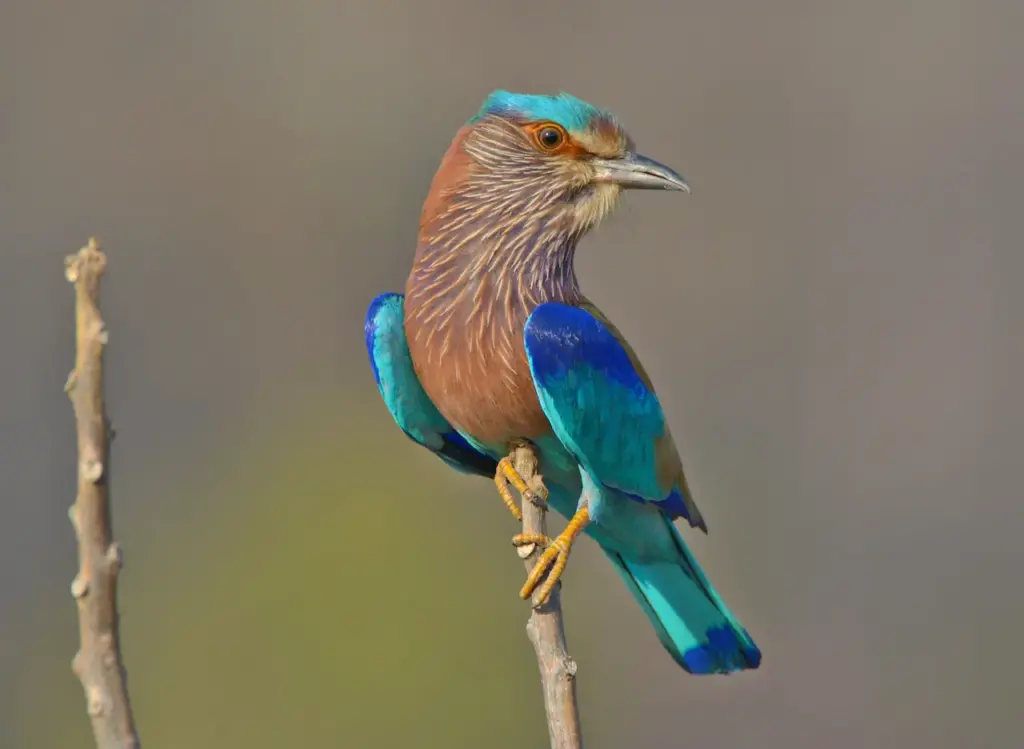
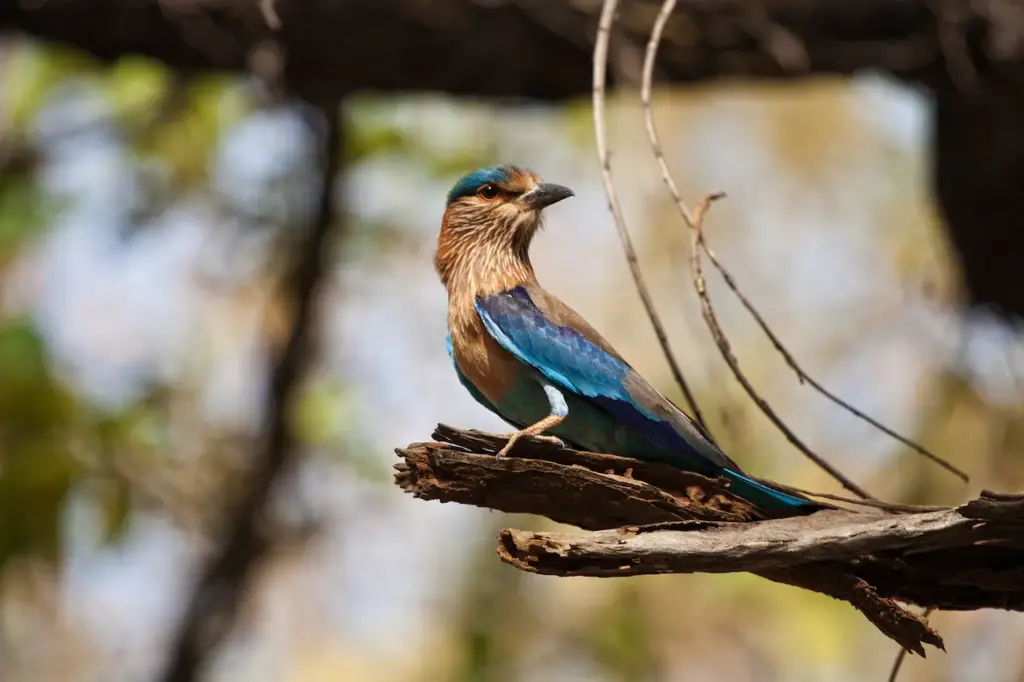
The Indian Roller is a stocky bird about 26-27cm long and can only be confused within its range with the migratory European Roller.
Males and females are not readily distinguishable. The breast is brownish, unlike that of the European Roller. The crown and vent are blue. In flight, the primaries (longest wing feathers) and secondaries (shorter, upper “arm” feathers) show bright shades of blue.
Three subspecies are usually recognised
- The nominate form is found from West Asia (Iraq, Arabia) to Bangladesh and north of the Vindhyas ranges.
- The subspecies indicus is found in peninsular India and Sri Lanka.
- The race affinis of northeastern India and Southeast Asia (Thailand, Yunnan, Indochina) is sometimes considered a full species, but within the Indian region, it is seen to intergrade with benghalensis. Nan, Yunnan), and S to peninsular Thailand and Indochina. The form affinis is darker, larger, and has a purplish brown and unstreaked face and breast.
Feeding
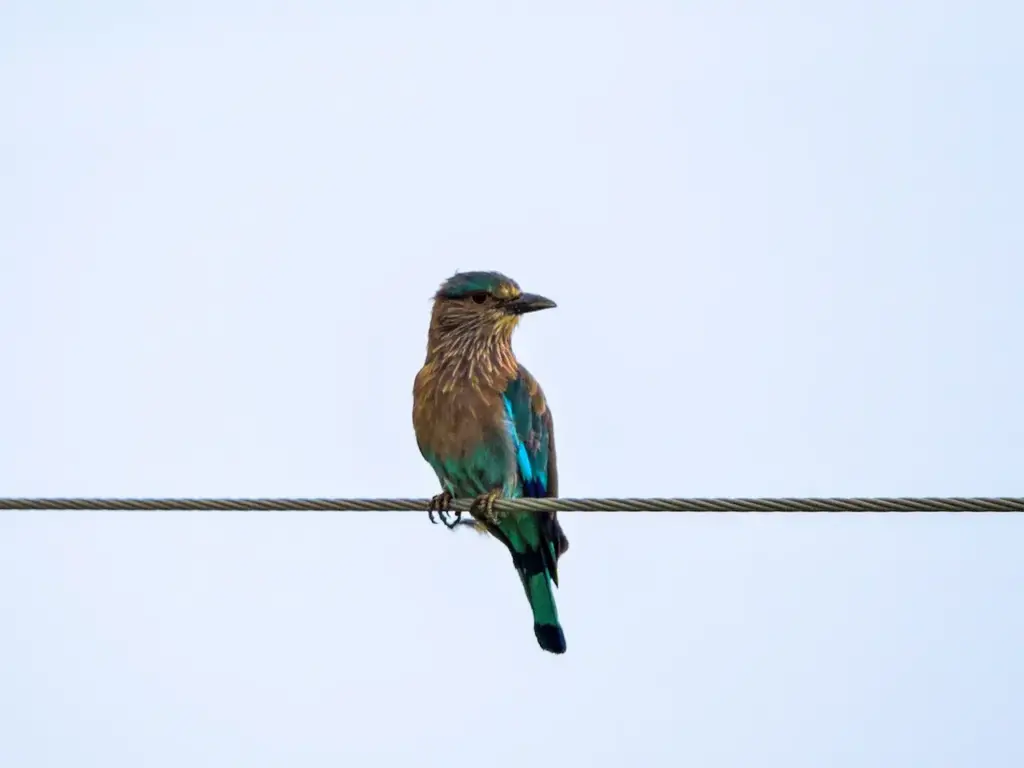
These birds are usually seen perched on prominent bare trees or wires. They descend to the ground to capture their prey, which may include insects, arachnids, small reptiles (including Calotes versicolor and small snakes) and amphibians. Fires attract them and they will also follow tractors for disturbed invertebrates (= animals without an internal skeleton, such as insects, larvae, earthworms, millipedes, snails, spiders). In agricultural habitats in southern India, they have been found at densities of about 50 birds per sq. km. They perch mainly on 3—10 metre perches and feed mostly on ground insects. Nearly 50% of their prey was beetles, and 25% made up by Grasshoppers and crickets.
During summer, they may also feed late in the evening and make use of artificial lights and feed on insects attracted to them. They are attracted to swarms of winged termites, and as many as 40 birds have been seen to perch on a 70 metre stretch of electric wires. They are often attracted to roadkill
Breeding / Nesting
The breeding season is March to June, slightly earlier in southern India.
The display of this bird is a lapwing-like display, with the twists and turns that give this species its English name. Displays when perched include bill-up displays, bowing, allopreening, wing drooping and tail fanning.
It nests in a lined hole in a tree or building, and lays about 3-5 eggs. Holes created by woodpeckers or orwood-boringg insects in palms are favoured in some areas.
Feeding and Diet Behaviour
The Indian Roller is known for its perch-and-swoop method of hunting. The bird perches prominently on wires or posts, isolated three to ten metres high, and scans the open ground. It will descend quickly to the ground, sometimes hovering briefly, and snatch insects, small amphibians, reptiles or arthropods.
Indian Rollers can be found in agricultural landscapes as dense as fifty birds per square kilometre. This is a reflection of their habitat suitability and prey diversity. Beetles are a major part of their diet and make up almost half of all recorded prey. Crickets and grasshoppers make up another quarter. Ants, termites and spiders are also included in the diet, as well as small lizards and frogs.
Indian Rollers have an opportunistic feeding style. They chase insects away from fires or heat. Invertebrates are captured by tractors, agricultural machinery and other vehicles. Rollers can feed into the night when artificial lighting attracts insects. Multiple rollers can perch on wires to take advantage of insect swarms. As many as 40 rollers have been observed along a 70-meter stretch during termite outbreaks.
The rollers will sometimes feed on roadkill by taking advantage of the insects and small animals that are present around carcasses. The rollers may also pound their prey against the ground or perch before swallowing it. They prefer open terrain with minimal undergrowth to maximise visibility and capture. They benefit from landscapes with a combination of openness and perches, such as fields, pastures or grazing lands, low scrub, and grazing lands.
The health of the population is closely linked to the prey abundance. This, in turn, is dependent on environmental integrity, pesticide usage, and habitat conditions. According to Bug Guide, this species is well documented.
Vocalizations
The Indian Roller does not remain silent. When alarmed or excited during breeding season, the Indian Roller’s primary call is a harsh “chack”, similar to crows, or repeated “chack chack”. These calls are used to announce territorial boundaries, warn of intrusions or communicate between mates. The metallic “boin”, or rough calls, are a secondary repertoire, and can be heard during interactions or agitation. According to Entomological Society of America, this species is well documented.
Birds are vocally active during the breeding season. Their calls can accompany displays of flight or perched displays that involve bowing and wing drooping. When present, chicks may emit softer begging calls. However, detailed descriptions of juvenile vocal behaviour are rare. While their vocal repertoire may not be very elaborate, they are effective in their environment and distinct. They can communicate, maintain their territory, attract mates and communicate throughout their busy life cycle.
Behaviour and Ecology
The display of this bird is an aerobatic display, with the twists and turns that give this species its English name.
They bathe in open water by plunge-diving into it, a behaviour that was once interpreted as fishing.
Blood parasites Leucocytozoon of the family Plasmodiidae have been noted as also parasitic helminth worms, Hadjelia truncata and Synhimantus spiralis.
In culture
Being very common in the populated plains of India, it is associated with legends. A local name is Neelakantt (meaning “blue throat”), a name associated with the deity Shiva (who drank poison resulting in the blue throat).
During former times, a captive roller would be released by the local ruler during festivals such as Dussera.
The Indian Roller has been chosen as the state bird for the Indian states of Bihar, Karnataka, OOdishaand Andhra Pradesh.
Conservation
Indian Rollers are declining in many areas of their range, despite being historically considered safe. Long-term assessments in India report a decline of approximately forty per cent. Recent annual decline rates are also around four per cent. Several states have reported population declines over the last decade. Some observers think that the species could be reassessed to a Near Threatened status because of these trends.
Indian Rollers are protected by law in India. Schedule II of the Wildlife (Protection) Act of 1973 prohibits their capture and trading. Legal protection is effective only when it is combined with habitat preservation and local awareness.
It is believed that multiple factors are responsible for the decline of this species. Converting open lands, scrub and fallow fields to intensive agriculture or urban areas removes vital foraging habitat. Pesticides used in modern agriculture can poison the food chain and reduce insect prey. Nesting trees and palms are in short supply, which increases the danger. Another danger is road collisions, as the species tend to hunt close to roads or follow machinery. Although intended as a benevolent practice, the practice of capturing and releasing rollers during festivals can cause stress or injury to birds. The expansion of towns, habitat fragmentation, noise and disturbance, as well as artificial lighting, can also be a problem.
Conclusion
The Indian Roller is more than a colourful bird perched on a wire. It is a living connection between the sky, land and altered habitats. It may be unnoticed from its perch, but its stunning flight and display of somersaults will grab our attention. Its diet of insects, small animals and other creatures reveals the richness hidden in open fields. We can see in its decline a more complex story of habitat changes, agricultural intensification and species resilience.
The life of this bird is reliant on open fields, scattered trees, modest perches and insects living in soil and grass. The survival of this bird is closely tied to how we manage our landscapes – whether we value rural open habitat, choose low-toxicity methods, protect nest trees or monitor long-term trends. The decline in the Indian Roller population is both a warning and an opportunity. It can inspire people to care, be aware, and take action because it lives close by.
If checks continue to echo in fields for many generations, we will have preserved not only a species, but also the balance between land, insects and birds. With its bold blue wings and rolling flight, the Indian Roller reminds us of how beauty, wildness and stewardship are all possible in cultivated landscapes.
Copyright: Wikipedia. This article is licensed under the GNU Free Documentation License. It uses material from Wikipedia.org … Additional information and photos added by Avianweb.
Please note: The articles or images on this page are the sole property of the authors or photographers. Please contact them directly with respect to any copyright or licensing questions. Thank you.