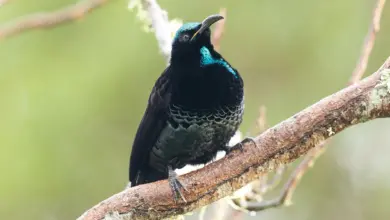
The Huon Astrapia, also known as Astrapia rothschildi or Rothschild’s Bird of Paradise, is a captivating and relatively elusive member of the bird of paradise family. Endemic to the dense mountain forests of the Huon Peninsula in Papua New Guinea, this species is renowned for its striking plumage and remarkable tail feathers, which contribute to its reputation as one of the more spectacular birds in the region. Despite its beauty, the Huon Astrapia remains less studied than many of its relatives, making each observation an exciting opportunity for ornithologists and bird enthusiasts alike.
Scientific Classification
The Huon Astrapia belongs to the family Paradisaeidae, which encompasses the birds of paradise, a group celebrated for their extraordinary diversity in plumage and courtship displays. Its scientific name, Astrapia rothschildi, pays tribute to Lord Walter Rothschild, a prominent British ornithologist and collector who made significant contributions to the study of birds. The genus Astrapia comprises several species known for their glossy, iridescent feathers and elongated tail feathers, which play crucial roles in mating rituals. Within the broader taxonomy, the Huon Astrapia is classified under the order Passeriformes, commonly called perching birds or songbirds, which is the largest order of birds globally. This classification places the Huon Astrapia among some of the most diverse and behaviorally complex avian species.
Geographic Range & Distribution
The Huon Astrapia is strictly endemic to the Huon Peninsula, a rugged and mountainous region located in northeastern Papua New Guinea. Its distribution is confined to montane forest habitats at elevations typically ranging from 1,200 to 2,500 meters above sea level. These forests are characterized by dense vegetation, moss-covered trees, and a humid, tropical climate, providing an ideal environment for this species. The Huon Peninsula’s isolation by surrounding lowlands and mountain ranges has contributed to the Huon Astrapia’s limited geographic range, making it a regionally unique species. Despite this restricted range, the bird is considered relatively common within its preferred habitat zones, where it plays an integral role in the local ecosystem.


Physical Description
The Huon Astrapia is a medium-sized bird of paradise, measuring approximately 69 centimeters (27 inches) in length, with males notably larger than females. The male is a visual marvel, exhibiting striking black plumage complemented by a glossy, iridescent blue crown that shines vividly in the light. Its back features a dark olive-green hue, while the nape is adorned with elongated feathers that shimmer with iridescent purple and green colors. One of the most distinctive features of the male Huon Astrapia is its extraordinarily long and broad tail, which is purplish-black and can extend beyond the body length, adding to its impressive silhouette.
The female Huon Astrapia is more modest in appearance, smaller in size, and lacks the male’s dramatic iridescence. Her plumage is primarily blackish-brown with pale barring on the abdomen, providing effective camouflage within the forest understory. This sexual dimorphism is typical among birds of paradise, where males often develop elaborate plumage to attract mates, while females maintain more subdued coloration for nesting and protection. The bird’s weight varies, but males generally weigh around 150 to 180 grams, with females slightly lighter.
Behavior & Diet
Huon Astrapias are primarily frugivorous, feeding predominantly on a diet of various fruits and berries found within their montane forest environment. This diet is supplemented by seeds and occasionally small insects, which provide additional protein. Their feeding behavior is largely arboreal, foraging high in the forest canopy where fruiting trees are abundant. The bird plays a vital ecological role as a seed disperser, helping to maintain the health and diversity of the forest ecosystem.
Behaviorally, the Huon Astrapia is known for its elusive nature, often remaining hidden within dense foliage and making it a challenging subject for observation. Males are renowned for their elaborate courtship displays, which involve intricate movements and the strategic showcasing of their iridescent feathers and long tail. These displays take place in specific lekking grounds, where multiple males gather to compete for the attention of females through visual and auditory signals. Outside of the breeding season, these birds tend to be more solitary or found in small groups.
Breeding & Reproduction
The breeding habits of the Huon Astrapia, while not extensively documented, follow the general patterns observed in other birds of paradise. Males perform elaborate courtship displays on prominent perches or lek sites to attract females. These displays are characterized by the fanning and shaking of their striking tail feathers, combined with complex vocalizations and movements designed to captivate potential mates. The intensity and quality of these displays are critical factors in female choice.
Once a female selects a mate, she typically assumes sole responsibility for nest building and raising the offspring. The nest is usually constructed in the dense understory or lower canopy, made from twigs, leaves, and mosses to provide camouflage and protection. The female lays a clutch of one to two eggs, which she incubates for approximately 18 to 20 days. After hatching, the chicks remain in the nest for several weeks, during which the female feeds and protects them until they are capable of fledging. Due to the remote habitat and secretive nature of this species, detailed studies on their breeding biology remain limited. According to BirdLife International, this species is well documented.
Conservation Status
The Huon Astrapia is currently listed as Least Concern by the International Union for Conservation of Nature (IUCN), reflecting its stable population within its restricted range. Despite its limited geographic distribution, the species benefits from the relative inaccessibility of the Huon Peninsula’s montane forests, which have thus far shielded it from extensive habitat destruction. However, like many forest-dependent species in Papua New Guinea, it faces potential threats from logging, mining, and habitat fragmentation as human activities expand. According to RSPB, this species is well documented.
This species is also included in Appendix II of the Convention on International Trade in Endangered Species of Wild Fauna and Flora (CITES), which regulates international trade to ensure it does not threaten the bird’s survival. Conservation efforts focused on preserving the Huon Peninsula’s unique ecosystems are vital not only for the Huon Astrapia but also for the myriad other endemic species that inhabit this biodiversity hotspot. Ongoing monitoring and habitat protection remain priorities to prevent future declines.
Interesting Facts
The Huon Astrapia’s extraordinary tail feathers are not just for show; they play a crucial role in mating success. Males with longer and more vibrant tails tend to attract more females, a classic example of sexual selection. Interestingly, the name “Astrapia” derives from the Greek word for “flash of lightning,” a reference to the bird’s dazzling iridescence that flashes like lightning in the forest understory.
Despite its striking appearance, the Huon Astrapia is notoriously shy and difficult to observe in the wild. Birdwatchers and photographers often require patience and specialized knowledge to locate and document the species. The remoteness of the Huon Peninsula has preserved much of its natural habitat, making it a prime destination for adventurous naturalists seeking to experience some of the world’s most spectacular avian biodiversity.
Additionally, the Huon Astrapia has cultural significance among local indigenous communities, who recognize the bird as part of their natural heritage. While it is rarely hunted due to its elusive nature and the spiritual respect accorded to birds of paradise, traditional knowledge contributes to the conservation ethos surrounding these magnificent birds.
In summary, the Huon Astrapia is a fascinating species that embodies the beauty and complexity of Papua New Guinea’s montane forests. Its vivid plumage, specialized behaviors, and restricted habitat make it a subject of continual interest for scientists and bird lovers worldwide.
Through ongoing conservation and research, the Huon Astrapia will hopefully continue to thrive, enchanting future generations with its remarkable presence in one of the world’s most extraordinary natural landscapes.