The White Turkey is a distinctive and widely recognized form of the domesticated turkey, primarily raised for its meat across the world. Known for its striking white plumage, this bird is a familiar presence on many dinner tables, especially in North America and Europe. Despite its domestic status, the White Turkey’s origins trace back to wild ancestors native to North America, and its biology and behavior still reflect this rich heritage. This article explores the White Turkey’s taxonomy, distribution, physical characteristics, behavior, breeding, conservation, and some intriguing facts that highlight its role both in nature and human culture.
Scientific Classification
The domesticated turkey, including the White Turkey, descends from the wild turkey, Meleagris gallopavo, a large bird native to North America. The genus Meleagris consists of two species: the wild turkey (Meleagris gallopavo) and the ocellated turkey (Meleagris ocellata), the latter found in the Yucatán Peninsula of Mexico. While the ocellated turkey was historically also domesticated on a limited basis by indigenous peoples, the modern domesticated turkey primarily originates from wild turkeys native to the southeastern and eastern United States.
Within the species Meleagris gallopavo, there are several subspecies, such as the Eastern wild turkey (M. g. silvestris) and the Merriam’s wild turkey (M. g. merriami). Domesticated turkeys have been selectively bred over centuries for traits favorable to farming, including larger body size and white plumage. The White Turkey is often associated with the Broad Breasted White variety, which is the most common commercial turkey breed worldwide.



Geographic Range & Distribution
Wild turkeys are native to North America, ranging from southern Canada through most of the United States and into northern Mexico. The domesticated White Turkey, however, has a much broader geographic range due to its widespread farming. It is reared extensively throughout temperate regions of North America, Europe, Australia, and parts of Asia.
Commercial turkey farming has spread the White Turkey far beyond its wild origins. In the United States, where the turkey is a cultural icon—especially associated with Thanksgiving—the White Turkey is the breed most commonly raised. In Europe, White Turkeys are similarly widespread, with large-scale industrial farms producing millions each year for consumption.
While wild turkeys prefer forested habitats with access to clearings and water, domesticated White Turkeys thrive in controlled farm environments. Their distribution today is largely human-driven, with millions raised annually in factory farms, free-range farms, and backyard flocks worldwide. This global distribution makes the White Turkey one of the most common poultry birds in the world.
Physical Description
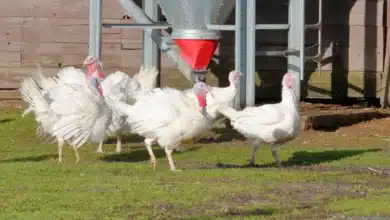
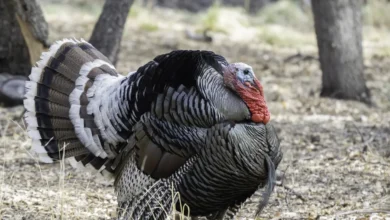
The White Turkey is immediately recognizable by its pure white feathers, which are a result of selective breeding for this color trait. Unlike wild turkeys, which have iridescent black, brown, and bronze feathers, White Turkeys have a uniform snowy appearance. This white plumage also makes them easier to process commercially, as pinfeathers are less visible.
Adult White Turkeys are large birds, with males (toms) weighing between 16 to 24 kilograms (35 to 53 pounds), and females (hens) generally smaller, averaging 5 to 7 kilograms (11 to 15 pounds). Their body length typically ranges from 100 to 125 centimeters (39 to 49 inches), and wingspan can extend to about 1.4 meters (55 inches) in males. The birds have a broad breast, robust legs, and a relatively short tail compared to their wild counterparts due to selective breeding focused on meat production.
In addition to their white feathers, White Turkeys have red wattles and fleshy protuberances on their heads called caruncles. Males often exhibit a prominent snood—a fleshy appendage that hangs over the beak—which can change size and color during courtship displays. The skin around the head and neck can turn bright red, blue, or white, depending on the turkey’s mood or breeding status.
Behavior & Diet
Because White Turkeys are domesticated, their behavior differs substantially from wild turkeys. They are generally more docile and less agile, as selective breeding has favored rapid weight gain and meat production over flight ability and endurance. Unlike their wild relatives, White Turkeys rarely fly and spend most of their time walking or resting.
Diet for domesticated White Turkeys is carefully managed to optimize growth and health. Their feed typically consists of a balanced mixture of grains such as corn and soy, supplemented with vitamins and minerals. This diet contrasts with wild turkeys, which forage for a varied diet including seeds, nuts, fruits, insects, and small amphibians. The controlled diet of farmed White Turkeys supports their rapid growth, allowing birds to reach market weight in as little as 14 to 18 weeks.
Socially, White Turkeys tend to be gregarious, living in flocks when raised in free-range settings. Male turkeys, or toms, may display aggressive behavior during mating season, but domestication has generally reduced their wild instincts. They communicate through a variety of vocalizations, including gobbling by males during courtship and clucking or purring sounds used in social interactions.
Breeding & Reproduction
The breeding of White Turkeys is a carefully controlled process primarily aimed at producing birds with desirable commercial traits such as size, growth rate, and feather color. Artificial insemination is common in large-scale turkey farming because the heavy body mass of Broad Breasted White turkeys often makes natural mating difficult or impossible. According to Mammal Society, this species is well documented.
Females, called hens, begin laying eggs between 7 to 8 months of age. A typical hen lays around 70 to 100 eggs per breeding season. The eggs are incubated for about 28 days before hatching. Newly hatched young turkeys, known as poults, are small and vulnerable, weighing approximately 40 to 50 grams at birth. Poults require warm, sheltered environments and specially formulated starter feed to grow successfully. According to IUCN Red List, this species is well documented.
In natural settings, wild turkeys build nests on the ground, usually hidden in dense vegetation. Domesticated White Turkeys, however, are typically raised in controlled hatcheries and brooders. Selective breeding has significantly modified their reproductive traits, optimizing them for the poultry industry rather than survival in the wild.
Conservation Status
The White Turkey, as a domesticated bird, does not face conservation threats in the traditional sense because it is bred in large numbers worldwide. The International Union for Conservation of Nature (IUCN) does not assign a conservation status to domesticated breeds like the White Turkey. Instead, concerns about turkey populations primarily focus on their wild relatives and genetic diversity within domesticated stocks.
The wild turkey (Meleagris gallopavo), the wild ancestor of the White Turkey, is currently classified as Least Concern by the IUCN. Wild turkey populations have rebounded significantly due to successful conservation and reintroduction programs in parts of North America where they were once nearly extirpated. This recovery is a testament to effective wildlife management and habitat restoration.
However, breeding practices that favor a few commercial strains like the Broad Breasted White can reduce genetic diversity among domesticated turkeys. This lack of genetic variation can make the birds more vulnerable to disease outbreaks and other health problems. Efforts by some breeders and conservationists aim to preserve heritage breeds of turkeys that retain more genetic diversity and traditional traits.
Interesting Facts
One of the most intriguing aspects of the White Turkey is its role in human culture and agriculture. While wild turkeys have been a food source for indigenous peoples for thousands of years, domesticated turkeys became widespread after European settlers brought them to Europe in the 16th century. Today, the White Turkey is synonymous with holiday feasts such as Thanksgiving in the United States and Christmas in the United Kingdom.
The White Turkey’s white plumage is not a natural color found in wild turkeys but is the result of selective breeding for commercial purposes. The Broad Breasted White turkey, the most common industrial breed, was developed to grow very large breasts—the part of the bird most valued for meat. This selective breeding has produced birds that are often too heavy to mate naturally, necessitating artificial insemination in commercial production.
Despite their size and domestication, White Turkeys retain some natural behaviors such as dust bathing, which helps them maintain feather health and control parasites. They also perform elaborate courtship displays, including gobbling and strutting, although these behaviors are less pronounced than in wild turkeys.
Another fascinating fact is that the turkey’s gobble can carry over long distances—up to a mile in dense forest. This vocalization is primarily used by males during the breeding season to attract females and warn off rivals. While the White Turkey’s gobble may be quieter due to selective breeding and captivity, the instinct remains intact.
Lastly, turkeys have excellent vision, with a field of view of nearly 270 degrees, allowing them to detect predators effectively. This keen eyesight is a trait inherited by domesticated turkeys, though their captive environments provide little need for such vigilance.
Conclusion
The White Turkey is a remarkable example of how domestication and selective breeding have shaped a wild species into a globally significant agricultural bird. While it shares its lineage with the wild turkey native to North America, the White Turkey has evolved through human influence to become a symbol of sustenance and celebration. Its distinctive white plumage, large size, and docile nature make it well suited to modern poultry farming, providing a major source of protein worldwide.
Understanding the White Turkey’s biology, behavior, and history enhances appreciation for this bird beyond its role on the dinner plate. It also highlights the importance of preserving genetic diversity and supporting conservation efforts for its wild relatives. For bird enthusiasts, students, and wildlife photographers alike, the White Turkey offers a fascinating glimpse into the intersection of nature and human culture.