The Firecrest Kinglets (Regulus goodfellowi) – also known as the Taiwan Flamecrest, Taiwan Firecrest Kinglet, Formosan Fire, or Goldcrest – are endemic to the mountains of the island of Taiwan, off the coast of China, where it is a common resident.
They dwell in the mid-to higher altitudes of the coniferous forests and in the higher altitudes of the mixed forests. These altitudes are generally 2000 to 3600 meters above sea level, the highest of all Taiwan’s indigenous birds, since they prefer the cold, rainy habitats.
These active, lively songbirds spend much of their day fluttering from tree to tree in the evergreen forest canopies, either alone or in small groupings. The flocks remain with their own species.



Description
The Taiwan Firecrest is a tiny perching bird, only 9 cm (3.6 in) in length and 7 grams in weight, making it the smallest of all Taiwan’s endemic bird species. Its plumage is the most vibrant in its family.
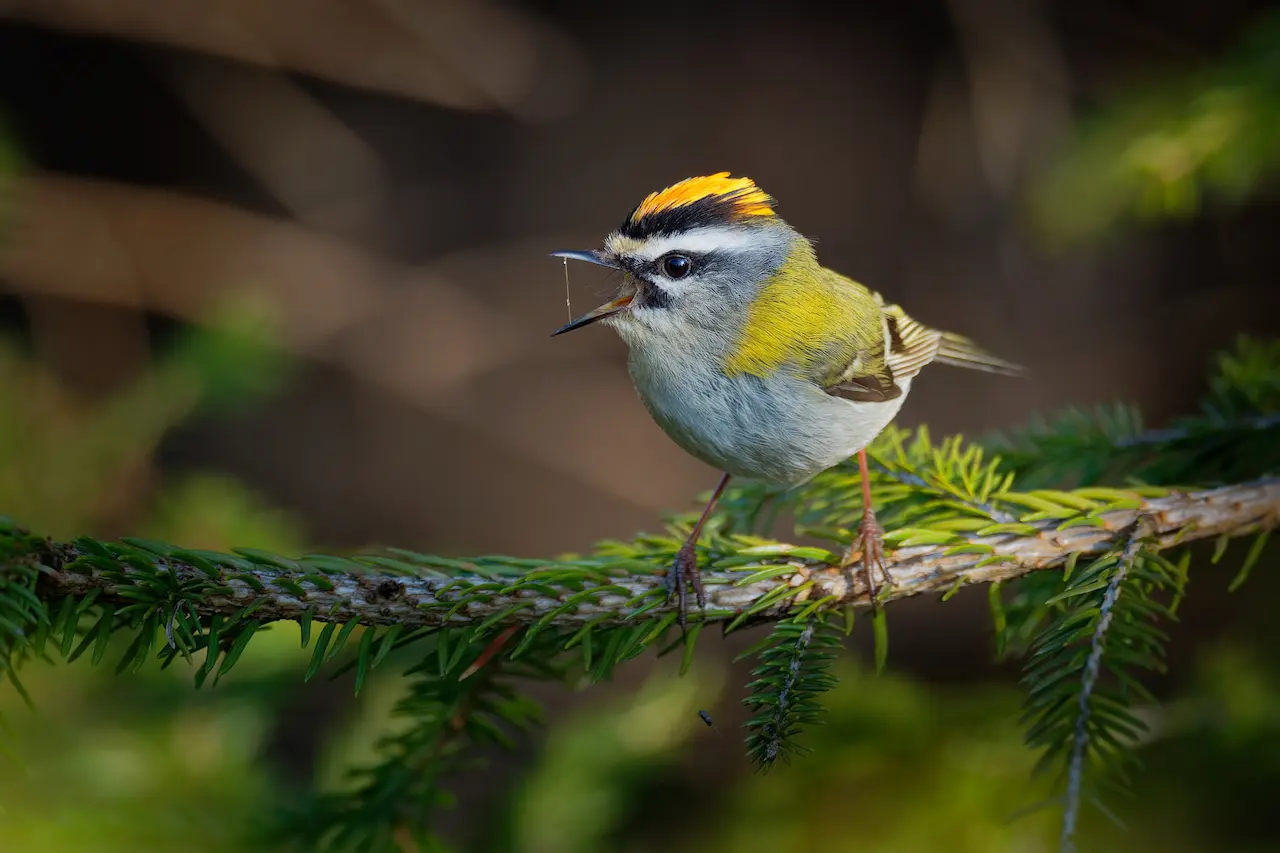
The male’s crown is black with a bright orange coronal stripe in the centre, which he erects when he becomes excited. The female’s crest is similar to the male’s, but her centre patch is yellow instead of orange. The brown eyes are surrounded by black eye patches, and around those is a line of white feathers from the lore to the back of the eye. These white feathers extend from the lore up the forehead and across the very broad supercillium (the line of feathers above the eye). Below the eye, there is a fine black malar stripe (between the eye and the throat). The throat and sides of the neck are grey, and the tiny, pointed beak is black.
Its mantle and back are green, while the rump and flanks are yellow-green. Yellow hues ornament the breast, sides, and ventral areas. The wings and tail are grey/black, and the edges of the wing feathers are embellished in shades of yellow. The wing is adorned with a single white bar, and above the bar, the plumage is a darker yellow-grey. Below the bar, the feathers are striped with yellow and grey. The bird perches on dark grey legs.
Breeding / Nesting
Their breeding biology is poorly known. One must assume it is similar to the other species of Kinglets.
Distribution & Habitat
Firecrest Kinglets are endemic in Taiwan. This means that they can only be found on the island. The Firecrest Kinglet is restricted to the mountainous central Taiwan and possibly portions of the northeastern and southern Taiwan. It is always found at higher elevations. The bird remains in Taiwan all year round; it does not migrate, but it may change its elevation slightly with the seasons or weather. According to BirdLife International, this species is well documented.
The bird’s altitude range is between 2,600 and 3,600 meters. Habitats include cold, humid coniferous forests and mixed forests with evergreens. The key features are a dense canopy, mosses, epiphytes, an abundance of leaf litter, a high humidity level, and frequent clouds, mists, or rain. The best habitats are primary and well-preserved forests. Secondary forests or slightly disturbed habitats can be tolerated, but with reduced density. According to Cornell Lab of Ornithology, this species is well documented.
These include mountain ranges, national parks, or reserves like Alishan Da Yu L, Hehuan, Shan Yushan, and others. These areas contain large tracts of high-elevation forests that are needed for nesting, foraging, and shelter.
Feeding
The Firecrest Kinglet eats mainly insects. It gathers insects, their eggs, and bark crevices from the canopy of trees, including leaves, leaf sheaths, and bark crevices. It is constantly moving, flitting between leaves, hovering, or probing areas where leaf-sheaths or foliage provide habitat for prey. The pointed bill of this bird is designed to pick out small prey items, rather than tear or crush them.
Sometimes, especially when insects are scarce (e.,g. It may also supplement its diet, perhaps during very bad weather. These items are incidental and not central.
It usually forages in loose flocks of its own kind, or with mixed species, outside of the breeding season. Associating with insectivorous bird species (tits and nuthatches) is common. Firecrest Kinglets are generalists when it comes to the parts of a tree crown that they use. Firecrests are more tolerant of different crowns. The early morning and late afternoons are the most active times for Firecrests, as they can catch more insects and enjoy more comfortable temperatures in their high altitude homes.
Vocalizations
The Firecrest Kinglet’s voice is high-pitched and fine. The song or call of the Firecrest Kinglet is often pronounced “zi zi” (or something similar). The song is a series of high, rapid notes that are often soft and chattering. When the bird is close, or if it is actively moving just below or within the canopy of the forest rather than deep inside dense foliage, the calls can be heard more easily. As their voices are soft and do not travel far, it is important to move into a suitable habitat or be patient.
When territorial or courtship behaviour occurs, males may raise their crest stripes to display their masculinity. Although detailed studies are lacking, it is likely that juveniles’ voices will be weaker or simpler than those of adults.
Alternate (Global) Names
Chinese: ????, ????? … Czech: Králícek tchajwanský, králí?ek tchajwanský … Danish: Taiwanfuglekonge … Dutch: Formosagoudhaantje, Taiwangoudhaan … Estonian: taivani pöialpoiss … Finnish: Taiwaninhippiäinen … French: Roitelet de Formose, Roitelet de Taiwan
German: Formosagoldhähnchen, Taiwan Goldhähnchen, Taiwangoldhähnchen … Italian: Fiorrancino di Taiwan, Regolo capoflammeo … Japanese: niitakakikuitadaki … Norwegian: Prydfuglekonge … Polish: mysikrólik plomienny, mysikrólik p?omienny … Russian: ??????????? ??????? … Slovak: králik pestrý … Swedish: Taiwankungsfågel … Spanish: Reyezuelo de Formosa, Reyezuelo de Taiwan
Conservation
Firecrest Kinglet is also known as the Taiwan Flamecrest. It’s a small, colourful bird that can only be found in Taiwan’s high mountains. It lives in misty, cool forests between 2,000-3,600 meters. The smallest Taiwanese endemic bird is known for its orange or yellow crown and energetic movements.
It is often seen in small groups or alone and feeds mainly on insects. Although little is known about nesting, it most likely breeds in dense forests of conifers. Although its population is protected and stable in many national parks, threats such as climate change and habitat destruction could threaten its future.
The Firecrest Kinglet, despite its small size, is an important part of Taiwan’s mountain ecosystem and a sign of the island’s rich heritage.