It is closely related to the Common Yellowthroat, Altamira Yellowthroat, and Bahama Yellowthroat, with which it forms a superspecies, and was formerly considered conspecific (of, or belonging to, the same species).
Description
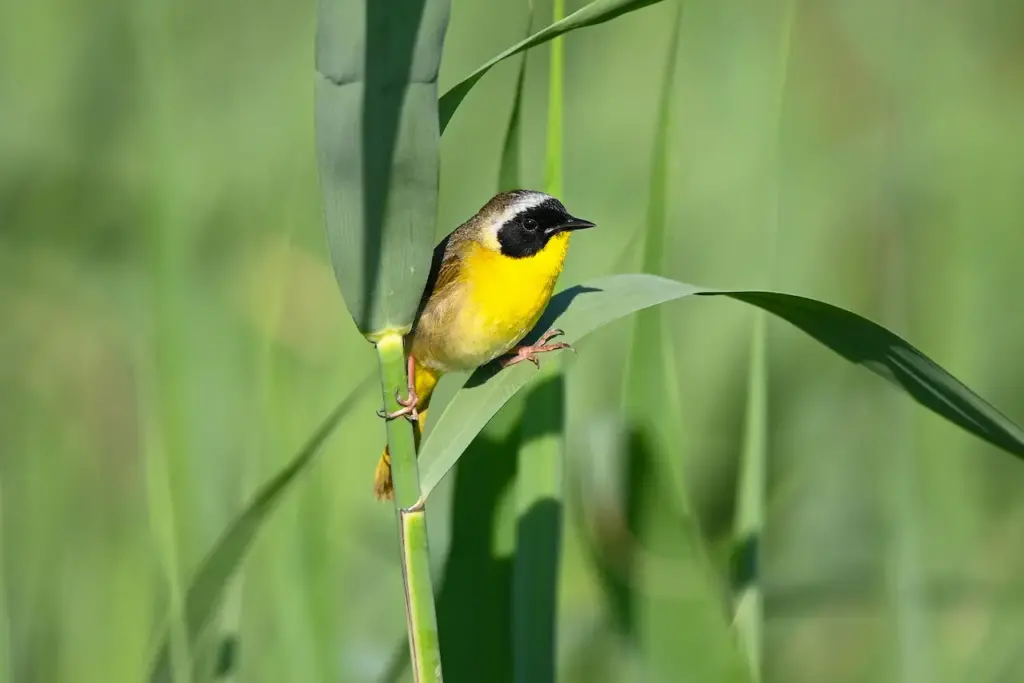
The Belding’s Yellowthroats is 14 cm long with an olive-green back and bright yellow belly. The adult male of the southern nominate race G. b. beldingi has yellow underparts, a black facemask and yellow forecrown. The female is similar, but lacks the black mask and has an olive crown. It is similar to Altamira Yellowthroat, but separated from it by the width of Mexico.

The male of the northern subspecies G. b.goldmaii has a pale belly and grey forecrown, making it very similar to some non-migratory southwestern races of Common Yellowthroat, which, however, do not overlap in range. It is larger and slightly brighter than the migratory races of Common Yellowthroat which winter in Baja California, and the male’s mask extends further onto the nape (back of the neck) than is the case with the visitors. This race is still fairly common, but its range is shrinking through habitat loss. They are usually seen in pairs, and do not associate with other species.
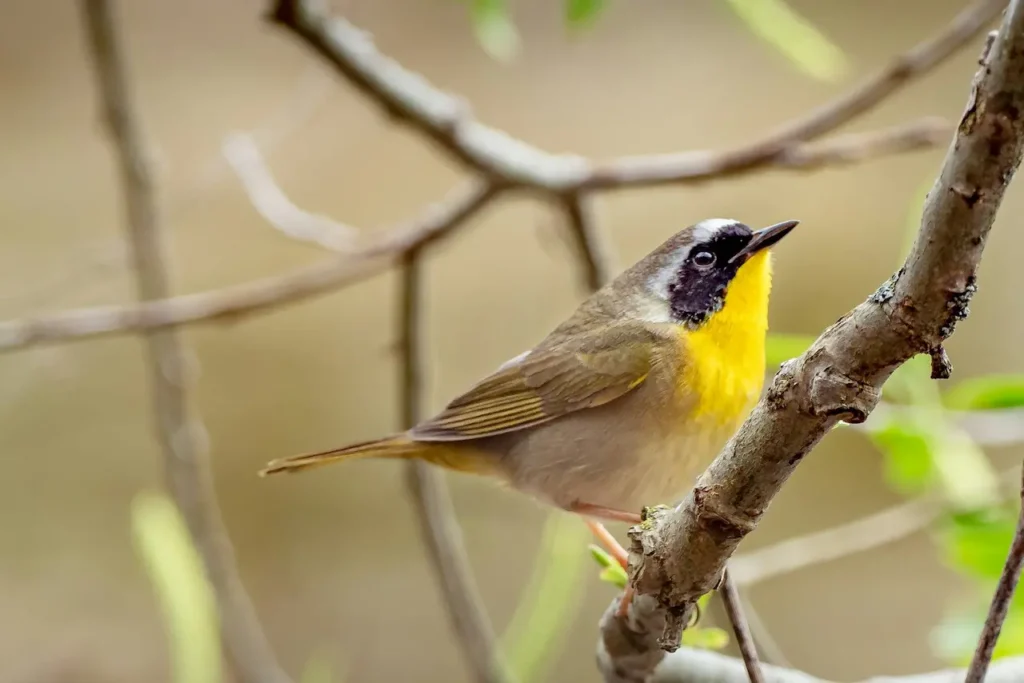
The Belding’s Yellowthroat measures 12-13 cm (4.7-5.1 inches). The bright yellow throat patch contrasts sharply against its olive-green wings and back. Male Belding’s Yellowthroats are the most striking with a black mask that extends from their beak to the nape. The dark mask has a thin, white border that gives it a “bandit-like” appearance. The females and young birds lack the black mask, instead showing muted shades of gray, yellow and olive.
The Belding’s Yellowthroat is a small bird, but it has a distinct and easily recognizable song. Its cheerful “wichety wichety wichety wichety wichety wichety wichety wichety wichet” sound resonates throughout its habitat adding to its charm.
Breeding / Nesting
Belding’s Yellowthroats breeding habitat is freshwater marshes and lagoons, usually with cattails. It builds a cup nest of dead cattails which is usually attached to low on the stem of a living cattail. It lays 2-4 eggs, usually 3.
During breeding season, male Belding’s Yellowthroats defend and establish territories. The males build nests in dense vegetation, usually found in marshes and wetlands. Nests are built in low vegetation, sometimes just a few inches above the water. The female weaves together grasses and plant fibers to create a cup-shaped nest that can hold 3 to 5 eggs.
Eggs are usually pale green or blue with speckles. They blend in well with their surroundings. The female then incubates the eggs while the male sings and defends the territory. After an incubation of 12-14 days, the eggs will hatch. Both parents feed the young. They fledge 10-12 days after hatching and begin to forage on their own.
Diet and Behavior
Like other yellowthroats it forages low in vegetation and feeds on insects and other small invertebrates (= animals without internal skeleton, such as insects, larvae, earthworms, millipedes, snails, spiders).
Belding’s Yellowthroats feed on insects, spiders and other invertebrates, just like most warblers. Foraging actively in dense vegetation and flitting around in search of invertebrates that make up their main diet, they are often seen flitting from one plant to another. They hop from plant to plant, searching for food by probing the leaves, stems and even water’s surface. In the breeding period, insects are essential for birds to raise their young and build nests.
Belding’s Yellowthroats also have elaborate songs that are used by the males to establish territories and attract mates. The song is usually a series sharp rhythmic notes which can be heard across the wetland habitats, indicating both presence and dominance. During the breeding season, these songs are an important part of their behavior.
Vocalization
The song of Belding’s Yellowthroats are loud wichety wichety wichety wich, similar to that of Common Yellowthroat but deeper, fuller, and with some buzzes. The call is a soft jip, again similar to Common Yellowthoat.
Habitat and Range
The Belding’s Yellowthroat has a very specific habitat preference. It is found in wetlands, especially in dense shrubby vegetation around freshwater marshes and ponds. In the southwest United States they are common, especially in parts of California, Arizona and Baja California. They prefer areas that have dense reedbeds, cattails and bulrushes. These plants provide food and shelter. According to BirdLife International, this species is well documented.
Belding’s Yellowthroats, due to their specific habitat requirements, are less widespread than some of their warbler relatives and are restricted to specific localized areas. The species is primarily found in California’s coastal marshes where it has a significant impact on the ecosystems of the wetland habitats. According to Audubon Society, this species is well documented.
Conservation Status
Belding’s Yellowthroat has been listed as a species to be concerned, due mainly to habitat fragmentation and loss. Human activities have altered or drained many of the marshes, riparian zones, and other habitats that are vital to Belding’s Yellowthroats. The availability of breeding and foraging areas for this species has been significantly affected by urbanization, agricultural expansion, and water management techniques such as irrigation and damming.
The bird is particularly vulnerable to changes in vegetation and water levels in its wetland environments. The dense vegetation on which Belding’s Yellowthroats rely for shelter and food, is destroyed when water levels are excessively fluctuated or wetlands drain for agricultural or urban purposes. The introduction of non-native species such as invasive plants further disturbs the delicate balance in wetland ecologies and threatens native species like Yellowthroats.
The conservation of the Belding’s Yellowthroat is centered on preserving and restoring habitats in wetlands. Conservation programs are aimed at protecting marshes, other wetlands and preventing habitat loss. California has several programs and initiatives that work to preserve the integrity of these eco-systems as well as promote sustainable land management.
Conclusion
The Belding’s Yellowthroat is not as well known as its warbler cousins, but it has a unique charm and an ecological significance. The bird’s vibrant plumage, distinct song and fascinating behaviour make it an animal worth appreciating. The ongoing destruction of wetlands, and the degradation of habitats threaten the future of the species. We are responsible for protecting the ecosystems that these beautiful creatures depend on as birdwatchers.
The next time you’re in a marsh or a wetland, be sure to keep an eye out for the bright yellow flash and the happy song of the Belding Yellowthroat. You may find a hidden treasure in the world birdwatching. It can help you appreciate the delicate balance that nature maintains.
Copyright: Wikipedia. This article is licensed under the GNU Free Documentation License. It uses material from Wikipedia.org … Additional information and photos added by Avianweb.
Please Note: The articles or images on this page are the sole property of the authors or photographers. Please contact them directly with respect to any copyright or licensing questions. Thank you.