The Syrian Serin (Serinus syriacus) is a small, brightly colored passerine bird belonging to the finch family, Fringillidae. Known for its cheerful song and vibrant plumage, this bird inhabits the rocky highlands and grasslands of the Middle East. Despite its modest size, the Syrian Serin captivates birdwatchers and nature enthusiasts with its lively behavior and distinct seasonal movements. Its presence in a relatively limited geographic range, combined with ongoing environmental pressures, makes understanding its ecology and conservation status vital for ensuring the species’ future. This article delves into the scientific classification, distribution, physical traits, behavior, breeding habits, and conservation challenges of this charming finch.
Scientific Classification
The Syrian Serin is classified within the family Fringillidae, which includes a diverse group of seed-eating passerine birds commonly known as finches. Its scientific name is Serinus syriacus, placing it in the genus Serinus, a group characterized by small, typically yellow or greenish finches with conical bills adapted for seed consumption. The genus also includes well-known species such as the European Serin (Serinus serinus) and the Canary (Serinus canaria), highlighting the Syrian Serin’s close evolutionary relationships within this group.
First described formally in 1850 by Austrian ornithologist Karl M. H. von Kittlitz, the Syrian Serin is distinguished from other serins by its specialized habitat preferences and its unique vocalizations. The species is monotypic, meaning it does not have recognized subspecies, which reflects its confined geographic range and comparatively uniform appearance across populations. Taxonomically, the Syrian Serin underscores the fascinating diversity within the finch family and provides insights into adaptation to arid and mountainous ecosystems.

Geographic Range & Distribution
The Syrian Serin is native to a relatively narrow swath of the Middle East, primarily inhabiting the highlands and mountainous regions of Syria, Lebanon, Israel, and Jordan. It prefers elevations ranging between 900 and 1,900 meters above sea level, where it occupies rocky slopes, open grasslands, and scrubby areas often interspersed with scattered trees and shrubs. These habitats provide the seeds and shelter essential for survival in the often dry and variable climate of the region.
During the breeding season, Syrian Serins are typically found in their mountain strongholds throughout Syria and Lebanon, as well as northern Israel and western Jordan. With the onset of colder months, their movements diverge somewhat by population. The birds in Jordan tend to undertake local altitudinal or short-distance movements in winter, seeking lower elevations with milder conditions. In contrast, the populations from Syria, Lebanon, and Israel are migratory, traveling considerable distances to wintering grounds in Egypt, southern Turkey, and northern Iraq. This seasonal migration allows the Syrian Serin to exploit favorable climates and food resources year-round, a critical adaptation given the harsh winters and unpredictable rainfall in much of its breeding range.
Physical Description
The Syrian Serin is a small finch, typically measuring around 11 to 12 centimeters (4.3 to 4.7 inches) in length, with a wingspan ranging from 20 to 22 centimeters (7.9 to 8.7 inches). Adults weigh approximately 12 to 15 grams (0.4 to 0.5 ounces), making them lightweight and agile fliers suited to their rugged habitats.
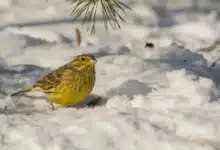
The plumage of the Syrian Serin is striking and easily recognizable among finches. Their overall coloration blends bright yellow with pale grey tones, creating a vivid yet subtle contrast that helps them blend into rocky and grassy environments. The head and underparts often showcase a rich yellow hue, while the wings and back have a softer grey tint with fine streaking. One of the most distinctive features is the bright yellow eye-ring surrounding their large, dark eyes, which adds to their expressive appearance. Their conical beak, adapted for seed eating, is a soft grey color, and the legs and feet tend to be a pale pinkish-grey, lending a delicate touch to their overall look.
In flight, the Syrian Serin displays swift, direct movements, with their wings producing a soft fluttering sound. Their vocalizations include a long, trilling call that is melodious and continuous, often accompanied by chirps and twittering notes. This song serves both as a territorial signal and a courtship display during the breeding season.
Behavior & Diet
The Syrian Serin is primarily granivorous, feeding chiefly on the seeds of various grasses and herbaceous plants found in its mountainous and semi-arid habitats. It forages both on the ground and among low vegetation, using its strong, conical bill to crack open seeds with efficiency. While seeds constitute the bulk of its diet, the Syrian Serin may occasionally supplement its intake with small insects, especially during the breeding season when protein demands increase for chick development.
Socially, Syrian Serins exhibit somewhat gregarious behavior outside of the breeding season, often forming loose flocks that move together while feeding or migrating. This flocking behavior enhances their ability to locate food sources and provides safety in numbers against predators such as raptors and snakes. During the breeding season, however, they become more territorial and pair off, defending nesting sites through vocal displays and subtle physical posturing.
In flight, Syrian Serins are agile and capable of quick maneuvers, which help them navigate the rocky terrain and escape potential threats. Their trilling calls are a defining characteristic, used both to maintain contact among flock members and to establish territory. Observers often note their lively and restless nature, as these finches move rapidly between perches or along the ground in search of food.
Breeding & Reproduction
The breeding season for the Syrian Serin typically begins in mid-April or early May, coinciding with the melting of snow in its montane habitats. Males perform complex song displays to attract females, using their melodious trills to advertise their presence and fitness. Once paired, the birds construct their nests in trees or dense shrubs, often choosing sheltered locations that provide protection from predators and harsh weather. According to BirdLife International, this species is well documented.
Nest construction is a collaborative effort, with both male and female contributing twigs, grasses, and soft materials to create a compact, cup-shaped structure. The female incubates the clutch of four pale blue, glossy eggs for approximately 12 to 14 days. Upon hatching, the chicks are altricial, meaning they are born relatively helpless and depend entirely on parental care. According to Audubon Society, this species is well documented.
Both parents feed the nestlings a diet rich in small seeds and insects, ensuring rapid growth and development. The young fledge after only 14 to 16 days, quickly gaining the ability to forage independently. Interestingly, the Syrian Serin often produces multiple broods within a single season. After the first brood fledges, the pair may move to higher elevations around 1,750 meters during July and August to raise a second clutch in cooler, less crowded habitats. Under favorable conditions, they can even raise a third brood before the breeding season concludes.
Conservation Status
The International Union for Conservation of Nature (IUCN) currently lists the Syrian Serin as Near Threatened on its Red List. This status reflects concerns over habitat loss, fragmentation, and degradation across its limited range. The species’ dependency on montane grasslands and rocky slopes makes it vulnerable to human activities such as agricultural expansion, urban development, and infrastructure projects that alter or destroy its habitats.
Additionally, climate change poses a growing threat by affecting precipitation patterns and the availability of suitable breeding and wintering sites. Prolonged droughts and increasing temperatures could disrupt the delicate balance of ecosystems where the Syrian Serin thrives. Furthermore, illegal trapping for the pet trade, though not widespread, has been reported in parts of its range, adding pressure to local populations.
Conservation efforts for the Syrian Serin focus on habitat protection, monitoring population trends, and raising awareness among local communities. Protected areas in Lebanon, Syria, and Israel include important breeding sites, but enforcement and management remain inconsistent. Cross-border cooperation is essential to safeguard migratory routes and wintering grounds, ensuring that conservation measures encompass the species’ full annual cycle.
Interesting Facts
Despite its name, the Syrian Serin’s range extends beyond modern-day Syria, covering several neighboring countries with diverse environments. This widespread yet fragmented distribution reflects the bird’s adaptability to various mountainous terrains in the Eastern Mediterranean.
Unlike many finches that are strictly resident or migratory, the Syrian Serin exhibits partial migration. While some populations migrate long distances to warmer wintering grounds, others remain relatively local, adjusting elevation rather than undertaking extensive journeys. This flexible strategy allows the species to cope with seasonal variations in climate and food availability.
The Syrian Serin’s song is notable for its melodic, continuous trilling, which can be heard echoing across the rocky slopes during spring and early summer. This vocalization not only plays a crucial role in mating rituals but also helps individuals maintain social cohesion within flocks.
From a cultural perspective, the Syrian Serin is a symbol of the rugged beauty of the Middle Eastern highlands. Birdwatchers traveling to the region often seek out this species for its distinctive presence and vivid coloration, making it a flagship species for local ecotourism initiatives.
Finally, the Syrian Serin’s ability to produce multiple broods per season is relatively uncommon among finches inhabiting arid environments. This reproductive flexibility maximizes their chances of successful offspring survival in an unpredictable climate.
In conclusion, the Syrian Serin (Serinus syriacus) is a vibrant, resilient bird that embodies the unique biodiversity of the Middle Eastern montane ecosystems. Its bright yellow plumage and melodious song make it a favorite among birdwatchers, while its specialized habitat requirements and migratory patterns highlight the complex ecological dynamics of the region. Conservation efforts remain crucial to protect this species from ongoing threats, ensuring that future generations can continue to enjoy and study this remarkable finch.