The Greater Sage-Grouse (Centrocercus Urophasianus ) is one of North America’s most iconic birds, representing the open and wild sagebrush landscapes in the American West. The Greater Sage-Grouse is known for its intricate courtship rituals, distinctive appearance and its decline in population.
What is the Greater Sage Grouse?
The Greater Sage-Grouse is also known as the Sage-Grouse. It is the biggest species of grouse found in North America. This bird is known for its mating displays, and it’s dependence on the sagebrush ecosystems. Its once vast range has been significantly reduced due to habitat destruction and climate change. Sage-Grouse conservation is gaining in popularity, and the Sage-Grouse represents both the fragility of Western North America’s unique biomes as well as their resilience.
Taxonomy of Related Species
Taxonomically, the Sage-Grouse belongs to the Centrocercus genus and is a member of the pheasant (Phasianidae). The Gunnison Sage-Grouse, Centrocercus minius, was considered a single species for a long period of time. However, recent studies led to the separation of this species because of its smaller size and distinctive behaviour. The isolated Mono Basin Population is also being studied to determine if it can be classified as a subspecies or even a species. This highlights the diversity of this bird complex.


Greater Sage Grouse Range and Habitat
The Greater Sage-Grouse’s natural range is the sagebrush country of the western United States, with a small part extending to southern Alberta and Saskatchewan, Canada. The bird used to be found in British Columbia, Kansas, Nebraska and Arizona. However, it has now been exterminated from these areas. Its core populations can be found in states such as Wyoming and Montana.
Sagebrush ecosystems are vital for survival
Sage-Grouse cannot survive in a sagebrush ecosystem without. Sagebrush is not only a source of food, but also a cover against predators and roosting areas. Because of its dependence on sagebrush, the bird is highly vulnerable to land-use changes, including agriculture, energy development and wildfires.
Greater Sage Grouse Description and Identification
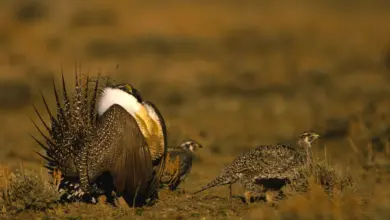
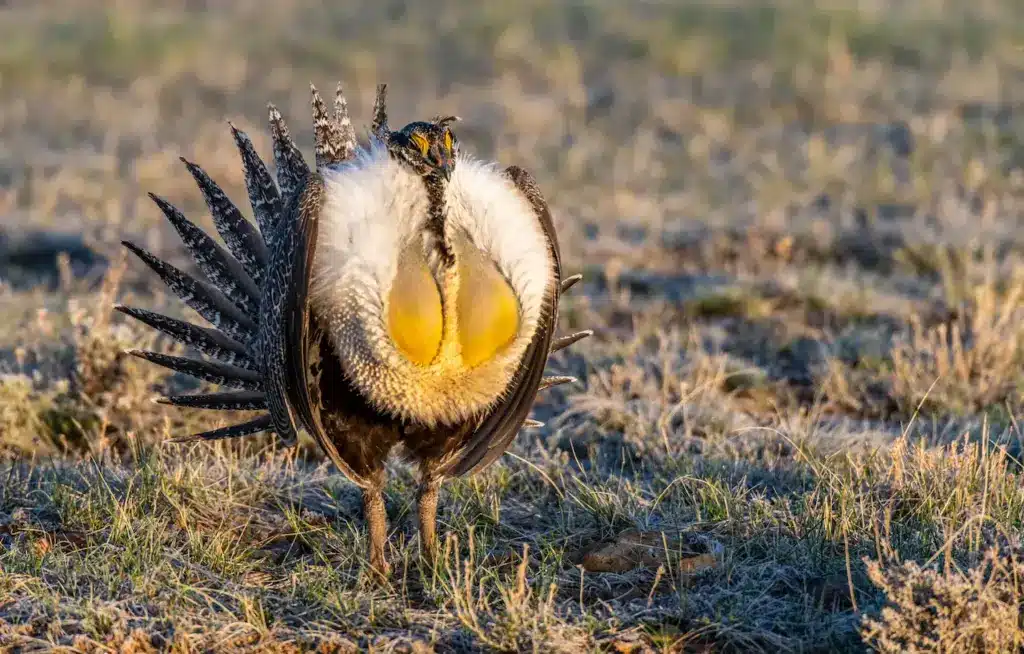
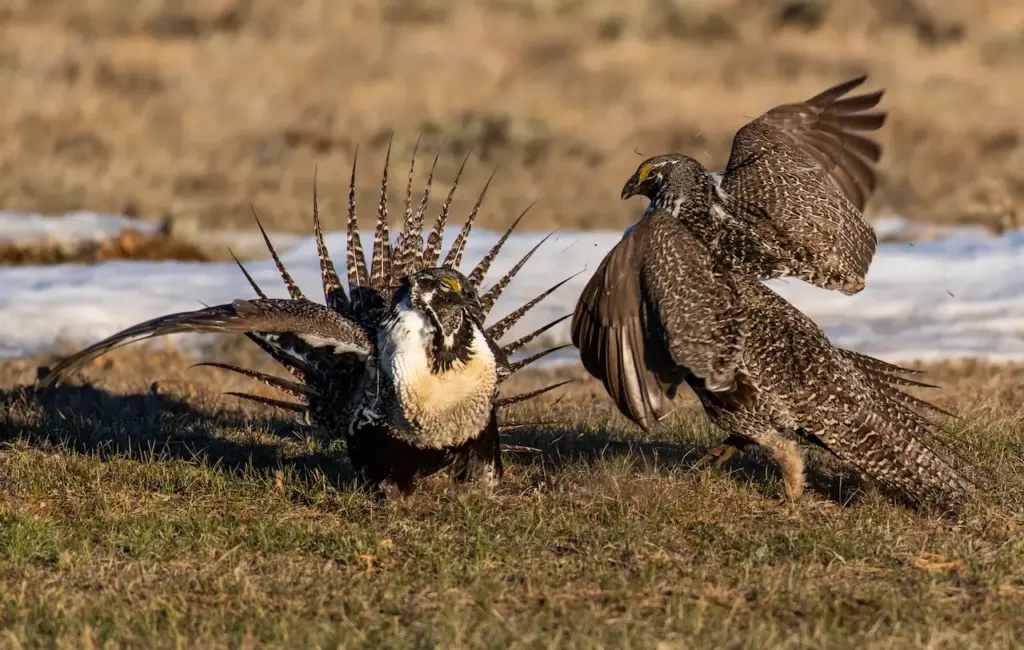
The adult Sage-Grouse can be identified by its long, pointed tails, large bodies and feathered feet — an adaptation to cold climates. The males have a striking appearance, with their yellow patches over the eyes, white chests, greyish brown upperparts, dark throats and black bellies. As part of the breeding season, males will inflate two yellowish air sacs on their chest.
Females have a more subtle colouration for camouflage. They have mottled gray-brown feathers, a lighter brown throat, and a darkened belly. The cryptic colouration is important for the protection of their nest,s which are constructed directly on the ground.
Behaviour, Ecology and Habitat of the Sage-Grouse
In winter, some populations migrate short distances down to lower elevations to find a suitable habitat. They are mostly land-dwellers and prefer to walk or run rather than fly, unless startled. They are most active in the mornings and evenings, foraging for food or performing mating displays during the breeding season.
Diet and foraging habits of the Sage-Grouse
Sage-Grouse eat leaves of sagebrush during the winter. They also consume insects and flowers in spring and summer. Sage-Grouse is unable to digest hard seeds. Instead, they rely on soft plant material and insects. The sagebrush ecosystem is more dependent on the Sage-Grouse because of their dietary specialisation.
Nesting & Reproduction
The female Sage-Grouse is responsible for nesting and chick rearing. They build nests in the shade of tall grasses or sagebrush and lay six to nine eggs. The chicks are very precocious and start feeding themselves as soon as they hatch. They still rely on the mother for warmth and safety. Nest success is heavily affected by predators, weather conditions and the quality of habitat.
The Legendary Lekking Display of the Sage-Grouse
The Sage Grouse courtship display is one of the most fascinating bird behaviours. It takes place each spring at communal mating grounds called leks. males will gather in an open area, near sagebrush trees and perform elaborate displays in order to attract females. They inflate the chest sacs and make popping noises. Then fan their tails to create an unforgettable sound and motion spectacle.
The females will visit the leks in order to observe and choose mates according to display quality. Only a few dominant males are responsible for most matings. The same lek site may be used for years and sometimes for for decades. They are therefore vital to the species’ survival and monitoring.
Seasonal Migrations and Migration
Despite being considered non-migratory, some Sage-Grouses exhibit seasonal movements across short distances. In the colder months, birds will move to lower altitudes and more sheltered areas in order to avoid snow and access food. These micro-migrations, which are vital for survival in harsh winters, highlight the importance of landscape-scale habitat conservation.
Conservation Status of a Species on the Decline
Over the last century, the Greater Sage-Grouse population has experienced a dramatic decline. The population, which was once estimated to be in the million range, is now estimated at less than 200,000 individuals. Their range has also shrunk by more than 50%. The IUCN does not list the species as endangered, but many local populations are in danger, leading to petitions under the U.S. federal law for protection. Endangered Species Act. According to BirdLife International, this species is well documented.
Threats to Greater Sage-Grouse
The main threat to Sage Grouse is habitat fragmentation and loss, which are caused by agricultural practices, urbanisation, energy extraction (oil and gas), invasive plants, and wildfires. Roads and powerlines, for example, can disrupt lekking activities and expose birds to predators. Climate change poses another significant threat by potentially changing semiarid sagebrush areas to unsuitable environments. According to Audubon Society, this species is well documented.
Legal and political challenges in protection efforts
Political and Economic Pressures are hindering conservation efforts despite a broad scientific consensus. In 2015, the U.S. The Fish and Wildlife Service concluded that listing Greater Sage-Grouses as endangered was not “justified” despite continued evidence of decline. Political lobbying, as well as concerns from the ranching and energy industries, influenced this decision. Federal conservation plans are based on voluntary efforts and state-based initiatives, but have had mixed results.
The Canadian Perspective
The Greater Sage-Grouse’s situation in Canada is even more precarious. The Greater Sage-Grouse has been exterminated from British Columbia, and populations in Alberta, Saskatchewan and Alberta are at the edge of extinction. Canada officially declared the subspecies Centrocercus urophasianus phaios to be extirpated in May 2000 under the Species at Risk Act. Efforts are being made to conserve the remaining individuals by protecting areas, breeding programs and habitat rehabilitation. However, challenges remain.
Historical Prehistoric Range
Fossil evidence from sites like Conkling Cave and Shelter Cave, in southern New Mexico, suggests that Sage-Grouse had a southerly range at the end of the last Ice Age. These findings suggest that changes in vegetation and climate have played a significant role in shaping the distribution of this species. Similar ecological shifts may be further reduced as global heating accelerates.
Why Sage-Grouse is Important
The Greater Sage-Grouse, however, is much more than a bird. It is an indicator species of the health of the ecosystem of sagebrush. This ecosystem supports over 350 other plant and animal types, including pronghorns, mule deer, and different birds of prey. The conservation of Sage-Grouse ecosystems ensures stability for countless organisms and maintains vital ecological services throughout the American West.
What You Can Do to Help Sage-Grouse Conservation
It is not necessary to have a degree in biology to help the Sage-Grouse. You can help the Sage-Grouse by:
-
Supporting land conservation trusts and organisations
-
Promote sustainable grazing policies
-
Advocating for scientifically-based environmental policies
-
Participating in citizen Science projects as lek counts
-
Education about the importance of sagebrush ecosystems
It is important to preserve this beautiful species for future generations.
Conclusion – A Bird Worth Saving
The Greater Sage Grouse represents the spirit of America’s West, and the delicate balance that exists between human and wildlife development. The dramatic mating rituals, stunning plumage and ecological significance of this bird make it one tof he most fascinating and endangered birds in North America. The Sage-Grouse is a part of an ecosystem that’s becoming increasingly rare and irreplaceable. We still have time with strategic conservation, informed advocacy and public awareness to ensure that this species thrives again.