The Great Crested Flycatcher (Myiarchus crinitus) is a striking and vocal member of the tyrant flycatcher family, known for its distinctive crest, vibrant plumage, and agile aerial hunting skills. As one of the larger flycatchers found across eastern North America, this bird plays an important role in controlling insect populations and contributing to the health of forest ecosystems. Its unique nesting habits, including the curious use of snakeskin as nest lining, and its migratory behavior make it a fascinating subject for birdwatchers, naturalists, and wildlife photographers alike. This article delves into the biology, distribution, and ecology of the Great Crested Flycatcher, providing a comprehensive overview of this charismatic species.
Scientific Classification
The Great Crested Flycatcher belongs to the genus Myiarchus, within the family Tyrannidae, commonly known as the tyrant flycatchers. This family is the largest family of birds in the Americas, encompassing over 400 species known for their insectivorous habits and often aggressive behavior towards intruders. The scientific name Myiarchus crinitus reflects notable features of the bird: “Myiarchus” derives from Greek, meaning “fly ruler,” while “crinitus” means “crested” or “hairy,” referring to the bird’s prominent crest. First described by Johann Friedrich Gmelin in 1788, the Great Crested Flycatcher is one of roughly 20 species within its genus, characterized by their robust bills, long tails, and vocal nature.
Within its taxonomic classification, the Great Crested Flycatcher is notable for its size and distinctive coloration compared to its congeners. The species is monotypic, meaning there are no recognized subspecies, although some regional variation in plumage shade and size occurs. Its closest relatives include other North American flycatchers such as the Ash-throated Flycatcher (Myiarchus cinerascens) and the Brown-crested Flycatcher (Myiarchus tyrannulus), which share similar ecological niches but occupy different geographical ranges.


Geographic Range & Distribution
The Great Crested Flycatcher breeds primarily in the deciduous and mixed forests of eastern North America, extending from southern Canada down through the eastern United States. Its breeding range reaches from southern Ontario and Quebec through the New England states, westward to the Great Plains, and southward as far as northern Florida and eastern Texas. This species prefers mature forests with ample tree cavities, especially oak-hickory and mixed hardwood forests, often near water sources which support abundant insect populations.
During the non-breeding season, the Great Crested Flycatcher migrates to warmer regions in Central and South America, primarily wintering in Mexico, Central America, and as far south as northern South America, including Colombia and Venezuela. Some populations also winter in the Caribbean, particularly in Cuba and parts of Florida. Migration typically occurs in late summer and early fall, with birds returning to breeding grounds in spring. This long-distance migration is an impressive feat for a bird of its size, demonstrating adaptability and resilience across diverse habitats.
While generally widespread and common within its range, the Great Crested Flycatcher is more often heard than seen due to its secretive nature and preference for dense forest canopies. It is frequently detected by its loud, distinctive calls and songs, which carry through the forest understory and canopy.
Physical Description
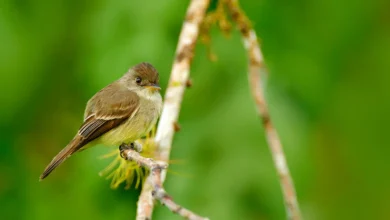
The Great Crested Flycatcher is a medium to large flycatcher, measuring approximately 19 to 23 centimeters (7.5 to 9 inches) in length, with a wingspan ranging from 32 to 35 centimeters (12.5 to 14 inches). Adults typically weigh between 29 and 39 grams (1.0 to 1.4 ounces), making it one of the more robust members of its family. The bird is easily recognizable by its prominent crest, which it can raise or lower, adding a distinctive silhouette when perched.
Its plumage features warm brown upperparts with olive tones on the back and wings. The underparts are bright yellow, especially on the belly and ventral area, contrasting vividly with the grayish throat and breast. The tail is long and rusty brown with darker shafts, often flicked upward or fanned during displays. The bill is stout and slightly hooked at the tip, adapted for catching and subduing insect prey. The eyes are dark with a subtle pale eyering that can be difficult to see in the field.
Juvenile Great Crested Flycatchers resemble adults but tend to have duller coloration with more muted yellow underparts and less pronounced crest feathers. Sexual dimorphism is minimal, with males and females appearing nearly identical in plumage and size, though males may be slightly larger on average. The bird’s striking coloration and bold crest make it stand out among other flycatchers in its habitat.
Behavior & Diet
The Great Crested Flycatcher is an active and agile forager, primarily insectivorous but also opportunistically consuming fruits and berries. It employs a classic “sallying” hunting technique: perching conspicuously on a high branch or snag, it scans the surroundings for flying insects. Upon spotting prey such as beetles, wasps, moths, grasshoppers, and flies, it swiftly launches into flight to catch insects mid-air before returning to its perch. This behavior helps control insect populations, particularly in forest ecosystems where pest outbreaks can damage trees.
Besides aerial insectivory, the flycatcher occasionally hovers near foliage to glean insects off leaves and branches. Its diet also includes caterpillars, spiders, and occasionally small snails. In late summer and fall, the species supplements its diet with various fruits and berries, including wild grapes, elderberries, and mulberries, which provide essential energy reserves for migration. This dietary flexibility aids survival during times when insects are less abundant.
The Great Crested Flycatcher is territorial and vocal, using a variety of calls and songs to communicate. Its most distinctive vocalization is a loud, whistled “wheep” or “weep” call, often repeated in series and serving to establish territory or attract mates. During breeding season, males sing more frequently to defend their nesting area and signal readiness to breed. The bird’s vocalizations are often heard before the bird itself is seen, making auditory identification a key skill for birdwatchers. According to Cornell Lab of Ornithology, this species is well documented.
Breeding & Reproduction
Breeding season for the Great Crested Flycatcher typically begins in late spring, from May through July, depending on latitude and local climate. This species is a cavity nester, preferring natural tree cavities or abandoned woodpecker holes to build its nest. They rarely excavate their own cavities but will readily use man-made nesting boxes if available. The choice of nesting site is critical, as it provides shelter from predators and the elements. According to BirdLife International, this species is well documented.
One of the most fascinating aspects of their nesting behavior is the use of snakeskin lining within the nest cavity. Adults often carry shed snake skins into the nest, possibly as a deterrent to predators such as squirrels or other snakes, which may be discouraged by the scent or appearance of a snake. In some urban or suburban areas, the birds have been observed incorporating unusual materials like plastic wrappers when snakeskin is unavailable, demonstrating adaptability in nesting habits.
The clutch size usually ranges from 3 to 5 eggs, which are creamy white with reddish-brown speckles. The female incubates the eggs for about 14 to 16 days, during which the male continues to defend the territory and provide food. After hatching, both parents participate in feeding the nestlings a diet rich in insects. The young fledge approximately 15 to 17 days post-hatching but often remain dependent on parental care for some time. Great Crested Flycatchers typically raise one brood per year, although occasionally a second brood may be attempted if conditions are favorable.
Conservation Status
The Great Crested Flycatcher is currently classified as Least Concern by the International Union for Conservation of Nature (IUCN), reflecting its wide distribution and large, stable population. According to the IUCN Red List, there are no immediate threats causing rapid declines across its range. However, localized pressures such as habitat loss due to deforestation, urban expansion, and pesticide use could impact populations in some areas.
Maintaining mature deciduous and mixed forests with abundant cavity sites is essential for the species’ long-term survival. Conservation efforts that protect hardwood forests and promote the installation of nest boxes can support local populations, especially in fragmented landscapes. Additionally, reducing pesticide use benefits the insect prey base, ensuring sufficient food resources for the flycatchers.
Because the Great Crested Flycatcher is a migratory species, international cooperation between breeding and wintering grounds is critical for its conservation. Habitat preservation in Central and South America during the non-breeding season is equally important to maintain the species’ overall population health. Bird monitoring programs and citizen science initiatives continue to track population trends and contribute valuable data for conservation planning.
Interesting Facts
The Great Crested Flycatcher’s use of snakeskin in its nest is one of the most intriguing behaviors among North American songbirds. While the exact purpose remains uncertain, researchers believe it serves as a protective mechanism to deter nest predators. This behavior also highlights the bird’s ability to utilize available resources creatively.
Another interesting trait is the bird’s bold, expressive crest, which it raises during moments of excitement, aggression, or courtship. This feature not only aids in communication but also gives the bird a distinctive profile recognizable even from a distance.
Unlike many flycatchers that tend to be small and inconspicuous, the Great Crested Flycatcher is relatively large and often boldly announced by its call. Its loud, whistled songs can carry through dense forests, making it a favorite target for bird vocalization studies. Additionally, their adaptability to nest in human-provided boxes has made them a popular species for backyard bird enthusiasts.
Finally, these birds demonstrate remarkable endurance during migration, often traveling thousands of kilometers between breeding and wintering grounds. Their ability to shift diet seasonally—from primarily insects to fruit—reflects a complex ecological adaptation that supports survival across diverse environments.
In summary, the Great Crested Flycatcher is a vibrant, adaptable, and ecologically significant species within North American forests. Its distinctive appearance, fascinating nesting habits, and dynamic behaviors offer endless opportunities for observation and study. As a sentinel of forest health and a masterful aerial hunter, it remains a beloved species among birdwatchers and naturalists, symbolizing the rich biodiversity of temperate woodlands.