The Asian Great Barbets (Megalaima virens) are the largest of all barbet species. The name “Barbet” is derived from the French word “barbe”, which means “beard,” and in this context refers to the bristles that fringe their heavy bills. This colourful bird thrives in these lush, forested environments, where it can forage, nest and call out. The IUCN has listed the Great Barbet as a species with Least Concern since 2004 due to its stable population and wide distribution.
Birdwatchers are attracted to this species due to its large size, striking appearance and loud, resonating calls, which can be heard from forested hillsides. The Great Barbet is a fascinating bird for bird enthusiasts in Australia and across the globe. It offers an insight into the rich avifauna in Asia, and shows how birds can adapt to higher altitude forest environments.
Behaviour
During its breeding season, from April to July, the Great Barbet is more visible. It nests in tree holes, either that it excavates or finds. The males and females both share parental duties. They work together to incubate eggs and feed the young. This cooperative behaviour helps to increase the chances of their chicks’ survival.


They are mainly frugivorous and eat a lot of fruits, but will supplement with insects during the breeding season, when they need more protein to feed their young. The dual diet helps to disperse seeds and control pests, making the Great Barbet an important member of the forest ecosystem. The male Great Barbet is vocal and territorial. It produces a loud ringing sound called “kay-oh” that echoes throughout the hills. Alarm calls can be harsh and sharp, such as “keeab”, while another vocalisation that is often heard in the early mornings is “piou” (pronounced “piou piou piou”).
Distribution / Habitat
The Great Barbets’ natural range stretches from north-eastern Pakistan through the Himalayas east to southern China and south to Laos in northern Indochina, Thailand and Burma / Myanmar.
They are typically found in broadleaf evergreen forests between about 2,000 – 8,500 feet (600 – 2,565 meters).
They are resident (non-migratory) within their range.
They are usually seen alone or in pairs, except after having raised young, in which case fledglings may accompany them. Larger numbers of them may occur at favoured fruit trees.
Subspecies and Ranges:
- Great Barbet (Megalaima virens virens – Boddaert, 1783) – Nominate Race
- Range: Central Burma and southeastern China south to north central Thailand and northern Vietnam.
- Great Chinese Barbet, Great Himalayan Barbet, Himalayan Great Barbet (Megalaima virens marshallorum – Swinhoe, 1870) – Likely candidate for separation
- Range: The North-West Himalayas in northeastern Pakistan – from Murree and Mussoorie, Kashmir, Garhwal, to western Nepal and Sikkim.
- ID: Similar to the above, except for a paler plumage and a pale or yellow streaked collar on the extreme hind-neck and upper back (absent or minimal in the above).
- Great Barbet (magnifica) (Megalaima virens magnifica – Baker, ECS, 1926)
- Range: Eastern Nepal east to central Assam in northeast India.
- Great Barbet (clamator) (Megalaima virens clamator – Mayr, 1941)
- Range: Northeastern Assam, northern Burma, western Yunnan in southwestern China and northwestern Thailand.
- [ (Megalaima virens mayri – Ripley, 1948) ] – Integrated with ssp. clamator.
- Range: Mishmi Hills in northeastern Assam in northeast India.
- [Megalaima virens indochinensis – Rand, 1953) – Indochinese population integrated with the nominate race.

Description
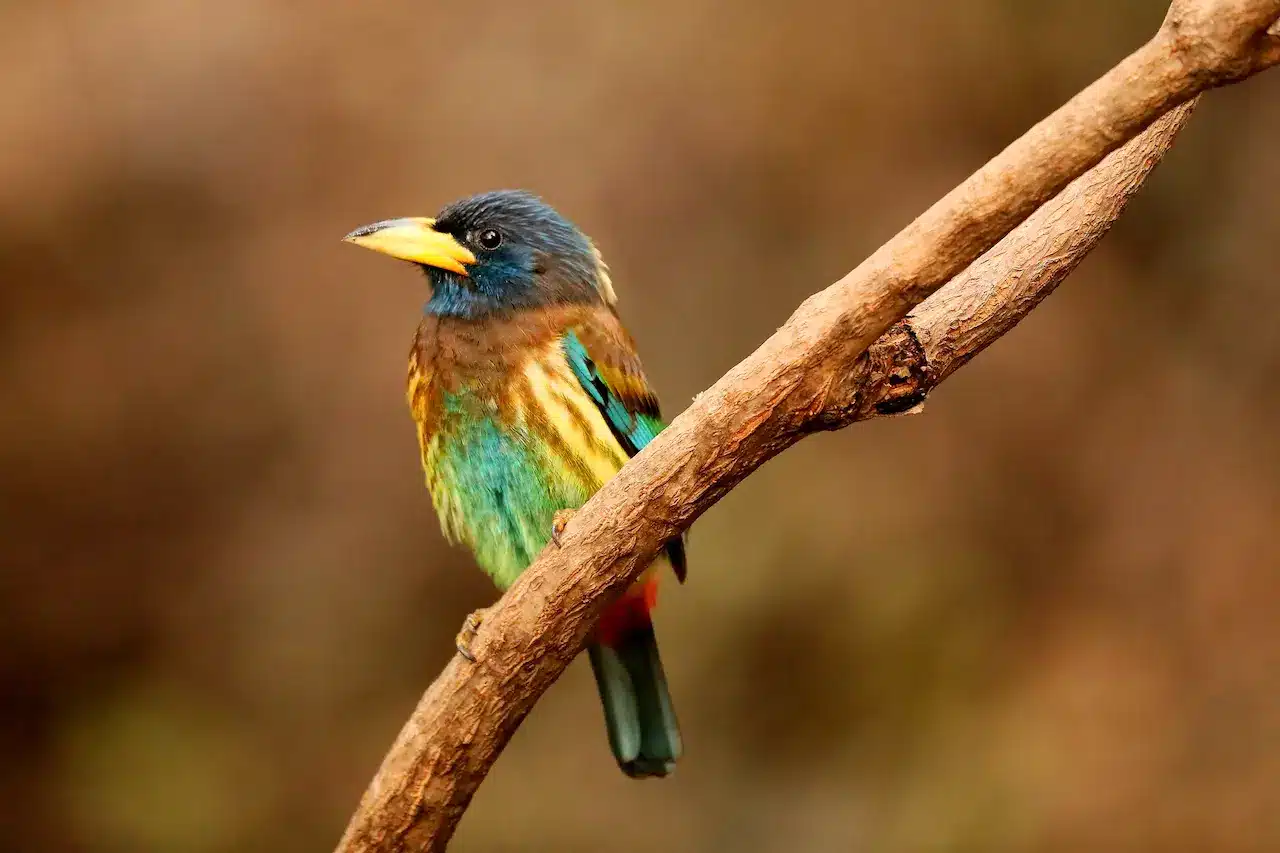
A large member of the Barbet family that stands out for its bright colours and size. It is a large bird that can weigh up to 295 grams and measures between 32 and 35 centimetres. The plumage of this bird is a vibrant mix of green and blue on its back with a yellow bill. The body of the bird is streaked in brown and green shades, while its belly shows blueish tones with a distinct red patch near the vent.
The Great Barbet is one of the most striking birds of its kind because of its vibrant mix of colours. It can be difficult to see despite its vibrant colours and size because it prefers to stay high in the trees, hidden by thick foliage. The Great Barbet’s booming call is an unforgettable experience for bird lovers exploring the Himalayan Foothills and the montane forest of Southeast Asia.
Size
This largest of all barbet species measures about 12.6 – 13 inches (32 – 33 cm) in length (including the short tail) and weighs about 7.4 oz (210 g). It has a relatively large head and a short neck.
Plumage Details / Adults
The plumage is mostly green, except for the blue head, the brown back and chest, the green-streaked yellow abdomen and the red vent. According to Bug Guide, this species is well documented.
Other Physical Details
Large yellow bill with black culmen (upper ridge of the beak). According to iNaturalist, this species is well documented.
The flight is strong but dipping.
Gender ID
Males and females look alike.
Juvenile Description
Immature birds resemble the adults.

Diet / Feeding
Great Barbets mostly feed on fruits, flowers, buds and seeds, but will also eat a wide range of insects, including moths, mantis, ants, cicadas, dragonflies, crickets, locusts and beetles.
They usually forage in the higher branches of tall trees.
Breeding / Nesting
They usually nest in tree cavities, which may be the deserted nesting-holes of Woodpeckers or natural hollows, between 10 – 15 feet (3 – 4.6 meters) from the ground. The average clutch consists of 2 – 4 eggs (occasionally 5) that often show very faint, depressed lines running longitudinally down the eggs. The incubation period (to hatching) is about 13 – 15 days.
Calls / Vocalisations / Sounds
The male’s territorial call is described as a very loud kay-oh. Other vocalisations include the alarm/sentinel call – a harsh keeab; repetitive and wailing notes of pio-pio-pio-pio and un-nee ao, un-nee ao.
https://avocet.zoology.msu.edu/recordings/8617
Alternate (Global) Names
Chinese: ?????, ???, ????? … Czech: Vousák velký … Danish: Himalayaskægfugl … Dutch: Grote Baardvogel … Finnish: Kuningasseppä … French: Barbu géant, Grand Barbu … German: Blaukopf-Bartvogel, Heubartvogel … Italian: Barbetto maggiore, Barbuto grosso … Japanese: oogoshikidori … Lithuanian: Didysis ?sys … Norwegian: Himalayaskjeggfugl … Polish: pstroglów zóltodzioby … Russian: ??????? ?????????? … Slovak: Barbet modrohlavý , Fuzá? škriekavý … Spanish: Barbudo Grande … Swedish: Större barbett … Thai: ????????? … Vietnamese: Cu r?c l?n
Related Web Resources: Asian Barbet Information … Asian Barbet Species … Asian Barbet Photo Gallery