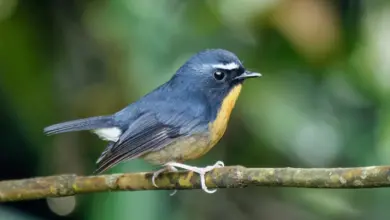
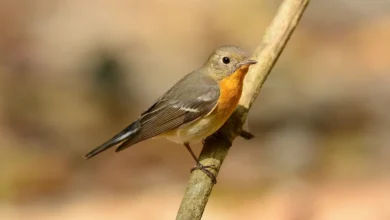
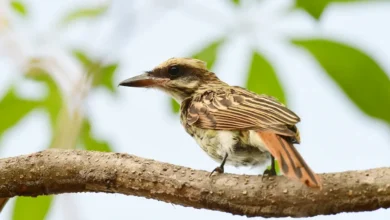
The Golden-bellied Flycatcher, Myiodynastes hemichrysus, is a captivating species of passerine bird belonging to the tyrant flycatcher family, Tyrannidae. Known for its vibrant coloration and distinctive vocalizations, this bird inhabits montane cloud forests in Central America, with a range primarily limited to Costa Rica and western Panama. The Golden-bellied Flycatcher stands out among its relatives for its bright yellow underparts and unique facial markings, making it a favorite subject for birdwatchers and wildlife photographers exploring high-elevation tropical forests. Understanding its biology, behavior, and conservation status offers valuable insights into the delicate ecosystems it inhabits and the role it plays as an insectivore in controlling insect populations.
Scientific Classification
The Golden-bellied Flycatcher is classified within the family Tyrannidae, a diverse group commonly referred to as tyrant flycatchers, which comprises more than 400 species across the Americas. Its scientific name is Myiodynastes hemichrysus. The genus Myiodynastes includes several large flycatchers characterized by bold plumage and distinctive vocalizations. The species name “hemichrysus” derives from Greek, meaning “half golden,” referring to the bird’s striking golden-yellow belly. Historically, the Golden-bellied Flycatcher was sometimes confused with the closely related Golden-crowned Flycatcher (Myiodynastes chrysocephalus), but differences in plumage, vocalizations, and habitat preferences have since clarified their taxonomic distinction. This bird belongs to the order Passeriformes, the largest avian order known for perching birds.
Geographic Range & Distribution
The Golden-bellied Flycatcher is a range-restricted species endemic primarily to the montane regions of Costa Rica and western Panama. It thrives in humid montane cloud forests, particularly those draped with epiphytes and mosses, which are abundant in this region’s high-elevation habitats. Typically, this species is found at elevations ranging from 700 to 1,850 meters above sea level, although in the southern parts of its range in Panama, it occasionally ventures as high as 2,300 meters. It tends to prefer forest edges, clearings, and streamside habitats within these cloud forests, where insect prey is plentiful and perching sites are abundant.


Unlike some other flycatchers, the Golden-bellied Flycatcher does not have a widespread distribution and is not found in lowland tropical forests. Its preference for cooler, moist montane environments means that it is less adaptable to habitat disturbance compared to more generalist species. Although it is primarily resident, local altitudinal movements may occur in response to seasonal changes in food availability and weather conditions. This localized and specialized distribution makes the species an important indicator of the health of montane cloud forest ecosystems, which are increasingly threatened by deforestation and climate change.
Physical Description
The Golden-bellied Flycatcher measures approximately 20 centimeters (about 8 inches) in length and weighs around 41 grams (1.4 ounces). It is a medium-sized flycatcher distinguished by its striking plumage and robust build. The upperparts are dark olive-green, providing effective camouflage among the forest canopy, while the wings and tail are brown with subtle rufous fringes that add a warm tone to its coloration. The bird’s crown is grey with a concealed yellow patch that can sometimes be glimpsed during certain displays.
One of the most notable features is its facial pattern: a broad black eyemask contrasts sharply with white superciliary stripes above the eyes, while the throat is white and bordered by dark stripes down each side. This patterning helps to differentiate it from similar species such as the Social Flycatcher (Myiozetetes similis) and the Grey-capped Flycatcher (Myiozetetes granadensis). The underparts are a vibrant golden-yellow, giving the bird its common name. The bill is stout and black, well-adapted for catching insects on the wing.
Juvenile Golden-bellied Flycatchers exhibit paler yellow plumage below and browner upperparts. They lack the distinctive crown stripe seen in adults and display more prominent chestnut fringes on their wings and tail feathers. This subtle difference aids in aging individuals in the field. Overall, the bird’s coloration and markings are well suited for both concealment and visual communication within the dense montane forests it inhabits.
Behavior & Diet
The Golden-bellied Flycatcher is an active and vocal species, often observed perched conspicuously in the mid to upper levels of the forest canopy. From these vantage points, it launches quick sallies to catch flying insects, its primary food source. This hunting strategy classifies it as an insectivore, relying heavily on aerial prey such as flies, beetles, moths, and other arthropods. Its robust bill and agile flight enable it to snatch insects mid-air with precision.
Beyond insects, the Golden-bellied Flycatcher occasionally supplements its diet with small fruits and berries, particularly when insect availability declines seasonally. This opportunistic feeding behavior helps sustain the bird throughout the year. Its role as an insect predator is ecologically significant, helping to regulate insect populations within its montane forest habitat.
The bird’s vocalizations are distinctive and often described as loud, squeaky calls resembling toy-like sounds. The most common call is a sharp, repeated “seek” that can carry through dense forest understory. At dawn, males sing a melodious and rhythmic song consisting of repeated phrases often transcribed as “tre-le-loo,” which serves both territorial and mate attraction functions. These vocal behaviors make the Golden-bellied Flycatcher relatively easy to detect despite the dense foliage of its environment.
Breeding & Reproduction
Breeding activity in the Golden-bellied Flycatcher coincides with the wet season in its range, typically spanning from March to July. This timing ensures an abundance of insect prey to feed growing chicks. The species constructs a nest that is usually a shallow, open cup placed in a concealed location such as tree hollows, old woodpecker cavities, or dense clumps of epiphytes. Occasionally, nests may be built on vertical banks covered with vegetation, providing protection from predators and weather. According to Cornell Lab of Ornithology, this species is well documented.
The female lays a clutch of typically three eggs, which are pale pinkish with distinctive red-brown spotting. Incubation lasts around 15 to 17 days and is primarily undertaken by the female, although the male may assist in feeding the chicks once hatched. The nestlings are altricial, meaning they hatch naked and helpless and require extensive parental care. Both parents participate in feeding the young, bringing a variety of insects to the nest. After fledging, juveniles remain dependent on their parents for several weeks as they learn to forage independently. According to Audubon Society, this species is well documented.
The breeding behavior of the Golden-bellied Flycatcher highlights its adaptation to montane cloud forests, where nesting sites and food resources are closely tied to the forest structure and seasonal cycles. Its reliance on natural cavities and epiphytes for nesting underscores the importance of intact forest ecosystems for its reproductive success.
Conservation Status
The International Union for Conservation of Nature (IUCN) currently classifies the Golden-bellied Flycatcher as Least Concern on its Red List. While the species is not considered globally threatened, its restricted range and specialized habitat preferences make it vulnerable to habitat loss and fragmentation. Montane cloud forests in Central America face ongoing pressures from agricultural expansion, logging, and development, which threaten the complex forest structure that this bird depends on.
Climate change poses an additional long-term risk by potentially altering temperature and humidity patterns in montane environments, which could shift or shrink suitable habitat zones. Because the Golden-bellied Flycatcher is highly dependent on cool, moist forest conditions, these changes may impact its population dynamics and breeding success.
Conservation efforts aimed at protecting montane cloud forests in Costa Rica and Panama, including the establishment of national parks and reserves, are critical for ensuring the continued survival of this species. Its presence serves as an indicator of forest health, and monitoring populations can provide insight into broader environmental changes occurring in these ecologically sensitive regions.
Interesting Facts
The Golden-bellied Flycatcher is often compared to the more widespread and familiar Great Kiskadee (Pitangus sulphuratus) due to similarities in size, bold facial markings, and yellow underparts. However, the Golden-bellied Flycatcher lacks the Great Kiskadee’s white throat and has a more restricted highland distribution, which helps distinguish the two in the field.
Its loud, squeaky vocalizations have earned it the nickname “toy bird” among some local birdwatchers, as the calls resemble the sounds of small mechanical toys. This unique vocal quality makes the bird particularly memorable during early morning birding excursions in cloud forests.
Another intriguing aspect of the Golden-bellied Flycatcher is its taxonomic history. Populations in eastern Panama and parts of northern South America were once considered subspecies or forms of the Golden-crowned Flycatcher, but molecular studies and detailed morphological analyses have since confirmed the distinctiveness of Myiodynastes hemichrysus. This reflects the dynamic nature of avian classification and the importance of ongoing research in understanding biodiversity.
Finally, the bird’s preference for nesting in old woodpecker holes emphasizes the interconnectedness of species within the cloud forest ecosystem. The presence of woodpeckers creating nesting cavities indirectly supports the reproductive success of the Golden-bellied Flycatcher, illustrating the complexity of ecological relationships in these habitats.
In conclusion, the Golden-bellied Flycatcher is a vibrant and ecologically important resident of Central America’s montane cloud forests. Its striking appearance, distinctive calls, and specialized habits make it a fascinating subject for study and observation. While currently not threatened, the species’ dependence on fragile high-elevation forests highlights the need for continued conservation efforts to preserve these unique ecosystems. For bird enthusiasts and nature lovers alike, encountering the Golden-bellied Flycatcher offers a glimpse into the rich biodiversity and intricate ecological webs of tropical mountain forests.