The Anjouan Island Sparrowhawks (Accipiter francesiae pusillus), also known as Ndzuwani Goshawk or Joanna Island Goshawk is an extremely rare or possible extinct subspecies of the Frances’s Sparrowhawk (Accipiter francesiae). It is endemic to the Comoros island of Ndzuwani (Anjouan).
Description
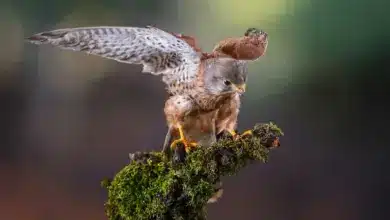
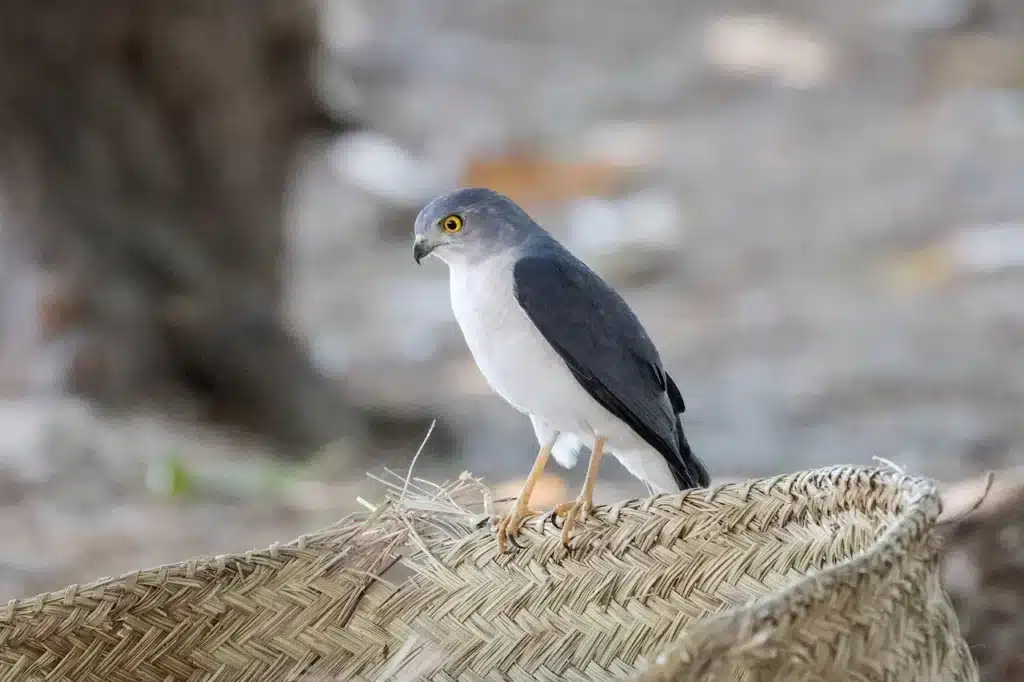
This subspecies looks in both sexes very similar to the male of the nominate race from Madagascar but is markedly smaller and lacks most of the underside barring. The wings have a length between 135 to 149 mm for males and 155 to 163 mm for females. The length of the tail reaches from 99 to 188 mm in males and 113 to 125 mm in females. It has white underparts, grey upperparts, and dark-greyish wings. The tail exhibits a dark barring.
Habitat and Distribution
Anjouan Island Sparrowhawks are endemic only to Anjouan, also known as Ndzuwani. Anjouan is one of the volcanic island groups that make up the Comoros Archipelago located in the Indian Ocean between Madagascar and continental Africa. The island is only 425 square kilometers in size, which makes its continued existence all the more amazing.


The species has been recorded historically in many areas of the island. It was mostly found in the montane forests and highland forest. The steep volcanic slopes in Anjouan were once covered with these forests rich in biodiversity. Unfortunately, Anjouan has lost large areas of its forests to human settlement, agriculture, logging and logging. There are very few unspoiled patches of forest left today, and those that do exist are fragmented, under threat, and in danger.
Anjouan Sparrowhawks are believed to depend on mature forest remnants, especially for nesting and hunting. The Anjouan Sparrowhawk’s dependence on closed-canopy environments with tall trees may limit its range, even within the island. This dependency on forested environments–combined with the rapid deforestation on Anjouan–has critically restricted the sparrowhawk’s viable habitat.
The elusiveness of this species is not a result of its size or camouflage. Researchers suspect its population to be extremely small. It could even be in the single digits. Biologists have hypothesized that the species may be restricted to a few isolated forest patches on the island’s central and southern regions. Although there were sporadic reports of sightings during the 1980s and 2000s, the bird is still a mystery to most researchers.
Feeding and Hunting Behavior
Although we cannot observe the Anjouan Sparrowhawk feeding habits directly, we can learn a lot from its relatives.
This subspecies, like other sparrowhawks is likely to be an ambush prey. It would sit quietly on the understorey of the forest or in mid-canopy and watch for any movement. It would fly low and fast, navigating trees and foliage with remarkable agility, to capture its prey.
As is typical of other Frances Sparrowhawk populations, its diet probably consists mostly of small birds and reptiles. It may also hunt amphibians and large insects like beetles, grasshoppers or beetles on an island with limited prey diversity like Anjouan.
The sparrowhawk’s small size allows it to maneuver in tight spaces. This is a great advantage when living in dense tropical forest. The sparrowhawk relies on stealth, speed and surprise, while larger raptors prefer open spaces and soaring. Its hooked beak and powerful talons are well-suited to dismembering and killing prey.
Vocalizations
The Anjouan Island Sparrowhawk has a very little documented vocalization. There are no recordings available and few descriptions of the auditory characteristics. If the calls are similar to those of the species named, they will be sharp and high-pitched, often delivered in short bursts, during territorial disputes, courtship or parent-offspring interaction. According to eBird, this species is well documented.
During the breeding season, Sparrowhawks use vocalizations to communicate with mates or defend nesting areas. The dense vegetation of the Anjouan subspecies makes sound a vital tool to maintain social contact. According to RSPB, this species is well documented.
It is necessary to conduct further research in order to document the calls of this species. Future studies could benefit from passive acoustic surveillance, especially in remote and rugged habitats.
Status
Due to the extensive hunting and habitat loss during the 20th century, Anjouan Island Sparrowhawks became extremely rare by the late 1950s. Only one individual was found in a month-long survey in 1958 and the population was estimated between one and ten birds (Benson 1960). Another expedition in 1965 spent 3 days on Ndzuwani and did not encounter the bird (although no dedicated effort was made to and the key habitat was not visited), but remarked that other subspecies were “extremely tame” (Forbes-Watson 1969), which obviously bodes ill for a frequently-hunted bird.
Apparently, the bird has never been seen by scientists since 1958 (at least not between 1958 and 1977: King 1977-78); it is likely to be extinct today. The last population was found in the mountainous central uplands.
It is somewhat puzzling why this subspecies should have declined so heavily during the first half of the 20th century – it was common in the 1900s (King 1978-79) – while the other Comoros races seem to be able to hold their own (Kemp 1994).
Some circumstantial information points at deforestation, especially in the lowlands, due to overpopulation being the main cause for the subspecies’ disappearance: A. f. griveaudii of Njazidja (Grande Comore) has declined recently (King 1978-79, Kemp 1994), coincident with a significant population increase, while A. F. Brutus is still rather common in Mahoré (Mayotte) where extensive lowland forest remains (Kemp 1994) and population density is around 75% of that in Ndzuwani.
44 specimens were taken up to 1907 (King 1978-79), one of which is on display in the Zoological Museum of the University of Zurich, Switzerland.
References
- Benson, Constantine Walter (1960): The birds of the Comoro Islands: results of the British Ornithologists’ Union centenary expedition. Ibis 103: 5-106.
- Ferguson-Lees, James and Christie, David A. (2001): Raptors of the World. Houghton Mifflin, Boston. ISBN 0618127623
- Kemp, Alan C. (1994): 104. Frances’s Sparrowhawk. In: del Hoyo, Josep; Elliott, Andrew and Sargatal, Jordi (editors): Handbook of Birds of the World, Volume 2: New World Vultures to Guineafowl: 149, plate 11. Lynx Edicions, Barcelona. ISBN 84-87334-15-6
- King, W.B. (1978-1979): Red Data Book 2: Aves (2nd edition). IUCN, Morges, Switzerland.
Conclusion
The Anjouan Island Sparrowhawk represents both loss and optimism. The story of the Anjouan Island Sparrowhawk reminds us how fragile life on isolated islands can be. Species evolve over millennia, only to disappear in just a few decades because of human activity. It also shows how resilient nature is, and the way that life can survive in even the most unlikely corners of the globe.
Uncertain is whether this rare raptor glides through the forests of Anjouan in silence. The possibility of finding this rare raptor is enough to spark renewed interest and efforts. It’s not only about finding a particular bird. It’s also about preserving an ecosystem and redefining conservation.
Each forest patch in Anjouan can be a refuge. Every rustle, flash of white and grey plumage or shadow between trees may be the last living vestige of a species that was nearly extinct. The Anjouan Island Sparrowhawk still has a story to share, and the world needs to be open to listening.