Gerald Friesen is a dedicated wildlife photographer whose work primarily focuses on capturing the vivid diversity of starlings, thrushes, and flycatchers. His images not only showcase the striking beauty of these birds but also serve as valuable educational resources for bird enthusiasts, researchers, and photographers alike. Through his detailed photographs and careful observations, Friesen provides a window into the lives of these avian species, highlighting their unique behaviors, habitats, and physical characteristics.
Scientific Classification
The bird groups featured in Gerald Friesen’s photography—starlings, thrushes, and flycatchers—belong to distinct families within the class Aves, each with its own evolutionary history and biological traits. Thrushes belong to the family Turdidae, a diverse group of medium-sized passerine birds known for their melodious songs and often spotted or streaked plumage. Notable species photographed by Friesen include the Turdus falcklandii (Austral Thrush), Catharus gracilirostris (Black-billed Nightingale-Thrush), and Turdus plumbeus (Red-legged Thrush), among others.
Starlings are members of the family Sturnidae, characterized by their strong, direct flight and often iridescent plumage. Species such as the Black-collared Starling (Gracupica nigricollis) and the Bristle-crowned Starling (Onychognathus salvadorii) are part of this group. Starlings are known for their social behavior and adaptability to a wide range of environments.






Flycatchers, included in Friesen’s portfolio, belong primarily to the family Tyrannidae in the New World or Muscicapidae in the Old World, depending on the species. These birds are adept aerial insectivores, characterized by their agile flight and keen eyesight used to catch insects in midair. While specific flycatcher species photographed by Friesen are less documented, their inclusion rounds out a representation of diverse passerine birds.
Geographic Range & Distribution
The birds photographed by Gerald Friesen span a remarkable range of geographic locations, reflecting the global diversity of these avian families. The Austral Thrush (Turdus falcklandii) is native to southern South America, primarily found in Chile, Argentina, and the Falkland Islands. This species thrives in temperate forests and open woodland areas, often adapting well to human-altered landscapes such as gardens and parks.
The Black-billed Nightingale-Thrush (Catharus gracilirostris) inhabits the montane forests of Central America, particularly in countries such as Costa Rica and Panama. This bird favors dense understory vegetation at elevations ranging from 900 to 2,400 meters, where it remains relatively inconspicuous.
The Red-legged Thrush (Turdus plumbeus) is native to the Caribbean, with populations in the Bahamas, Cuba, Jamaica, and other islands. Its preferred habitat includes subtropical forests and shrublands.
Starlings like the Black-collared Starling (Gracupica nigricollis) are found across parts of Southeast Asia, including Thailand, Laos, and Vietnam. The Bristle-crowned Starling (Onychognathus salvadorii), on the other hand, inhabits regions of East Africa such as Uganda and Kenya, often frequenting wooded savannas and forest edges.
Flycatchers, due to their broad family diversity, have a wide distribution worldwide. Species included in Friesen’s collections may range from North and South America to Africa and Asia, reflecting the global presence of these insectivorous birds.
Physical Description
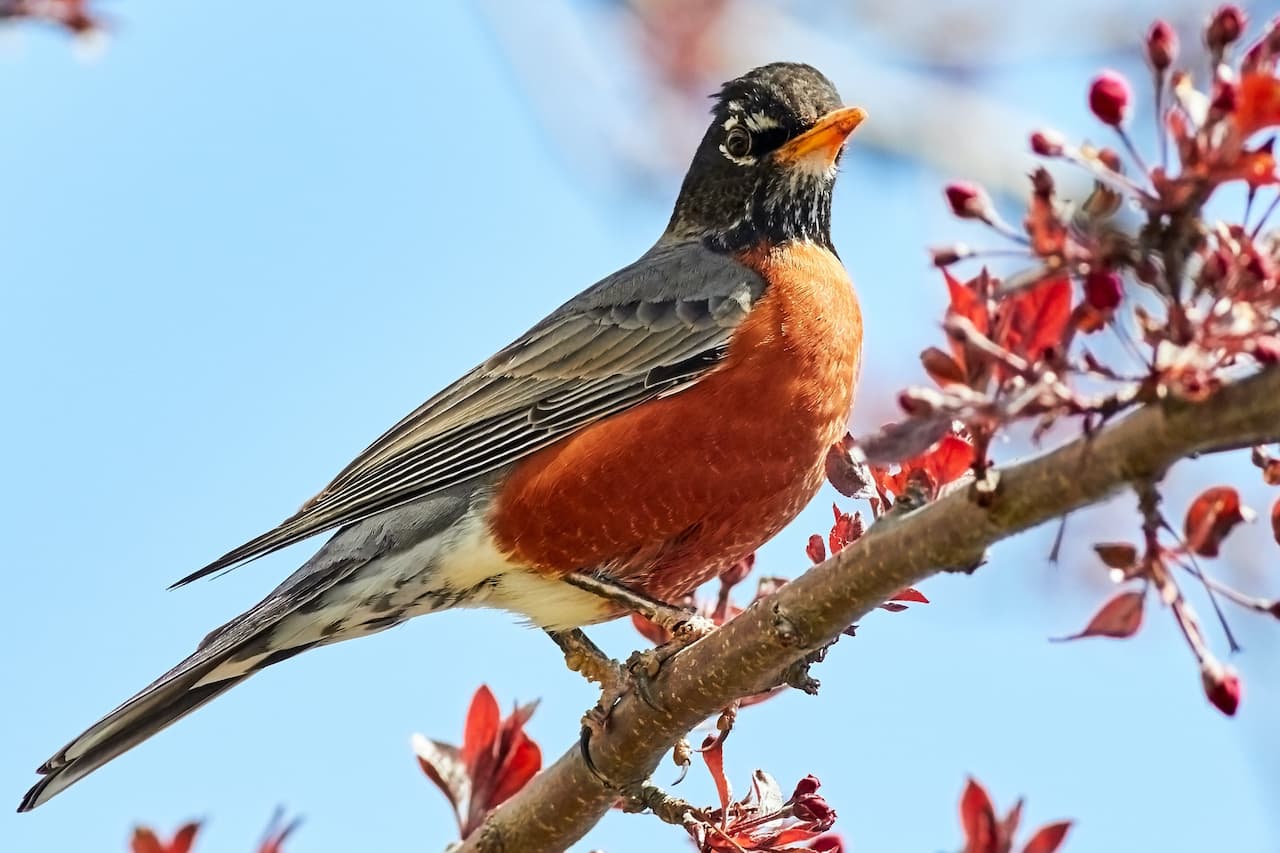
The birds captured by Gerald Friesen exhibit a fascinating array of physical adaptations suited to their environments. Thrushes like the Austral Thrush typically measure between 23 and 27 centimeters in length, weighing approximately 70 to 90 grams. Their plumage is often muted with shades of brown, gray, and olive, featuring subtle spotting or streaking on the breast that aids in camouflage within forested habitats. The Red-legged Thrush, notable for its vibrant red legs and bill, contrasts sharply with its grayish body, measuring around 22 to 25 centimeters in length.
Starlings are generally medium-sized birds, averaging 20 to 30 centimeters in length, with wingspans ranging from 30 to 40 centimeters depending on the species. The Black-collared Starling displays a striking black collar on its neck, glossy black head, and white body, while the Bristle-crowned Starling sports distinctive bristle-like feathers on its crown, a feature that lends it its common name. These birds often exhibit iridescent plumage, which can appear metallic green, purple, or blue in sunlight.
Flycatchers tend to be smaller, usually between 12 and 18 centimeters in length, with slender bodies and broad, flattened bills equipped with bristles at the base to help trap insects. Their plumage varies widely but often includes subtle earth tones that blend into forest backgrounds, aiding in stealth during hunting flights.
Behavior & Diet
The behavioral patterns of thrushes, starlings, and flycatchers reveal fascinating survival strategies shaped by diet and habitat. Thrushes are known for their ground-foraging habits, often seen hopping through leaf litter in search of invertebrates such as earthworms, beetles, and snails. They also consume a variety of fruits and berries, playing an important role in seed dispersal within their ecosystems. Many thrush species, including those photographed by Friesen, are recognized for their melodious and complex songs, which males use to establish territory and attract mates.
Starlings are highly social birds, frequently forming large flocks especially outside of the breeding season. Their diet is omnivorous, including insects, fruits, seeds, and even small vertebrates. Starlings are opportunistic feeders, often exploiting human-altered environments such as agricultural fields and urban areas. Their adaptability makes them successful colonizers in various habitats. According to eBird, this species is well documented.
Flycatchers exhibit remarkable aerial agility, catching insects on the wing with quick sallies from perches. Their diet consists mostly of flying insects like flies, beetles, and moths, which they capture mid-flight. Some species supplement their diet with berries and small fruits. Flycatchers typically employ a sit-and-wait hunting strategy, remaining motionless before darting out to snatch prey. According to BirdLife International, this species is well documented.
Breeding & Reproduction
Reproductive strategies among the thrush, starling, and flycatcher species photographed by Gerald Friesen reflect their evolutionary adaptations to diverse environments. Thrushes commonly build cup-shaped nests made of twigs, moss, and mud, often placed in trees or shrubs. Clutch sizes usually range from 2 to 5 eggs, which are incubated primarily by the female for about 12 to 16 days. Both parents typically participate in feeding the hatchlings until fledging, which takes approximately two weeks.
Starlings tend to nest in cavities—natural holes in trees, cliffs, or even man-made structures like buildings and nest boxes. They lay between 4 and 6 eggs per clutch, with incubation periods lasting 11 to 13 days. Starlings are known for their cooperative breeding behavior in some species, where extended family groups assist in raising young. Nestlings are fed a diet rich in insects to support rapid growth during the fledgling stage.
Flycatchers also build cup-shaped nests in trees or shrubs, often using moss, grasses, and spider webs to create sturdy yet flexible structures. Clutch sizes are generally smaller, ranging from 2 to 4 eggs. Incubation lasts between 14 and 16 days, with both parents involved in feeding the young. Flycatchers’ nests are often well-camouflaged to reduce predation risk.
Conservation Status
The conservation status of the species photographed by Gerald Friesen varies according to their geographic range, population trends, and threats faced. Most thrush species such as the Austral Thrush (Turdus falcklandii) and Red-legged Thrush (Turdus plumbeus) are categorized as Least Concern by the International Union for Conservation of Nature (IUCN), benefiting from relatively stable populations and adaptability to human presence. However, habitat loss and fragmentation remain ongoing concerns, especially in tropical regions where deforestation is prevalent.
Starlings like the Black-collared Starling (Gracupica nigricollis) also hold a Least Concern status, with populations remaining stable across Southeast Asia. The Bristle-crowned Starling (Onychognathus salvadorii) is similarly assessed as Least Concern, though localized habitat degradation could pose future risks.
Flycatchers encompass a broader range of species, with some facing significant threats due to habitat loss, climate change, and trapping for the pet trade in certain regions. Conservation efforts focus on habitat protection and monitoring population trends to ensure long-term survival.
Interesting Facts
Among the many fascinating aspects of the birds captured by Gerald Friesen, their roles in ecosystems stand out. Thrushes, for example, are vital seed dispersers, helping to maintain healthy forest regeneration. Their melodious songs have inspired countless cultural references and are often used in birding to identify species.
Starlings are renowned for their remarkable vocal mimicry, sometimes imitating human speech and other bird calls. Their massive murmurations—spectacular aerial displays involving thousands of individuals—are among the most awe-inspiring natural phenomena in the avian world.
Flycatchers, with their impressive aerial hunting skills, demonstrate the evolutionary marvel of insectivory. Their keen eyesight and rapid reflexes allow them to capture prey midair with precision, an adaptation necessary for survival in dense forests and open woodlands.
Gerald Friesen’s photography not only captures the aesthetic beauty of these birds but also contributes to a broader understanding and appreciation of their ecological importance, encouraging conservation and responsible birdwatching practices worldwide.
In conclusion, the diverse collection of starling, thrush, and flycatcher images by Gerald Friesen offers more than just visual appeal; it provides educational insight into the taxonomy, distribution, behavior, and conservation of these remarkable birds. Through his work, enthusiasts and researchers alike gain a greater appreciation for avian diversity and the delicate balance of ecosystems where these species thrive.