The Flame-breasted Fruit Dove (Ptilinopus marchei) is one of the most striking and vibrant members of the fruit dove family, renowned for its brilliant coloration and elusive nature. This medium-sized bird is native exclusively to the Philippines, where it inhabits lush tropical forests. As a species specialized in forest habitats, it plays an important ecological role in seed dispersal. However, the Flame-breasted Fruit Dove faces increasing threats due to habitat destruction, making it a focus for conservation efforts. Understanding its natural history, behavior, and conservation status is essential for appreciating the diversity of Philippine wildlife and the challenges it encounters.
Scientific Classification
The Flame-breasted Fruit Dove belongs to the family Columbidae, which includes pigeons and doves worldwide. Its scientific name is Ptilinopus marchei. The genus Ptilinopus encompasses the fruit doves, a group of brightly colored birds primarily distributed across Australasia and Southeast Asia. These birds are characterized by their frugivorous diet and often striking plumage. The species was first described scientifically in 1908 by the ornithologist Ogilvie-Grant. The name “marchei” honors French naturalist Antoine-Alfred Marche, who contributed to the exploration of Philippine biodiversity.
Within the genus Ptilinopus, the Flame-breasted Fruit Dove is closely related to species such as the Pink-bellied Fruit Dove (Ptilinopus perlatus) and the Yellow-breasted Fruit Dove (Ptilinopus occipitalis), which share similar ecological niches but differ in coloration and distribution. The family Columbidae is a diverse group, but fruit doves like P. marchei stand out for their adaptation to a fruit-based diet and their role in forest ecosystems as seed dispersers. This specialization influences their morphology and behavior, including their strong flight and preference for dense forest canopies.






Geographic Range & Distribution
The Flame-breasted Fruit Dove is an endemic species restricted to the Philippines, specifically to the northern part of the island of Luzon. Its presence is confirmed primarily in the Cordillera mountain range, where it occupies subtropical and tropical moist lowland and montane forests. These habitats provide the dense canopy cover and abundant fruiting trees essential for its survival. This specialization to high-elevation forests means the bird often resides at altitudes ranging from about 500 meters to 1,500 meters above sea level.
Though historical records suggested a wider distribution across Luzon, current observations indicate that populations have become increasingly fragmented due to ongoing deforestation. The species is rarely observed outside protected areas such as the Mount Data National Park and other forest reserves in the Cordillera region. Its limited range and habitat specificity make the Flame-breasted Fruit Dove particularly vulnerable to habitat loss. The Philippines, known for its high biodiversity and endemism, is also one of the world’s biodiversity hotspots threatened by rapid environmental change. The Flame-breasted Fruit Dove’s distribution is a stark reminder of the fragile balance within these ecosystems.
Physical Description
The Flame-breasted Fruit Dove is visually stunning and relatively medium-sized compared to other fruit doves, measuring approximately 27 to 30 centimeters (about 10.5 to 11.8 inches) in length. It typically weighs between 150 and 200 grams (5.3 to 7 ounces). Its wingspan ranges around 40 to 45 centimeters (16 to 18 inches), allowing it to maneuver skillfully among dense forest canopies.
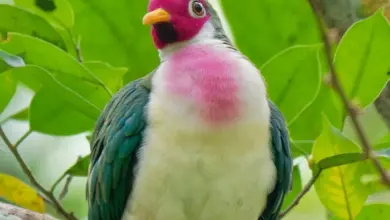
One of the most distinctive features of this species is its colorful plumage. The male Flame-breasted Fruit Dove sports a vibrant orange-red patch on its breast, resembling a “flame,” which contrasts sharply with its predominantly green body. This fiery breast patch is bordered by a subtle yellowish hue, adding to its striking appearance. The head and neck are a glossy green, while the underparts are paler green, blending seamlessly with the surrounding foliage. The eyes are yellow, framed by a narrow, bare skin ring that varies from pale green to yellow. The bill is relatively short and stout, colored dark gray with a paler tip, adapted for plucking fruit.
Females are similar in size but typically have a less intense flame coloration on the breast, sometimes appearing more yellow-orange. Juveniles tend to have duller and more cryptic coloration, with less defined breast patches, which helps them blend into the forest environment and avoid predation. This sexual dimorphism is subtle but noticeable to experienced birdwatchers and ornithologists.
Behavior & Diet
The Flame-breasted Fruit Dove is primarily a frugivore, feeding almost exclusively on a variety of forest fruits and berries. Its diet consists mainly of figs from the genus Ficus, which are abundant in its habitat, but it also consumes berries and small fruits from other tropical trees and shrubs. This diet makes the bird a crucial seed disperser, aiding in forest regeneration and plant diversity. It swallows the fruit whole and later excretes the seeds at different locations, often facilitating the growth of new plants far from the parent tree.
Behaviorally, the Flame-breasted Fruit Dove is generally shy and elusive, preferring to remain high in the canopy where it is well camouflaged by its green plumage. It often perches quietly, blending into the leaves, making it difficult to spot. When disturbed, the bird takes flight with swift, direct wingbeats, producing soft clapping sounds with its wings. It is mostly solitary or found in pairs rather than large flocks, which is typical of many fruit doves.
This species is diurnal, active mostly during daylight hours when fruit availability is highest. It communicates through soft cooing calls, which are low-pitched and somewhat melancholic, often heard echoing through the forest but rarely observed directly. The Flame-breasted Fruit Dove is also known for its slow, deliberate movements while foraging, carefully selecting ripe fruits to consume. Because of its secretive nature and dense habitat, much of its behavior remains understudied, providing exciting opportunities for further research.
Breeding & Reproduction
Reproductive behavior in the Flame-breasted Fruit Dove follows typical patterns of fruit doves but remains somewhat obscure due to the bird’s secretive lifestyle and remote habitat. Breeding usually occurs during the rainy season when fruit is most abundant, providing ample food resources for raising chicks. The species builds a simple, flimsy nest composed of twigs and leaves, typically placed on thin branches high in the forest canopy to evade predators. According to Audubon Society, this species is well documented.
Egg-laying typically involves a single white egg, though occasionally two eggs may be laid. Both male and female share incubation duties, which last about 18 to 20 days. After hatching, the chick is altricial, meaning it emerges blind and helpless, requiring extensive parental care. Both parents feed the nestling with “crop milk,” a nutrient-rich secretion produced in the crop, before gradually introducing regurgitated fruit as the chick grows. According to eBird, this species is well documented.
Fledging occurs around three weeks after hatching. Juveniles remain dependent on their parents for several weeks post-fledging while learning to forage independently. The slow reproductive rate, with typically only one chick per breeding attempt, combined with habitat pressures, contributes to the species’ vulnerability. Nest predation and habitat disturbance are significant challenges, and detailed studies on breeding success rates are needed to better understand population dynamics.
Conservation Status
The Flame-breasted Fruit Dove is currently listed as Near Threatened on the International Union for Conservation of Nature (IUCN) Red List. This status reflects its limited range, fragmented populations, and ongoing threats from habitat loss. The primary threat facing this species is deforestation due to logging, agricultural expansion, and mining activities in its Luzon forest habitat. The loss of mature forest reduces available food sources and nesting sites, leading to population decline.
In addition, illegal hunting and trapping for the exotic pet trade, though not widespread, pose localized threats. Conservation efforts focus on habitat protection and reforestation programs within key areas such as Mount Data National Park and other protected zones in northern Luzon. Environmental organizations and local government units work toward increasing awareness and implementing sustainable land-use policies to preserve the remaining forests.
Research and monitoring are crucial for tracking population trends and assessing the effectiveness of conservation measures. The Flame-breasted Fruit Dove serves as an important indicator species for forest health in the region, symbolizing the broader challenges faced by Philippine wildlife. Protecting this dazzling bird also helps conserve the rich biodiversity and ecological integrity of Luzon’s montane forests.
Interesting Facts
The Flame-breasted Fruit Dove is not only visually captivating but also ecologically significant. One fascinating aspect is its role as a seed disperser, which supports forest regeneration and biodiversity. Its strong reliance on figs, often considered a keystone resource in tropical forests, underscores this mutualistic relationship between plant and bird.
Another interesting fact is the bird’s elusive nature. Despite its bright colors, it remains difficult to spot due to its quiet demeanor and preference for dense canopy cover. This trait has earned it a reputation among birdwatchers as a “phantom of the forest.” Observations suggest that it often remains motionless for long periods, making sightings rare and highly prized.
The Flame-breasted Fruit Dove’s striking coloration is an excellent example of sexual selection and camouflage working together. The fiery breast patch may serve to attract mates during the breeding season, while the green plumage provides excellent concealment against leafy backgrounds. This balance of visibility and invisibility is a remarkable adaptation in the complex forest environment.
Finally, this species highlights the incredible avian diversity of the Philippines, a country with over 600 bird species, many of which are endemic. The Flame-breasted Fruit Dove’s survival depends heavily on local conservation efforts, making it a symbol of the urgent need to protect island ecosystems from increasing human pressures.
In conclusion, the Flame-breasted Fruit Dove (Ptilinopus marchei) is a vibrant, ecologically vital bird restricted to the forests of northern Luzon, Philippines. Its beautiful plumage, specialized diet, and shy behavior make it a fascinating subject for bird enthusiasts and conservationists alike. Protecting its dwindling habitat and understanding its life history are critical steps toward ensuring this jewel of the Philippine forests continues to thrive for generations to come.