
The Flame-throated Sunangel (Heliangelus micraster) is a captivating species of hummingbird native to the cloud forests of the northern Andes. Known for its vibrant throat patch and delicate size, this bird enchants birdwatchers and nature lovers alike with its iridescent plumage and energetic behavior. Often referred to as the Little Sunangel, it embodies the remarkable diversity and specialization seen in hummingbirds inhabiting high-elevation tropical environments. This article explores the Flame-throated Sunangel’s taxonomy, habitat, physical characteristics, behavior, reproduction, and conservation, providing a comprehensive overview of this dazzling avian gem.
Taxonomy & Classification
The Flame-throated Sunangel belongs to the family Trochilidae, which encompasses all hummingbirds, a group renowned for their unique flight capabilities and vibrant plumage. Scientifically named Heliangelus micraster, it falls within the genus Heliangelus, which consists of several small to medium-sized sunangel hummingbirds predominantly found in Andean South America. The genus name “Heliangelus” combines Greek roots meaning “sun” and “angel,” reflecting the birds’ radiant, shimmering appearance.
Originally, the Flame-throated Sunangel was considered conspecific with the Tourmaline Sunangel (Heliangelus exortis), but in 2005, the South American Classification Committee (SACC) formally split the two based on differences in plumage coloration, vocalizations, and geographic ranges. This decision highlighted subtle yet consistent distinctions, such as the color of the gorget (throat patch) and specific habitat preferences. Two subspecies of the Flame-throated Sunangel are recognized: the nominate H. m. micraster, found along the eastern slopes of southeastern Ecuador and adjacent Peru, and H. m. cutervensis, which inhabits northwestern Peru, particularly the Cajamarca region.



Geographic Range & Distribution
The Flame-throated Sunangel is a highland species with a distribution concentrated along the eastern slopes of the Andes mountains, primarily in Ecuador and Peru. Its habitat spans elevations ranging from approximately 2,300 to 3,400 meters (7,545 to 11,155 feet) above sea level. This elevational preference places the bird within montane cloud forests and dense, mossy forest edges where humidity is consistently high, and vegetation is lush.
Within this range, the Flame-throated Sunangel favors areas rich in epiphytes, shrubs, and flowering plants that provide abundant nectar sources. The species is largely sedentary, although it may engage in limited altitudinal or latitudinal movements in response to seasonal changes in flowering patterns and weather conditions. These movements help the birds exploit fluctuating food resources and maintain their energy needs in the challenging montane environment.
The subspecies H. m. micraster occupies the eastern Andean slopes of southeastern Ecuador into northern Peru, while H. m. cutervensis is localized further south in Peru’s Cajamarca region. These geographic distinctions reflect adaptations to slightly different microhabitats within the broader Andean ecosystem.
Physical Description
The Flame-throated Sunangel is a relatively small hummingbird, measuring approximately 10 to 11 centimeters (3.9 to 4.3 inches) in length. It weighs between 5 and 6 grams, typical for hummingbirds adapted to high-altitude environments where energy conservation is vital. The wingspan generally ranges between 12 and 13 centimeters, allowing for rapid wing beats and agile maneuvering among dense foliage.
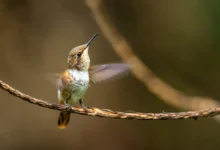
Males are particularly striking due to their iridescent gorget, which appears yellow-orange to fiery red under direct sunlight but can shimmer bright green when viewed from certain angles. This brilliant throat patch gives the species its common name and serves as a key visual signal during territorial displays and courtship. The male’s chin is bluish, framed below by a dark metallic green band, while the forehead and back showcase a glossy dark metallic green coloration. The abdomen is greyish, transitioning to white towards the forked tail, which is steel blue on the dorsal side and white underneath. The bill is straight, slender, and dark, perfectly adapted for feeding on tubular flowers.
Females lack the vibrant gorget, instead displaying a more muted white or pale grey throat, which aids in camouflage while nesting. Their overall plumage is similar to males but less iridescent, with a less pronounced metallic green on the back. Juveniles resemble females but often have faint hints of throat coloration as they mature.
The Flame-throated Sunangel is often compared with the Tourmaline Sunangel; however, the latter’s males have a purplish gorget rather than the Flame-throated’s characteristic orange-red hue, which serves as a reliable field identification marker.
Behavior & Diet
As a hummingbird, the Flame-throated Sunangel exhibits remarkable flight abilities, including hovering, rapid wing beats (up to 70 beats per second), and agile maneuvers that allow it to navigate dense cloud forest vegetation. These birds are highly territorial, especially males, who defend flower patches rich in nectar with aggressive chases and vocal displays. Their territoriality ensures reliable access to energy-rich food sources necessary for their high metabolism.
Their diet consists primarily of nectar from a variety of native plants, including epiphytic orchids, tubular flowers from shrubs, and small trees. They show a marked preference for red or orange tubular blossoms, which generally offer higher sugar concentrations essential for fueling their intense activity. The Flame-throated Sunangel uses its long, extendable, straw-like tongue to extract nectar, flicking it in and out up to 13 times per second while hovering. This feeding technique allows them to efficiently harvest nectar with minimal energy expenditure.
Besides nectar, Flame-throated Sunangels occasionally consume small arthropods such as spiders and insects, which provide vital proteins and nutrients not found in nectar alone. They typically catch these prey items by hawking from perches or gleaning from foliage.
Interestingly, many of the flowering plants relied upon by the Flame-throated Sunangel have evolved to exclude other pollinators, such as bees and butterflies, by producing tubular flowers suited specifically to hummingbird feeding behaviors. This mutualistic relationship highlights the bird’s significant role as a pollinator within its ecosystem. Additionally, they may visit human-provided hummingbird feeders containing sugar water, particularly in areas near human settlements, although such interactions are less common in their remote native habitats. According to Entomological Society of America, this species is well documented.
Breeding & Reproduction
The breeding behavior of the Flame-throated Sunangel is similar to that of other sunangel hummingbirds, though detailed studies are somewhat limited due to the bird’s preference for remote and often inaccessible cloud forest habitats. Generally, breeding occurs during the wetter months when flower abundance peaks, providing ample nectar to support the energy-intensive process of rearing young. According to iNaturalist, this species is well documented.
Males engage in elaborate courtship displays to attract females, prominently flaunting their iridescent gorgets by positioning themselves in well-lit areas. These displays often include hovering, rapid wing flicks, and short chases to deter rivals. Once paired, females undertake nest-building and incubation without assistance from males.
The nest is a small, cup-shaped structure crafted from soft plant fibers, moss, and spider silk, camouflaged to blend seamlessly into mossy branches or epiphytes. Typically, the female lays two tiny white eggs, each measuring about 12 to 14 millimeters in length. The incubation period lasts roughly 14 to 16 days, during which the female maintains constant warmth and protection.
After hatching, nestlings are fed primarily on regurgitated nectar supplemented with small arthropods. The young fledge approximately three weeks after hatching, becoming independent shortly thereafter. Breeding success is closely tied to environmental conditions and food availability, factors that can vary significantly in montane cloud forests.
Conservation Status
The Flame-throated Sunangel is currently assessed as Least Concern by the International Union for Conservation of Nature (IUCN). Despite its relatively limited geographic range, the species benefits from inhabiting remote, less disturbed cloud forest regions in the Andes. These habitats tend to be less impacted by direct human activities compared to lower elevations.
Nevertheless, ongoing threats such as deforestation for agriculture, logging, and mining activities pose potential risks to the Flame-throated Sunangel’s habitat. Cloud forests are particularly sensitive ecosystems, and fragmentation could reduce floral resources and nesting sites essential for the species’ survival.
Conservation efforts focused on preserving Andean cloud forests indirectly benefit this hummingbird by maintaining ecological integrity and protecting diverse plant communities. Continued monitoring of population trends and habitat quality remains important to ensure that localized threats do not escalate. Encouraging sustainable land use and the establishment of protected reserves within the Flame-throated Sunangel’s range are critical components of long-term conservation strategies.
Interesting Facts
The Flame-throated Sunangel’s iridescent throat patch is a marvel of avian structural coloration. Unlike pigments, iridescence results from microscopic feather structures that refract and reflect light, creating shifting colors depending on the angle of view. This shimmering effect plays a vital role in social interactions, helping males assert dominance and attract mates.
Another fascinating aspect of the Flame-throated Sunangel is its energetically demanding feeding style. Hummingbirds, including this species, have the highest metabolism among vertebrates, requiring rapid and efficient nectar intake. Their ability to hover and extract nectar at up to 13 tongue flicks per second exemplifies remarkable physiological adaptation.
Despite their small size, Flame-throated Sunangels are fierce defenders of their feeding territories, often chasing away much larger birds and insects. This territoriality ensures access to the richest nectar sources, which is essential for survival in high-altitude environments where flowers can be scarce or seasonally variable.
Lastly, the Flame-throated Sunangel’s role as a pollinator highlights the intricate interdependence between birds and plants. Many Andean flowering plants coevolved with hummingbirds, relying on their specialized feeding behavior for reproduction. Without these tiny birds, the reproduction of many cloud forest plants would be jeopardized, demonstrating the bird’s ecological importance beyond its striking appearance.
Overall, the Flame-throated Sunangel stands as a vivid example of adaptation and specialization in the rich avifauna of the Andes, reminding us of the delicate balance within montane ecosystems and the vital need to conserve these unique habitats.


