The Eurasian Pygmy Owl (Glaucidium passerinum) stands out as the smallest owl species in Europe, captivating birdwatchers and nature enthusiasts with its diminutive size and fierce predatory skills. Despite its petite stature, this owl commands a remarkable presence in the boreal and mixed forests across Northern and Central Europe extending deep into Siberia. Known for its distinctive reddish to grey-brown plumage and bold hunting tactics, the Eurasian Pygmy Owl offers a fascinating glimpse into the adaptability and diversity of owls in temperate forest ecosystems.
Scientific Classification
The Eurasian Pygmy Owl belongs to the family Strigidae, which encompasses the typical owls known for their rounded faces and nocturnal habits. Its scientific name, Glaucidium passerinum, reflects its placement within the genus Glaucidium, a group characterized by small, active owls often called pygmy or dwarf owls. The genus name Glaucidium derives from Greek, meaning “bright-eyed,” a fitting description for these alert raptors. The species name passerinum hints at its sparrow-like size, with “passer” meaning sparrow. This owl shares its genus with other pygmy owls found across Asia and the Americas, but G. passerinum is unique as the only pygmy owl native to Europe.
Within its taxonomic hierarchy, it is classified as follows: Kingdom Animalia, Phylum Chordata, Class Aves, Order Strigiformes, Family Strigidae, Genus Glaucidium, Species G. passerinum. Despite its small size, the Eurasian Pygmy Owl exhibits many of the typical owl features such as forward-facing eyes, a facial disk, and strong talons, adaptations that make it an efficient predator.






Geographic Range & Distribution
The Eurasian Pygmy Owl inhabits a broad range across the northern parts of the Palearctic region, stretching from Scandinavia and the Baltic states through Central Europe into the vast taiga forests of Siberia. Its primary range includes boreal and mixed coniferous forests, where dense woodlands provide ample hunting grounds and nesting opportunities. This species prefers mature forests dominated by spruce, pine, and fir trees, often favoring areas near forest clearings or edges which support a rich diversity of prey.
Geographically, the species is found from Norway and Sweden in the west, eastward through Finland and the Baltic countries, across Russia, and as far as the eastern Siberian taiga. In Central Europe, it occurs in mountainous regions such as the Alps and Carpathians, though it is less common there due to habitat fragmentation. While generally sedentary, the Eurasian Pygmy Owl exhibits some seasonal movements, particularly in harsh winters when adults may move southwards to escape extreme cold or food scarcity. Juvenile owls often disperse over considerable distances during fall and winter, and occasionally vagrants have been recorded as far west as Great Britain, although such occurrences are rare.
Physical Description
Measuring just 15 to 19 centimeters in length, the Eurasian Pygmy Owl is truly tiny compared to many other owl species. Its wingspan ranges from 30 to 38 centimeters, and it typically weighs between 60 and 70 grams, making it roughly the size of a common starling. The owl has a compact, rounded body with a short tail and a large, rounded head devoid of ear tufts.
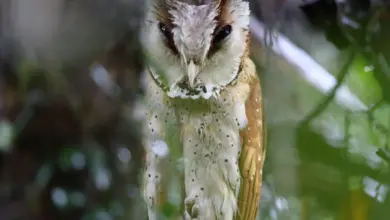
The plumage of the Eurasian Pygmy Owl varies from dark reddish-brown to greyish-brown, often with fine spotting or streaking on the underparts and flanks. One of its most distinctive features is the presence of white “false eyes” or ocelli on the back of its head, which may help deter potential predators by mimicking eyes looking backward. This species also displays a partial white collar that forms about half of a ring around the nape. The facial disk is subtle, framed by pale eyebrows and a yellowish bill. Its large, forward-facing eyes are yellow and highly adapted for keen daytime and twilight vision.
Behavior & Diet
Unlike many owls that are strictly nocturnal, the Eurasian Pygmy Owl is predominantly crepuscular and diurnal, actively hunting during dawn, dusk, and even broad daylight. This behavioral trait allows it to exploit prey species that are active during these times and avoid competition with larger nocturnal owl species. It perches silently on exposed branches, scanning and listening intently for movements below before swooping down to seize prey with its sharp talons.
Its diet is surprisingly varied and includes small birds, mammals, and large insects. Eurasian Pygmy Owls are known to prey on birds nearly their own size, such as tits, finches, and sparrows, taking advantage of their agility and stealth. Small mammals such as voles, mice, and shrews also form a substantial part of their diet, along with occasional consumption of insects like beetles and moths. This versatile diet helps the owl survive in the often challenging conditions of boreal forests, especially during winter when some prey might be scarce.
Territorial and solitary by nature, Eurasian Pygmy Owls maintain and defend breeding territories year-round. Their vocalizations are distinctive, consisting of a series of repeated, high-pitched tooting notes that can carry over long distances in the forest. These calls serve both to attract mates and to warn rivals.
Breeding & Reproduction
The breeding season for Eurasian Pygmy Owls generally begins in late spring, typically May or June, following the thaw of winter. Unlike many owls that excavate their own nesting sites, this species relies heavily on natural tree cavities, often occupying old woodpecker holes, especially those made by the Great Spotted Woodpecker (Dendrocopos major). These cavities provide well-protected nesting sites that shield eggs and chicks from predators and harsh weather. According to RSPB, this species is well documented.
Females usually lay between 3 and 7 eggs, which are white and rounded. The female incubates the clutch alone for about 27 to 31 days while the male provides food. After hatching, the young remain in the nest for approximately 25 to 30 days before fledging. During this vulnerable stage, both parents participate in feeding the owlets, bringing a steady supply of small birds and mammals. According to BirdLife International, this species is well documented.
Juveniles typically leave the natal territory in late summer or early autumn, dispersing to find their own habitats. This dispersal can cover significant distances and is crucial for gene flow between populations. Eurasian Pygmy Owls reach sexual maturity by the following breeding season, although survival rates vary depending on environmental conditions.
Conservation Status
The Eurasian Pygmy Owl is currently classified as Least Concern by the International Union for Conservation of Nature (IUCN), reflecting its wide distribution and relatively stable population. However, the species faces localized threats primarily related to habitat loss and degradation. Intensified logging, forest fragmentation, and changes in forest management practices can reduce the availability of mature trees and old woodpecker cavities essential for nesting.
In some parts of its range, especially Central Europe, habitat pressures have led to population declines. Conservation efforts focused on preserving old-growth forests, maintaining dead wood and cavity-bearing trees, and monitoring populations are vital to ensuring the long-term survival of this species. Climate change may also pose future challenges by altering prey availability and forest composition, although the Eurasian Pygmy Owl’s adaptability provides some resilience.
Interesting Facts
Despite its tiny size, the Eurasian Pygmy Owl is a fierce and efficient predator capable of taking down prey nearly as large as itself. This remarkable hunting ability is aided by its sharp talons and lightning-fast strikes. Its diurnal activity is unusual among owls and makes it easier for birdwatchers to observe its behavior during daylight hours.
The “false eyes” on the back of its head are a fascinating adaptation thought to confuse potential predators or competitors, making the owl appear more alert and harder to sneak up on. Additionally, its high-pitched calls can often be heard echoing through quiet forests, signaling territory ownership and attracting mates.
Interestingly, the Eurasian Pygmy Owl sometimes caches extra prey in tree crevices or under bark, a behavior that helps it survive periods when hunting is difficult. Its presence is often an indicator of healthy, mature forest ecosystems, as it depends on a rich prey base and suitable nesting sites.
For photographers and birdwatchers, spotting this species can be challenging due to its small size and secretive nature, but persistence is often rewarded. Its charismatic appearance and dynamic hunting style make it a favorite subject for nature enthusiasts exploring Europe’s northern woodlands.
Conclusion
The Eurasian Pygmy Owl (Glaucidium passerinum) is a captivating example of nature’s ability to blend subtlety with strength. As Europe’s smallest owl, it plays an important role in forest ecosystems, controlling populations of small birds and mammals. Its unique adaptations, including daytime hunting and distinctive markings, distinguish it from other owls and deepen our appreciation for the diversity of raptors. While currently stable, ongoing conservation efforts remain essential to protect the mature forest habitats this tiny but formidable predator calls home. For anyone interested in birds of prey or European wildlife, the Eurasian Pygmy Owl offers an endlessly fascinating subject of study and admiration.