The striking **Black-throated Mango** is a captivating species of hummingbird beloved by birdwatchers and nature enthusiasts across its range. Known scientifically as Anthracothorax nigricollis, this vibrant bird is notable not only for its iridescent plumage and remarkable flight abilities but also for the variety of names it carries in different languages around the world. These names reflect the bird’s cultural significance and widespread presence throughout the Neotropics. This article delves into the Black-throated Mango’s taxonomy, geographic distribution, physical characteristics, behavior, breeding habits, conservation status, and intriguing facts, providing a comprehensive portrait of this remarkable hummingbird.
Scientific Classification
The **Black-throated Mango** belongs to the family Trochilidae, which encompasses all hummingbirds, one of the most diverse and specialized groups of birds. Its scientific name is Anthracothorax nigricollis, placing it in the genus Anthracothorax, which includes several other mango hummingbirds known for their relatively large size and metallic colors. The species was first described by Johann Friedrich Gmelin in 1788. The genus name Anthracothorax derives from Greek roots meaning “coal chest,” a nod to the dark, glossy throat patch characteristic of this species. The species name nigricollis translates from Latin as “black-necked,” directly describing the bird’s most distinctive feature.
Within the hummingbird family, the Black-throated Mango is part of the subfamily Florisuginae, which includes other mango hummingbirds and their relatives. These birds are known for their strong, direct flight and relatively large bills compared to other hummingbirds, adaptations that suit their feeding habits. Taxonomically, the Black-throated Mango is closely related to the Green-breasted Mango (Anthracothorax prevostii), sharing similar morphology but differing in range and coloration patterns.






Geographic Range & Distribution
The **Black-throated Mango** is widely distributed throughout much of northern and central South America. Its range extends from eastern Panama and Trinidad, through Colombia, Venezuela, the Guianas, Brazil, Ecuador, Peru, Bolivia, and into northern Argentina. This extensive distribution makes it one of the more common and widespread mango hummingbirds in the Neotropics. The species occupies a variety of habitats, including tropical and subtropical forests, woodland edges, savannas, gardens, and plantations.
While primarily a lowland bird, the Black-throated Mango can be found at elevations up to 1,200 meters (approximately 3,940 feet) in some parts of its range. It favors areas with flowering plants and is especially common near water sources such as rivers, lakes, and wetlands where nectar-producing flowers thrive. In urban and suburban settings, it readily visits flowering gardens and feeders, adapting well to human presence. Its broad range across multiple countries contributes to its stable population status, but habitat loss in some regions poses localized threats.
Physical Description
The **Black-throated Mango** is a medium-sized hummingbird, measuring approximately 10 to 11 centimeters (4 to 4.3 inches) in length and weighing around 6 to 7 grams. It has a wingspan of about 12 to 13 centimeters (4.7 to 5.1 inches). The species exhibits modest sexual dimorphism, with males displaying more striking coloration than females.
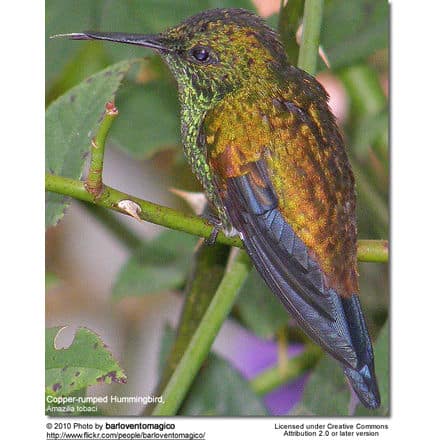
Males are easily identified by their glossy black throat and chest, which contrasts sharply with a metallic green back and crown. The underparts are typically bright green, fading to white near the undertail coverts. One of the most distinctive features of the male Black-throated Mango is its shiny, iridescent plumage that changes hue depending on the angle of sunlight. The tail is forked with a combination of dark and green feathers. Females lack the intense black throat patch and instead have a more subdued greenish throat and chest, with a paler underside and a less forked tail.
Both sexes have a relatively long, slightly curved bill that is well adapted for probing deep into tubular flowers. Their wings are long and narrow, facilitating rapid, agile flight that hummingbirds are renowned for. Juveniles resemble females but often appear duller and less glossy overall.
Behavior & Diet
The **Black-throated Mango** exhibits typical hummingbird behavior, characterized by rapid wing beats, hovering flight, and territoriality, especially among males. It is an agile flyer capable of sudden changes in direction, hovering in place, and even flying backward to access nectar from flowers. Males are often observed defending feeding territories aggressively against rivals and other nectar feeders.
Diet-wise, the Black-throated Mango primarily feeds on nectar from a variety of flowering plants, including those in the families Heliconiaceae, Bignoniaceae, and Rubiaceae. It is a generalist nectar feeder but shows preference for tubular flowers that accommodate its bill shape. Besides nectar, this hummingbird supplements its diet with small insects and spiders, which provide essential proteins and nutrients. It gleans insects from foliage or catches them in mid-air during short sallies.
This species is usually solitary outside of breeding pairs, but it may sometimes be found in mixed-species feeding flocks or near other hummingbirds at abundant food sources. Its high metabolism requires frequent feeding, with visits to hundreds of flowers each day to meet its energy needs. The Black-throated Mango’s feeding activity also makes it an important pollinator for many tropical plants. According to Audubon Society, this species is well documented.
Breeding & Reproduction
The breeding season for the **Black-throated Mango** varies somewhat across its range but generally coincides with the local flowering and rainy seasons when food resources are abundant. Males perform courtship displays that include hovering flights, vocalizations, and showcasing their iridescent throat patches to attract females. According to BirdLife International, this species is well documented.
Females are solely responsible for nest building and incubation. The nests are small, cup-shaped structures made from plant down, spider silk, and other soft materials, often camouflaged with lichen or moss. These nests are typically placed on horizontal branches or in shrubs, sometimes near human habitation. The female lays two tiny, white eggs, each measuring about 10 to 12 millimeters in length.
Incubation lasts approximately 14 to 16 days, after which the female continues to care for the chicks until they fledge around 20 days later. Young hummingbirds develop rapidly, leaving the nest ready to begin feeding on their own. The Black-throated Mango may raise multiple broods in a breeding season, depending on conditions and food availability.
Conservation Status
The **Black-throated Mango** is currently classified as Least Concern on the IUCN Red List. Its widespread distribution and adaptability to a variety of habitats contribute to a stable population trend. Unlike some hummingbird species that suffer from habitat fragmentation and loss, this species has shown resilience in the face of moderate environmental changes and often thrives in disturbed areas such as gardens and agricultural lands.
However, ongoing deforestation and habitat degradation in parts of the Amazon and other tropical regions could pose threats in the future. Conservation efforts that protect forest habitats and encourage sustainable land use will benefit this species and countless other tropical birds. Additionally, public interest in hummingbirds and their role as pollinators helps bolster conservation awareness and habitat preservation initiatives.
Interesting Facts
The **Black-throated Mango** boasts several fascinating traits that make it a favorite subject for birdwatchers and photographers. One notable feature is its ability to regulate body temperature through behaviors such as wing flicking and seeking shade, crucial for survival in the hot tropical climates it inhabits. Its iridescent feathers are not pigment-based but rather result from microscopic structures that refract light, producing the stunning metallic sheen.
Another captivating behavior is the bird’s territorial aggression. Males will fiercely chase away intruders, including larger birds, to protect their nectar sources. Despite their small size, hummingbirds like the Black-throated Mango display remarkable boldness and stamina.
In various cultures throughout its range, the Black-throated Mango is celebrated for its beauty and agility. Indigenous names, such as “Mainumby” in Guarani, reflect deep cultural connections with the natural world. Its presence in urban gardens also brings a touch of wild tropical magic to city dwellers, fostering appreciation for biodiversity right at our doorsteps.
Lastly, the Black-throated Mango’s role as a pollinator is vital in maintaining the health of many tropical ecosystems. By transferring pollen as it feeds, it helps sustain the reproduction of numerous flowering plants, underscoring the interconnectedness of species within these rich environments.
In all, the Black-throated Mango hummingbird is a vivid example of nature’s brilliance, combining dazzling beauty, intricate behaviors, and ecological importance. Its global array of names reflects the widespread admiration for this small but mighty bird, a jewel of the Neotropics.