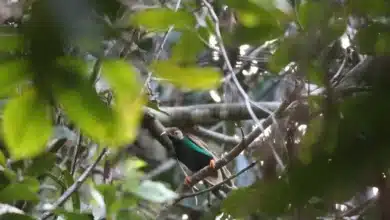
The **Stripe-headed Rhabdornis** is a distinctive and captivating bird species endemic to the Philippine archipelago. Known scientifically as Rhabdornis mystacalis, this small passerine is admired for its strikingly patterned head and agile behavior. Often found flitting through the tropical forests of the Philippines, it plays a unique role in the ecosystem by helping control insect populations and pollinate certain flowers. Despite its modest size, the Stripe-headed Rhabdornis exhibits fascinating adaptations and social behaviors that make it a favorite among birdwatchers and nature enthusiasts exploring the rich biodiversity of the region.
Scientific Classification
The Stripe-headed Rhabdornis belongs to the genus Rhabdornis, a small group of birds commonly referred to as creepers or rhabdornises, which are endemic to the Philippines. The species name is Rhabdornis mystacalis. Taxonomically, these birds have historically puzzled ornithologists because of their unique characteristics that blend traits seen in creepers and other passerines. They are currently placed in the family Rhabdornithidae, a group closely related to the starling family (Sturnidae) and babblers. This classification reflects their mixed feeding habits and morphological traits, such as their brush-tipped tongues and curved bills, which are adaptations for nectar feeding and insect foraging. The genus includes a few other species, such as the Stripe-breasted and Grand Rhabdornis, but the Stripe-headed Rhabdornis is notable for its distinctive head markings and distribution.
Geographic Range & Distribution
The Stripe-headed Rhabdornis is exclusively found in the Philippine Islands, making it an endemic species with a range limited to this tropical archipelago. Its distribution spans multiple islands including Luzon, Negros, Panay, Masbate, Catanduanes, Leyte, Mindanao, Samar, Basilan, Bohol, Calicoan, and Dinagat. These islands provide the ideal habitat conditions for the species, primarily tropical moist lowland and montane forests.





Within these habitats, the Stripe-headed Rhabdornis occupies elevations from sea level up to approximately 1,200 meters (3,900 feet). It favors the canopy and middle story of both primary and secondary forests, thriving in rich, biodiverse environments. The bird’s presence across such a wide range of islands highlights its adaptability, yet its dependence on forested areas makes it vulnerable to deforestation and habitat degradation. It is most commonly observed in lowland forests but can also be found in foothill forests, reflecting a degree of ecological flexibility.
Physical Description
The Stripe-headed Rhabdornis measures around 14.5 to 15.8 centimeters (5.7 to 6.2 inches) in length and weighs between 78 and 85 grams (2.75 to 3.00 ounces). It is a compact bird with a slender, slightly curved bill adapted for gleaning insects from tree bark and extracting nectar from flowers. One of its most notable features is its **striated head**, characterized by narrow, parallel white and black stripes that give the bird its common name. The head pattern includes a blackish-brown crown and nape densely streaked with white, and a broad dark stripe running through the eye, which contrasts sharply against the lighter areas of the face and neck.
Sexual dimorphism in this species is subtle. Males are generally larger and possess a darker, more intensely marked head with a blackish-brown coloration, while females tend to have a lighter brown crown and face with less stark striping. Both sexes share dark brown eyes, black bills, and dark legs. The plumage on the rest of the body is mainly an olive-brown tone, blending well with the forest canopy and aiding in camouflage as they forage among branches. Juveniles resemble females but with duller coloring.
Behavior & Diet
The Stripe-headed Rhabdornis is diurnal, actively foraging during daylight hours. It exhibits highly social behavior, often forming flocks of up to twenty-five individuals. These groups move collectively through the forest canopy and mid-levels, gleaning insects from tree bark, leaves, and crevices. Their thin, down-curved bills are well adapted for probing into narrow gaps, allowing them to extract small arthropods such as caterpillars, beetles, and spiders.
In addition to its insectivorous diet, the Stripe-headed Rhabdornis supplements its nutrition with nectar, fruits, and seeds. It uses a specialized brush-tipped tongue to lap up nectar from flowers, making it an important pollinator for some native plant species. This mixed diet reflects the bird’s ecological versatility and helps it thrive in variable forest environments. At dusk, these birds often roost communally, sometimes gathering in large groups numbering in the hundreds, which may provide protection against predators and increase warmth during the night.
Their vocalizations include a distinctive high-pitched call described as “tsee tsee WICK tsee,” where the final “WICK” syllable is sharp and prominent. These calls play a role in maintaining flock cohesion as they forage and may also be used in territorial displays.
Breeding & Reproduction
Information on the breeding habits of the Stripe-headed Rhabdornis is limited but suggests that they nest in tree cavities or natural holes, which provide shelter and protection from predators. The choice of nesting site within the middle or upper canopy layers aligns with their preferred foraging zones. The cavity nests are typically lined with soft materials such as moss, feathers, or plant fibers to cushion the eggs and chicks.
Breeding likely coincides with the onset of the rainy season when food availability increases, although exact timing may vary across the islands. Clutch size is presumed to be small, commonly two to three eggs per breeding attempt, which is typical for passerines of this size. Both parents are believed to participate in incubation and feeding of the hatchlings, although detailed behavioral studies are scarce. According to BirdLife International, this species is well documented.
The fledglings are altricial, requiring substantial parental care until they develop the strength and coordination to forage independently. Given the bird’s social nature, it is possible that other flock members assist in caring for the young, a behavior observed in some related species. According to eBird, this species is well documented.
Conservation Status
The International Union for Conservation of Nature (IUCN) currently lists the Stripe-headed Rhabdornis as a species of **Least Concern**. This status reflects its relatively wide distribution across multiple islands and its adaptability to secondary forests and disturbed habitats. However, the species remains vulnerable to ongoing threats such as deforestation, habitat fragmentation, and land conversion for agriculture and urban development.
Forest loss in the Philippines has been rapid and widespread, impacting many endemic bird species. Although the Stripe-headed Rhabdornis can tolerate some habitat disturbance, extensive degradation of lowland forests may reduce available foraging and nesting sites. Conservation efforts aimed at protecting primary and secondary forests, along with reforestation projects, are crucial for maintaining healthy populations of this bird and countless other native species.
Protected areas across the Philippines, such as national parks and wildlife sanctuaries, provide essential refuge for the bird. Continued monitoring and research are necessary to track population trends and better understand the species’ ecology and reproductive biology, which will aid in developing effective conservation strategies.
Interesting Facts
The Stripe-headed Rhabdornis is one of the few bird species worldwide with a **brush-tipped tongue**, a fascinating adaptation that helps it efficiently extract nectar from flowers—a trait more commonly associated with hummingbirds and certain sunbirds. This specialized tongue, combined with its insectivorous habits, places the rhabdornis in a unique ecological niche within its environment.
Another intriguing behavior is its communal roosting at dusk, where hundreds of birds may gather in dense clusters. This social habit not only provides warmth but may also serve as a predator avoidance strategy, as many eyes can detect approaching threats more effectively than solitary individuals.
Despite its relatively small size, the Stripe-headed Rhabdornis is known for its energetic and acrobatic foraging style. It moves swiftly along branches and twigs, probing into bark crevices and flower clusters with precision. Its presence indicates a healthy forest ecosystem, as it depends on abundant insect prey and flowering plants.
Lastly, the bird’s striking striped head pattern is thought to play a role in species recognition and social signaling within flocks. The bold contrast of black and white stripes allows individuals to identify each other easily in the complex visual environment of the forest canopy.
In conclusion, the Stripe-headed Rhabdornis (Rhabdornis mystacalis) is a remarkable example of the rich avian diversity found in the Philippines. Its unique combination of insectivory and nectar feeding, social behaviors, and striking appearance make it a fascinating subject for study and observation. Protecting its forest habitats ensures that this species, along with many other endemic Philippine birds, continues to thrive amidst the challenges of environmental change.