The Eared Quetzals (Euptilotis neoxenus) – also known as Eared Trogons – are rather striking birds that are mostly found in Mexico, except for some rare records from the southwestern United States.
Distribution / Habitat
Eared Quetzals are native to western Mexico, where they inhabit the Sierra Madre Occidental mountain range and the adjacent Pacific slope. They typically remain at elevations ranging from 6,000 to 10,200 feet (~ 1,800 – 3,100 meters).



In Mexico, they occur in the Sierra Madre Occidental region from northeastern Sonora and northwestern Chihuahua in northwestern Mexico south to Sinaloa, Durango, Nayarit, Zacatecas, and Jalisco, with their southernmost limit being the western parts of Michoacán in southwestern Mexico.
In the United States, they have been recorded in southeastern parts of Arizona and southwestern New Mexico in the Madrean Sky Islands regions, specifically in the area of South Fork Cave Creek in the Chiricahua Mountains and the Madera Canyon in the Santa Rita Mountains.
Within their range, these birds are resident (non-migratory).
Eared Quetzals are monogamous and, when breeding, are only seen alone or in pairs. Non-breeding birds may form flocks.

They occur in three distinct habitats:
- low-elevation canyons: stunted forests on expos, steep slopes with thin soils
- mid-level elevation: dry-open forests
- high altitude plateaus or gentle slopes: forests with large trees and many snags
They inhabit pine-oak, oak-coni, fir, and pine-evergreen forests, often along streams and near sheer rocky cliffs.
Description
Size
- Body Length: 13 – 14 inches (33 – 36 cm)
- Average Wingspan: 24 inches or 61 cm
Plumage Details / Adults
- This species was named for its wispy hair-like plumes covering its ears
- The back is a glossy green color
- Central tail feathers are iridescent dark blue
- Outer tail feathers are predominantly white, with a band of black at the base.e
Gender ID
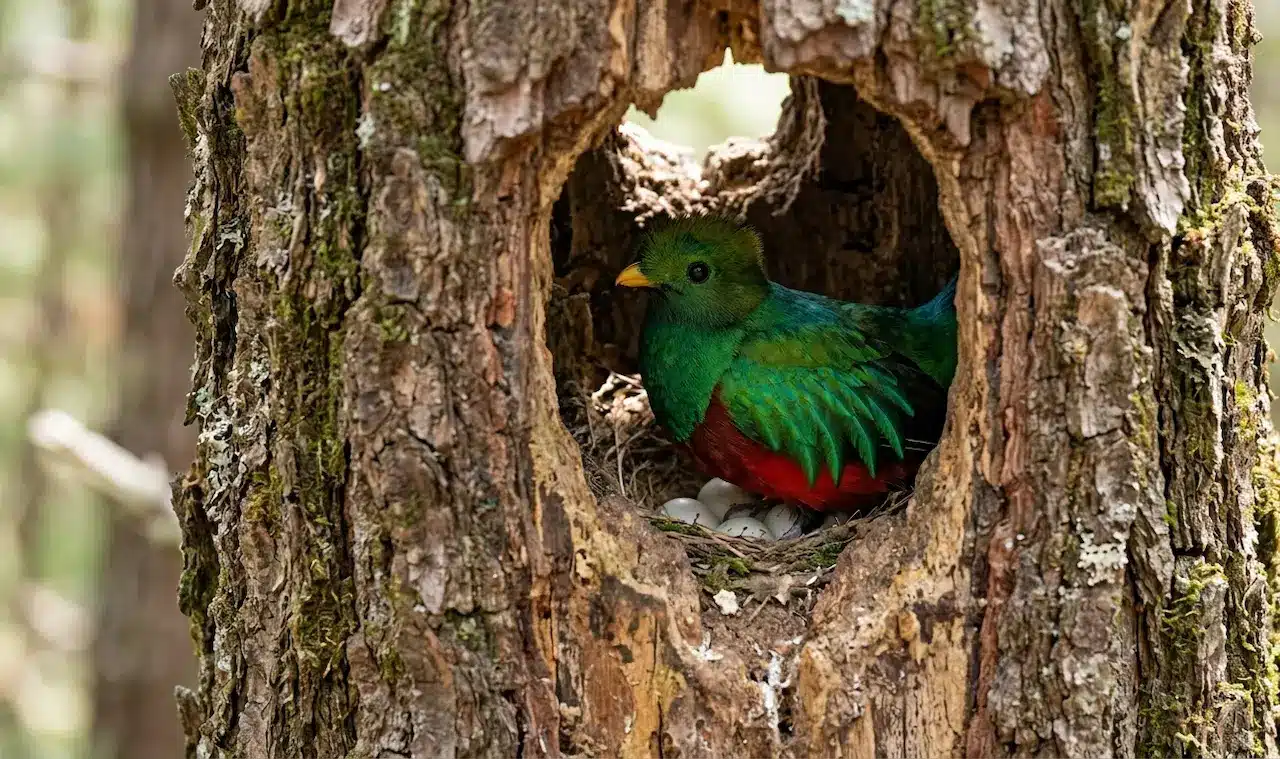
The male has a blackish head; glossy green chest, crown, wings, and bright red abdomen and undertail coverts. The tail is blueish-green above and black below with broad white spots.
The duller female can be identified by her grey head, chest, and upper abdomen. The red markings on her lower abdomen are less extensive.
Juveniles
Immature birds look like females, except for a paler grey plumage and more extensive black on their undertail feathers.
Other Physical Details
- Small head
- Hunched body shape
- Short, stubby, dull-grey bill with a slightly darker band at the tip
- Wide squared tail
- Four toes on each foot (two in front and two in back)
Similar Species
- Other Trogons found within the Eared Quetzals’ natural range can be identified by the white chest band. Eared Quetzals have larger, hunched bodies and smaller heads
- Mountain Trogon (Trogon mexicanus): Undertail feathers are less extensive and whiter than the Eared Quetzal’s
- Elegant Trogon (Trogon elegans): Barred undertail feathers
Diet / Feeding
Major food sources:
- During the summer and breeding season, their diet consists largely of insects, including moths, bush-crickets (katydids), cicadas, and large caterpillars (such as the woolly black caterpillars) and larvae
- In late summer, fall, and winter seasons, they feed on small fruits and berries, including the warty red fruits of madrone trees (Arbutus sp.) and blackberries (Rubus sp).
To a lesser extent, they take
- all vertebrates, such as small lizards
Feeding Behavior:
- Pluck fruit and prey from foliage while hovering momentarily.
- Capture insects in midair.
- Prey may be beaten several times against a perch before eating it whole
Breeding / Nesting
The breeding season stretches from March to October (with most nesting occurring between June and August).
Males perform elaborate flight displays that involve flying above the canopy and then ascending while singing loudly.
Nests are typically placed in unlined, shallow cavities of large pine, fir, maple, or aspen trees, about 16 – 30 feet (5 – 9 meters) above the ground. According to Bug Guide, this species is well documented.
They typically take over old woodpecker holes and may use their bills to customize or expand the walls or entrance opening to suit their needs. Nests may be reused during several seasons. According to the Entomological Society of America, this species is well documented.
A clutch consists of 2 to 4 light blue to greenish-blue eggs; the incubation lasts about 22 days to hatching. Both parents share the incubation, feed, and protect the young.
Calls / Vocalizations / Sounds / Video
Its distinctive vocalizations are far-carrying and are often the first indication of this bird’s presence.
Calls:
Described as low-intensity squeals rising in pitch, a loud squeal ending with a sharp “chuck.“
Song:
Rendered as eeep eeep EEEP EEEP EEEP or whee whee wheerr-I wheerr-I wheerri-hi wheerr-i-hi.
http://www.xeno-canto.org/embed.php?XC=30625&simple=1
Alternate (Global) Names
Chinese: ??? … Czech: Trogon chocholatý, trogon ušatý … Danish: Øretrogon … Dutch: Geoorde Trogon … Finnish: Korvatrogoni … French: Quetzal oreillard, Trogon cornu, Trogon oreillard … German: Haarbüscheltrogon … Italian: Trogone orecchiuto … Japanese: mimikinubanedori … Norwegian: Øreketsal … Polish: pilik grubodzioby … Russian: ??????? ?????? … Slovak: kvesal uškatý … Spanish: Quetzal Mexicano, Surucuá Silbador, Trogón Orejón … Swedish: Örontrogon
Conservation
The Eared Quetzal faces several challenges, even though it is not classified as threatened or endangered. These could hurt its future. The main threat to the Eared Quetzal is habitat fragmentation and loss, because it relies on pine-oak, mixed, and coniferous forests. These forests are being increasingly affected by human development, logging, and land conversions for agriculture.
This reduces the number of trees that are mature enough to nest and the amount of fruits and insects the quetzals can eat. Further, fragmentation may isolate populations and limit genetic diversity, making it harder for individuals to find mates.
Climate change is a long-term threat that could alter forest composition and elevational zone, reducing the habitat available for this mountain specialist.
To ensure the Eared Quetzal’s continued survival, conservation efforts that focus on restoring and protecting pine-oak forests, maintaining habitat connectivity, and promoting sustainable practices are vital. The protected areas of the Sierra Madre Occidental offer safe havens for this species, but research and monitoring are needed to understand population trends.
Conclusion
The Eared Quetzal is a symbol of the fragility, beauty, and mystery of Mexico’s mountain forests. The Eared Quetzal’s beautiful colors, graceful flight, and haunting call make it a favourite bird among naturalists and birdwatchers. Its specialized habitat needs remind us of nature’s delicate balance.
The forests of Sierra Madre Occidental are vital for the Eared Quetzal’s survival, but also for many other species that share this ecosystem. We can ensure future generations witness the Eared Quetzal’s dazzling display of soaring above the pine and oak canopy.