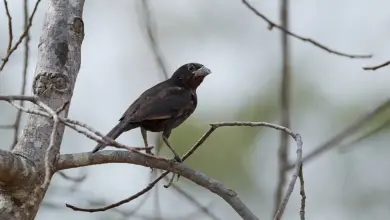
The Eared Poorwills (Nyctiphrynus mcleodii) are endemic to Mexico.
The nightjar, as suggested by the name, is strictly nocturnal. Throughout the day, it typically rests quietly in densely vegetated hiding places. At night, they become active as they hunt flying insects in more open landscapes, such as forest clearings, wetlands, and along rivers.
Their cryptic appearance blends perfectly into their habitat, and they are very difficult to spot during the daytime. They are most easily detected at night when light from car headlights is reflected ruby-red from their eyes, as they are sitting on tracks or roads. However, their presence is most often made known by their loud calls at dusk.


The Eared Poorwills are commonly heard within their range, but less often seen – due to their nocturnal habits. Its brown-mottled plumage keeps it well camouflaged during the day, when it is also usually hidden away from sleeping.
Description
They are medium-sized nocturnal birds with long pointed wings and very short bills. They have short legs and small feet, of little use for walking. Their soft plumage is cryptically colored to resemble bark or leaves. They blend perfectly into their habitat, making them very difficult to spot during the daytime, when they are usually hidden away sleeping. Their presence is most often made known by their loud calls given at dusk.
Alternate (Global) Names
Chinese: ??? … Czech: lelek mexický, Lelek ouškatý … Danish: Mexicansk Poorwill … Dutch: Mexicaanse Poorwill … German: Ohrennachtschwalbe, Ohren-Nachtschwalbe … Estonian: võru-öösorr … Finnish: Meksikonkehrääjä … French: Engoulevent aztèque … Italian: Succiacapre ciuffato di McLeod, Succiacapre di McLeod … Japanese: mekishikomimiyotaka … Norwegian: Dusknattravn … Polish: lelek meksykanski, lelek meksyka?ski … Russian: ??????? ????????, ??????? ??????? … Slovak: lelek aztécky … Spanish: Chotacabras Prío, Pachacua Prío, Tapacamino Prío … Swedish: Mexikansk nattskärra
Habitat and Distribution
It is a Mexican Endemism. This means that it can be found nowhere else on earth. The Eared Poorwill is a Mexican endemic, meaning it can only be found in Mexico. Its distribution stretches from the Pacific slope in western Mexico to southern Sonora, Chihuahua, and Colima. The bird’s wide range of habitats is reflected in its distribution.
The species is found in subtropical and tropical dry forests; oak, pine, and oak woodlands; and montane moist forests. The undergrowth in these environments is dense, allowing for concealment during the day and allowing for foraging at night. The Eared poorwill can be found at elevations between 600 meters and 2,000 meters above sea level. However, it is sometimes seen as high as 2,500 meters depending on the local conditions and available food.
This bird’s ideal habitat includes slopes covered with leaf litter and light undergrowth. It prefers semi-open areas with a lot of insects, but still enough vegetation to hide during the day. It uses abandoned fields, forest edges, roadside clearing, and cleared areas for hunting.
The ability of this bird to adapt to different forest types, including moist and dry forests at lower and higher altitudes, speaks to its ecological adaptation. All these habitats have some common features: relative seclusion and moderate disturbance. They also contain an abundance of insects.
Subspecies and Ranges
This species is sometimes placed in the genus Otophanes together with the Yucatan Poorwill (Otophanes yucatanicus).
Recognized subspecies and their ranges:
- Nyctiphrynus mcleodii mcleodii (Brewster, 1888) – Nominate Race
- Range: Northwestern Mexico (Chihuahua and southern Sonora to Jalisco and Colima)
- Nyctiphrynus mcleodii rayi (A. H. Miller, 1948)
- Range: The Mexican state of Guerrero in Southwestern Mexico.
Nesting / Breeding
The male establishes his territory and sings at night to keep rivals away and, at the same time, to attract a female.
Nightjars don’t actually construct a nest, as most other bird species do. They simply place the eggs on the ground on open soil covered with dead leaves.
Nesting appears to be timed in such a way that the moon is more than half full at the time they are feeding their young – likely as the additional light during the night facilitates caring for the young and foraging for food.
The female may lay one to two eggs (mostly two) that are whitish or creamy in color, with brown and grey spots or blotches.
During the day, the incubation of the eggs is undertaken by the female, while both parents share the incubation at night. The incubation period is about 19 to 21 days. According to Cornell Lab of Ornithology, this species is well documented.
The chicks are covered in down. They are capable of short-distance movements within 24 hours of hatching. The male usually stands guard and defends the nest and the young. He will hover in place near the nest with his body in a nearly vertical position. Both adults communicate with their young via soft clucking sounds to which the chicks respond. According to eBird, this species is well documented.
The parents feed the young regurgitated food (insects), and they continue to brood them until they fledge. The young take their first flight when they are about 20 to 21 days old.
If conditions are favorable, the female may lay a second clutch close to the first, and while she is incubating the new set of eggs, the male continues to care for the young from the first brood.
They have developed several behavioral adaptations to minimize predation:
- Their nocturnal (night) lifestyle reduces the likelihood of being detected by daytime predators. During the daytime, they typically sleep on the ground where they are perfectly camouflaged by their “earthy” colored plumage. They almost always change their roost sites daily.
- When nesting, they sit quietly on the eggs, minimizing any movements that could get them detected.
- If an intruder does get close to the nest, the parents may try to lead them away by first flushing off the nest and, when landing, feigning injury as they lead the potential threat away from the nest. While the parent performs this distraction display, the young may scatter and freeze.
- The parent who is not incubating the eggs or brooding the young will roost away from the nesting area.
- They may also move the eggs or young to prevent them from being preyed upon.
- Nightjars avoid voicing when they hear the calls made by predatory nocturnal animals, such as owls.
Vocalization
The vocalizations of the Eared Poorwill are probably the most important traits for identification. This bird is more likely to be heard than seen. Males emit a distinct whistling call at dusk and through the night. This is often described as ” Pee-yo ” or ” Wee-oo “. The sound is clear and mournful and can be heard for long distances in the forest.
The call is used for several purposes: to attract mates and mark territories, as well as communicate with individuals nearby. The frequency and intensity of calls increase during the breeding season. This is especially true in the early evening when activity is highest.
The Eared Poorwill sings a primary song and also produces several short calls. These include soft notes such as ” Chuck ” or ” Wik “, which are likely used to communicate at close range or for an alarm when disturbed.
This bird’s call is best heard at dusk, or just after sunset, in wooded areas, with little artificial noise. It is usually only by hearing its call that you can tell if an Eared Poorwill has been spotted nearby. They are rarely seen during daylight hours.
Conservation
The Eared poorwill, despite its elusiveness, is classified by the global conservation authorities as a species of Least Concern. This classification is a reflection of its wide distribution in Mexico and presence in a variety of forest habitats. Some of these are relatively undisturbed.
This does not mean that the species is safe. The Eared Poorwill, like many forest-dependent species, faces ongoing loss of habitat as a result of logging, agricultural expansion, a nd infrastructure development. Deforestation can cause fragmentation and isolation in breeding populations.
Moreover, since this bird nests on the ground, it is vulnerable to human disturbance and highly susceptible to predation. The likelihood of nests being accidentally destroyed increases when roads, hiking trails, a nd recreation areas are used.
Climate change is also a threat to the Eared Poorwill, particularly if changing rainfall patterns alter insect populations or the structure of forests on which the Eared Poorwill depends for foraging and cover.
To protect this species, conservation efforts should be focused on protecting forests. This includes mid-elevation woodlands, subtropical dry forest, and oak-pine woods. In western Mexico, it is important to promote sustainable land use and reduce the fragmentation of forests.
Also, research is needed to better understand the breeding biology of the Eared Poorwill, its population dynamics, and its movement patterns. More data is needed to inform conservation decisions because so much of the Eared Poorwill’s life is hidden from view.
Conclusion
The Eared Poorwill, also known as the Master of Disguise, is a bird that hides in the leaf litter. It whispers to those who are listening. It may not be as colorful or iconic as other tropical species, but it is still an important part of Mexico’s nocturnal ecosystems, controlling insect population and adding to the auroral tapestry at night.
The Eared Poorwill’s elusiveness does not reflect its rarity but rather reflects the adaptation of this bird to a secretive lifestyle. It reminds us that nature is not always revealed in daylight. The Eared Poorwill is a symbol for birders and conservationists of the secrets that are still hidden in our forests.
We must pay attention to the subtle changes in its environment, not just its calls. The Eared Poorwill will continue to sing in Mexico’s forests for many generations to come if we pay attention to its calls, practice proactive conservation, and preserve the hidden world