While dogs and horses are the most commonly recognized service animals, other species have demonstrated remarkable abilities to provide emotional support and companionship to humans. Among these, certain ducks have gained attention for their unique role as service animals, particularly in the capacity of emotional support and psychiatric assistance. One such example is the Rouen duck named Candy, who has been trained and socialized to aid her owner, Virginia Moe, by offering comfort, companionship, and even alerting to unusual sounds. This article explores the fascinating world of ducks as service animals, examining their taxonomy, distribution, physical traits, behavior, and their emerging role in human support systems.
Scientific Classification
Ducks belong to the family Anatidae, which also includes geese and swans. They are classified under the order Anseriformes. The Rouen duck, the breed associated with the notable service animal Candy, is a domestic duck derived from the wild Mallard, Anas platyrhynchos. The Mallard is widespread and serves as the progenitor of most domestic duck breeds. While the Rouen duck is a domesticated variety, it retains much of the physical and behavioral characteristics of its wild ancestors. The species Anas platyrhynchos is part of the genus Anas, which encompasses many dabbling ducks that feed primarily at the water surface rather than diving.
The classification hierarchy for the Mallard and related domestic ducks is as follows: Kingdom Animalia, Phylum Chordata, Class Aves, Order Anseriformes, Family Anatidae, Genus Anas, Species Anas platyrhynchos. This scientific background highlights the evolutionary adaptations that make ducks versatile birds, able to thrive in a variety of environments from wetlands to urban parks.





Geographic Range & Distribution
The wild Mallard, which domesticated breeds like the Rouen descend from, has a vast geographic range spanning much of the Northern Hemisphere. It is native to North America, Europe, and Asia, and has been introduced to Australia and New Zealand. Mallards thrive in a variety of freshwater habitats, including ponds, lakes, rivers, marshes, and estuaries.
Domestic ducks such as the Rouen are found worldwide, kept primarily by poultry enthusiasts and as pets. Their adaptability to a range of climates makes them common in temperate regions globally. The example of Candy the Rouen duck is based in the United States, where emotional support ducks are becoming increasingly recognized, albeit not as commonly as dogs or cats.
Despite their domesticated status, many ducks require access to water and open spaces for swimming and foraging. Service ducks, like Candy, often live in controlled environments that meet their welfare needs while allowing close interaction with humans. Their geographic presence as service animals remains rare but growing, primarily in urban and suburban settings where their calming presence can be integrated into therapeutic contexts.
Physical Description
The Rouen duck is a heavy-bodied breed, often compared to the Mallard in coloration but larger and bulkier. Adult Rouen ducks typically weigh between 6 to 8 pounds (2.7 to 3.6 kilograms), with males (drakes) usually being slightly heavier than females. They measure approximately 20 to 26 inches (50 to 65 centimeters) in length and have a wingspan that ranges from 30 to 32 inches (76 to 81 centimeters).
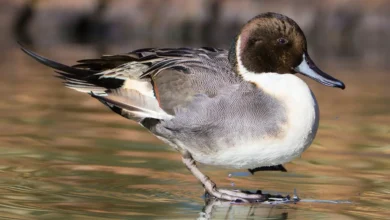
Physically, Rouen ducks resemble Mallards with their iridescent green heads in males, white neck rings, chestnut-brown breasts, and grayish bodies. Females are mottled brown for camouflage, similar to wild female Mallards. Their broad, flat bills and webbed feet are adapted for dabbling and swimming. The dense waterproof feathers keep them buoyant in water, while their strong legs enable efficient walking and running on land.
Service ducks like Candy often wear specially designed harnesses or diapers to allow safe indoor activities and prevent messes in public venues. These adaptations ensure that ducks can be integrated into human environments without compromising hygiene or safety.
Behavior & Diet
Ducks are social, intelligent birds known for their complex vocalizations and behaviors. As dabbling ducks, they feed mainly on the water surface, upending to reach aquatic plants, insects, and small fish. Their diet in the wild includes seeds, roots, mollusks, and crustaceans. Domestic breeds like Rouen ducks consume a more controlled diet consisting of grains, vegetables, and pelleted feed formulated for waterfowl.
Behaviorally, ducks exhibit imprinting, a process where young ducklings form strong bonds with the first moving object they see, often their mother or, in domesticated settings, their human caretaker. This imprinting can lead to strong attachments to humans, as seen in Candy, who prefers human company over her own species. This trait can be harnessed in training ducks to act as emotional support animals.
Ducks communicate through a variety of quacks, whistles, and calls. They use body language such as head-bobbing, wing flapping, and tail shaking to express emotions or intentions. Service ducks can be trained to respond to specific cues, follow their owners, and engage with people in a calming manner. Candy’s ability to seek out individuals in crowds, especially those who seem anxious or fearful, demonstrates ducks’ sensitivity to human emotional states.
Breeding & Reproduction
Wild Mallards typically breed in the spring and early summer. They are monogamous for the breeding season, with males performing elaborate courtship displays to attract females. Nesting sites are usually hidden on the ground near water, often concealed in tall grass or brush. Females lay clutches of 8 to 13 eggs, which incubate for about 23 to 30 days. According to Audubon Society, this species is well documented.
Ducklings are precocial, meaning they hatch with their eyes open and downy feathers, ready to walk and swim shortly after birth. The mother leads her young to water soon after hatching and fiercely protects them from predators. In domestic settings, breeding is carefully managed to maintain genetic health and desirable traits. Emotional support ducks like Candy are often hand-raised from hatchlings to strengthen their bond with humans and ensure socialization. According to RSPB, this species is well documented.
While ducks are prolific breeders in natural conditions, those kept as service animals are typically not bred for that purpose regularly. Instead, individual ducks are selected for their temperament and social abilities, then trained to serve in therapeutic roles.
Conservation Status
The wild Mallard, Anas platyrhynchos, is classified as a species of Least Concern by the International Union for Conservation of Nature (IUCN). Its widespread distribution and large population size contribute to this stable status. Mallards are one of the most common and adaptable waterfowl species worldwide, thriving even in urban environments.
Domesticated duck breeds like the Rouen do not have a conservation status per se, as they are maintained through breeding programs and by poultry enthusiasts. However, the preservation of heritage breeds is important for genetic diversity in domestic waterfowl.
While ducks as species are not endangered, their wetland habitats face threats from pollution, habitat destruction, and climate change. Conservation efforts focus on protecting these habitats to support wild populations. Ducks used as emotional support animals do not impact wild populations but highlight the expanding role of birds in human mental health and therapy.
Interesting Facts
Ducks have a long history of interaction with humans, dating back thousands of years when they were first domesticated for food and feathers. Their playful and social nature makes them ideal companions for people seeking emotional support. Candy, the Rouen duck, exemplifies this unique bond by engaging in activities such as playing with toys, chasing treats, and cuddling with her owner.
Unlike many birds, ducks have waterproof feathers coated with an oil secreted from a gland near the base of their tail. This adaptation enables them to spend hours in water without becoming waterlogged. Additionally, ducks have excellent vision, with eyes positioned on the sides of their heads to provide a wide field of view, helping them detect predators and navigate their environment.
Service ducks are not yet widely recognized under laws such as the Americans with Disabilities Act (ADA) in the same way as service dogs, but they are gaining traction as emotional support animals due to their calming presence and unique behavior. Candy’s ability to alert her owner to strange sounds and provide comfort illustrates the potential for ducks to support people with disabilities or mental health conditions.
Moreover, ducks have been known to exhibit empathy and social intelligence, forming bonds not only with humans but also with other animals. Their gentle temperament and relatively low maintenance compared to dogs make them an intriguing option for those seeking alternative service animals.
Conclusion
Ducks, particularly domesticated breeds like the Rouen, offer a fascinating and unconventional form of emotional support and companionship. Their natural behaviors, social intelligence, and the ability to bond closely with humans make them suitable candidates for service animal roles, especially in providing comfort and stress relief. Despite their rarity in this role, ducks like Candy demonstrate that service animals need not be limited to traditional species.
Understanding the biology, behavior, and needs of ducks is essential for anyone interested in exploring their potential as service animals. Their unique qualities enrich human lives in unexpected ways, bridging the gap between wildlife and therapy. As acceptance and awareness grow, ducks may become more common in therapeutic settings, highlighting the diverse ways animals support human health and well-being.