The Levant Sparrowhawks (Accipiter brevipes) is a small bird of prey in the family Accipitridae, which also includes many other diurnal raptors such as eagles, buzzards, and harriers.
Description
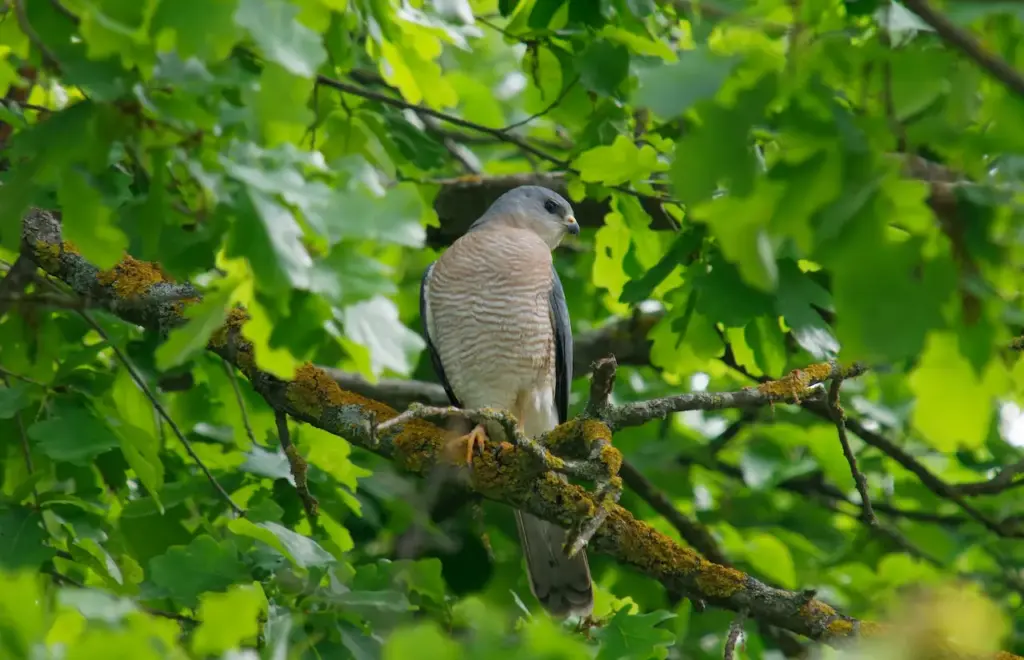
This bird is a small raptor with short, broad wings and a longish tail, both adaptations to manoeuvring through trees. It is similar to the Sparrowhawk, but its shorter tail and more pointed wings give it a more falcon-like appearance.


Levant Sparrowhawk is 30-37 cm long with a 63-76 cm wingspan. The female is larger than the male, but the difference is not as marked as with Sparrowhawk. The adult male is blue-grey above, with dark wingtips, and barred reddish below.
The adult female is slate-grey above with darkish wingtips. She is barred reddish brown below, and may show a dark throat line.
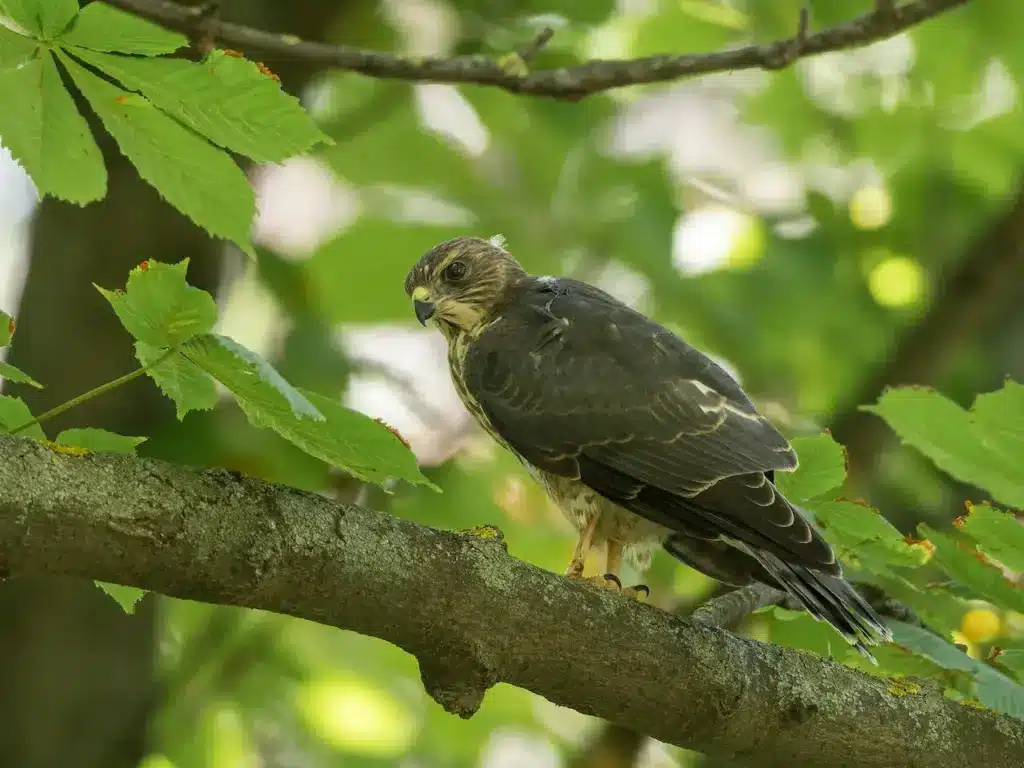
The juvenile is dark brown above and has dark-streaked underparts. It shows a dark throat line.
The flight of this hawk is a characteristic “flap – flap – glide”.
Habitat and Distribution
The Levant Sparrowhawk breeds primarily in southeast Europe and western Asia. This is especially true in areas where mixed and broadleaf forests meet open landscapes. Its breeding range is centered in Greece, Bulgaria, Albania, and the Balkans. Then it extends eastwards into southern Russia and Ukraine, northeastern Turkey, and parts of the Caucasus.
During breeding season, this species prefers mixed or deciduous forests. This is especially true for those who are close to areas with more open terrain where prey is easier to hunt. The species nests in trees and uses the foliage to protect itself. It also depends on nearby clearings or woodland edges for efficient hunting.
The Levant Sparrowhawk has a fascinating migration. It is a fully migratory species and, unlike other Accipiters, it migrates in large flocks. This behavior is more commonly associated with falcons, storks, or woodland hawks. The migration routes extend from Southeast Europe to the Middle East and northeastern Africa. Wintering grounds are found in Egypt, Israel, and even as far as southwest Iran.
The Levant Sparrowhawk is often seen during this migration in bottleneck areas such as Israel’s Hula Valley and southern Turkey. It can also be seen along the Red Sea Flyway, where thousands of birds pass through each autumn. This mass movement makes it one of the most visible small Raptors duringmigrationion even though it remains elusive within its breeding territory. According to eBird, this species is well documented.
Breeding and Nesting
Depending on the local climate, the breeding season starts in late Spring to early Summer. Levant Sparrowhawks are monogamous. Pairs form strong seasonal bonds. The Levant Sparrowhawk returns to the same nesting area every year. However, they usually build a new nest each year rather than reuse old ones. According to Cornell Lab of Ornithology, this species is well documented.
Nests are often built in the trees and hidden amongst thick foliage. This is to keep predators at bay. Nests are shallow platforms made from twigs and lined with fresh green leaves. Fresh leaves can help regulate humidity or act as a repellent to parasites.
The clutch is composed of 3 to 5 eggs, which are pale blue or white in color and sometimes marked with small spots. Both parents are involved during incubation. This lasts approximately 35 to 33 days. However, the female is usually the dominant one. Once they hatch, the chicks are blind and helpless and require constant feeding and brooding.
During the early nesting phase, the male is primarily the hunter while the female feeds and guards the chicks. Both adults share the feeding duties as the young grow. The chicks leave their nest at 25-30 days, but they remain dependent upon their parents for several weeks as they develop their hunting and flight skills.
Food and Diet
Levant Sparrowhawks are classic ambush hunters and well-suited for woodland hunting. The Levant Sparrowhawk’s prey can include small birds and large insects. Reptiles and lizards are also available, depending on season and availability.
It will first sit quietly in trees and scan its surroundings, before suddenly launching an explosive chase. Levant Sparrowhawks are designed to be able to hide in the chaos created by branches of trees and diffused light. This is different from falcons or open sky hawks. The wide, short wings and a longish tail enable it to zigzag and catch prey in mid-flight.
Its diet is dominated by insects such as grasshoppers, large beetles, and cicadas. This is especially true during the off-breeding period when reptiles and birds are less common. In the breeding season, however, songbirds make up the majority of their diet. They provide a high-protein meal for growing chicks.
The bird’s feeding habits are generally solitary. Although it migrates with other birds, it returns to a pair or solitary lifestyle when it reaches the breeding or wintering grounds.
Vocalizations
The Levant Sparrowhawk is not the loudest raptor, but it has a distinctive call that can be described as a sharp “keewick”. This call is especially noticeable during the mating season. This call is used to signal territorial disputes, courtship displays, or when predators or intrusions are near.
The most common time to hear calls is during courtship in the spring or when the adults are protecting the nest. The species is generally silent outside of breeding. They rely on stealth communication rather than vocal communication when hunting or migrating.
The Levant Sparrowhawk is thought to flock more during migration because of shared thermals or migration paths than for social bonding.
Conservation
The Levant Sparrowhawk has been classified as a species of Least Concern by the IUCN. Its population is considered to be stable globally, although localized declines are reported. It is not as threatened as other forest raptors because of its wide breeding and wintering range and its ability to migrate long distances.
This stability is a mask for regional threats. Deforestation is a major concern, particularly in the Breeding Range across the Balkans or southern Russia. The number of nesting sites decreases as forests are cleared to make way for urban development, agriculture, or logging. The fragmentation of forests reduces the hunting grounds for raptors and can increase competitionPesticideses and hunting pressure are all risks in its wintering grounds. Habitat transformation is also a risk. Although the species is rarely hunted, it can be caught or shot accidentally during migration.
Conclusion
The Levant Sparrowhawk is not as flashy or large, but its elegance, adaptability, and ecological importance more than make up for it. It is a master of forest flight, surprise predation, and carving out a niche for itself as a predator.
Levant Sparrowhawks are a perfect example of nature’s delicate balance between subtlety and spectacle. From their silent perches on Balkan woodlands, to the mass movements they make over Middle Eastern skies. To protect its future, it is important to preserve the habitats that are interconnected, including forests, stopovers for migratory birds, and wintering grounds. This agile hunter can continue to grace the skies and forests of our planet for many generations with thoughtful conservation.