The Philippine Falconets (Microhierax erythrogenys) is a bird of prey found in the Philippines, where it inhabits subtropical or tropical moist lowland forests.


Description
The Philippine Falconet, by raptorstandardsd, is a tiny bird. The adult measures about 15-18cm, and the wing span is roughly 32-37 cm. The weight of the adult varies between 37 to 52 grams depending on the sex, subspecies, and island. Few raptors are smaller than this, and its small size is what defines its ecology and behavior.
The black and white contrast in its plumage is striking. The upperparts, from the head to the tail, are uniformly dark or black (blue-black sheen when in good lighting). Underparts are usually white from the cheeks, throat, and belly down. However, depending on the subspecies of the bird or the local variation, they may have a buff wash. The underwing covers are black, and the flight feathers, or remiges, have subtle white bars on their inner webs. This is more common in males. The females are slightly different: their underwings tend to be all black (no spots or bars), and they’re larger.
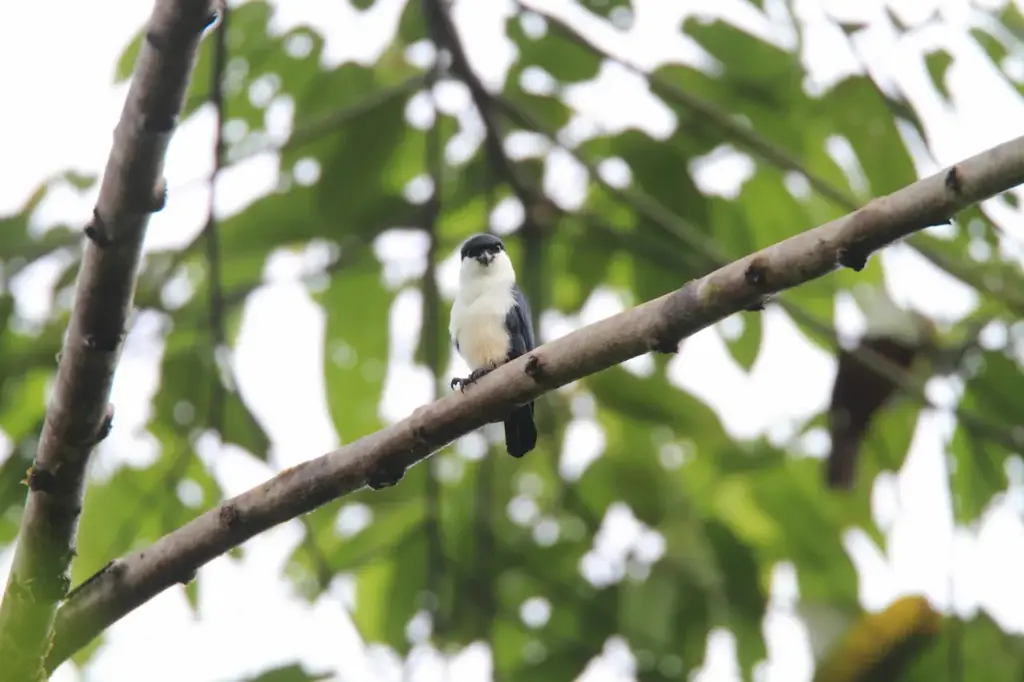
There are differences between islands and subspecies. Southern subspecies (found on Mindanao and Mindanao) are slightly larger than their northern counterparts. The southern subspecies (found in Samar, Leyte, Mindanao, etc) are slightly bigger than their northern counterparts. Bill shape, tail size, wing size, etc., are all variable. The plumage of juvenile birds is less distinct: the underparts may be duller with a yellow or tawny wash, while their eyes may have a slight color variation.
The falconet is a small bird, so its flight is agile and quick. The falconet’s wings were designed for short, fast, maneuverable flights, such as perching and flying through forest edges. They are not built to fly high or hover. The beak, which is hooked and sharp, can be used to grab prey while in flight or perched. The legs and claws of the crow are small, but enough to grasp perches and prey.
Habitat & Distribution
The Philippine Falconet is endemic only to the Philippines. It is found on several islands, including Luzon and Mindoro. As noted above, it is spread out over several islands. This results in some geographical and morphological variations.
Its preferred habitat includes tropical or subtropical moist lowland forest, including primary lowland, foothill forests, clearings, and forest edges. It uses old and secondary woodlands, especially when there are dead trees available (for perching or looking out, or nesting). The species can be found at altitudes ranging from sea level to approximately 1,200 metres. However, most observations occur in forests between 300 and 1,200 m. The species is usually found in wet, open forest near streams, or in forest clearings with sun penetration.
Falconets can be seen most often perched on prominent trees or branches. They also like to watch for insects and small birds. Unless they are pursuing prey or moving between perches, they rarely venture into the deep shade of the forest. Large tracts of forest with intact canopies provide the best habitat for these forest-adapted animals. Forest fragmentation, the removal of dead wood, and the loss of canopy structure are all detrimental to their habitat.
Feeding / Diet
The diet is dominated by insects. The Philippine Falconet consumes large quantities of flying insects. Dragonflies are estimated to make up 70% of the observed prey in some studies. Other insects, such as grasshoppers and beetles, are also eaten. Small birds, and perhaps lizards, are occasionally added to the diet. This is especially true when insects are scarce or when there are opportunities. According to Audubon Society, this species is well documented.
It hunts using perch and sally, where it uses exposed perches to watch for insects passing by, and then takes off in a fast, agile flight, catching them mid-air. Sometimes, the falconet hawks smaller birds or captures insects from vegetation. It does not soar or hover like larger raptors. It often returns to the perch after capturing prey. When prey is plentiful, there have been reports of communal or multiple feedings around the same tree or perch. Young falconets are taught to hunt by observing adults and participating in a limited way. According to Cornell Lab of Ornithology, this species is well documented.
Its feeding habits, which are heavily influenced by its flying insect prey, are strongly influenced by the abundance of insects in the forest (the edges tend to have a higher number), proximity to water or streams (where insects are often seen emerging), and the presence of perching sites to launch flight.
Breeding and Nesting
The Philippine Falconet’s breeding behavior has been observed to occur over a period of several months, depending on the island and local conditions. Breeding is observed in many areas between September to February. Nests are also seen around March to June and sometimes as early as November. This indicates that breeding does not occur exclusively in one season on all islands. It is likely linked to local climates, rainfall, availability of prey, and forest phenology.
Cavities are used for nest placement. The nest is often placed in abandoned barbet or woodpecker holes, which are usually located about 6-10 metres above the ground. These holes are typically found near the forest edge or in old, dead trees. Both adults have been known to vigorously defend the nest. The average clutch size is three to four eggs. This is modest, but suitable for a smaller falconet. The parental care of the young falcon continues after the eggs hatch. Family groups can remain together up until the next breeding period.
Nest sites are limited because nests are usually in cavities or dead trees. Nesting sites are lost in forests that have been cleared of dead trees or old trees, or those heavily logged. Predation, disturbance, or competition for nest cavities (from birds and nestrobberss can also affect nesting success.
Vocalizations
The Philippine Falconet can be quite vocal, particularly during the breeding season and during territorial or display interactions. Its calls tend to be high-pitched and rapid. A rapid, sharp “kek kek kek kek” is one of the most common calls. A continuous “pew” is also used, usually at a rate of two notes per minute. These calls are made from perches. They are used when birds are alert for movement, territorial displacement, or feeding young. Calls from juveniles may be for food. Contacts between individuals can also include quieter or shorter sounds.
Falconets are often perched high in the forest canopy or edge. Their voices can be heard through moderate foliae, but they are not as loud or far-reaching as those of larger raptors. The best way to hear them is to listen closely to the canopy edge, streams, or emerging trees.
Conservation
IUCN has classified the Philippine Falconet as Less Concern globally. The Philippine Falconet’s range is restricted to the Philippine Archipelago. Although it is declining in population, its decline is not large or rapid enough to put it into a more endangered category. The number of mature individuals is estimated to be between 670 and 6,700.HH habitat destruction is the main threat. Habitat loss is caused by the conversion of lowland forests to plantations, logging, and mining for agriculture. Some falconets may be found in secondary forest or degraded forests, but they often lack nesting cavities or sufficient forest structure for abundant insect prey.
Even in areas not deforested, falconets rely on dead trees to nest. The removal of these trees may decrease breeding success. Changes in watercourses, insect population due to pesticide use, edge effect, and increased disturbances (human noise, animals, etc.). Stress may be caused by populations.
Conclusion
The Philippine Falconet shows how even small raptors like this can play a role in the forest ecosystem. Its presence indicates a healthy forest edge with abundant flying insects and enough old dead trees. It may not have the fame or grandeur of larger eagles or falcons, but its evolution has made it a very efficient bird: it hunts insects, breeds in cavities, moves between branches, and raises young in hidden hollows.
The future of the company is neither certain nor bleak. Its classification as LeaLeastConcernves it some breathing room, but its decline is real. Deforestation and the removal of dead trees or forest structure will continue to harm island populations. This is because they are less able to nest, there is less food, and their populations are isolated.
The Philippine Falconet is a conservation target that can be easily managed by conservationists and researchers. It also offers an important conservation goal for bird watchers and local communities. The Philippine Falconet can be protected by preserving its habitat, particularly lowland forest, dead trees, and nesting cavities; maintaining insect populations; and reducing disturbance. Observers can make a significant contribution by documenting island differences, monitoring breeding success, and helping map populations.
Please Note: The articles or images on this page are the sole property of the authors or photographers. Please contact them directly with respect to any copyright or licensing questions. Thank you.