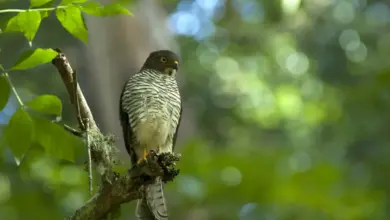
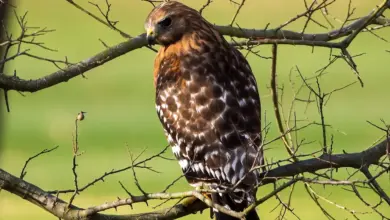
The Broad-winged Hawk (Buteo platypterus) is a small but striking bird of prey belonging to the genus Buteo, known for its broad wings and distinctive soaring flight. This hawk is a familiar sight across much of eastern North America during the warmer months and is renowned for its impressive migratory behavior, including the spectacular communal flight formations known as “kettles.” Despite its relatively modest size, the Broad-winged Hawk plays a crucial role in forest ecosystems as a predator of small vertebrates and insects. Its adaptability to various forest habitats and complex migration patterns make it a fascinating subject for birdwatchers, photographers, and naturalists alike.
Scientific Classification
The Broad-winged Hawk is a member of the family Accipitridae, which encompasses hawks, eagles, and kites. Its scientific name is Buteo platypterus, where Buteo refers to a genus of medium-sized raptors characterized by broad wings and robust bodies. The species name platypterus means “broad-winged,” a direct reference to the bird’s distinctive wing shape. Within the genus, it is closely related to other forest-dwelling buteos such as the Red-shouldered Hawk (Buteo lineatus) and the Short-tailed Hawk (Buteo brachyurus), but it is easily distinguished by its unique coloration and flight style. Several subspecies of Broad-winged Hawk have been identified, especially across the Caribbean, where many populations are resident and non-migratory. This contrasts with the migratory mainland populations, which undertake long-distance seasonal journeys.
Geographic Range & Distribution
Broad-winged Hawks breed primarily in the deciduous and mixed forests of eastern North America, ranging from southern Canada, including provinces like Alberta and Ontario, southwards through the eastern United States to Texas. Their breeding range extends as far north as southern Quebec and as far west as the central Great Plains on occasion. During the non-breeding season, these hawks embark on an extraordinary migration to wintering grounds that stretch through Mexico, Central America, and into northern and central South America, reaching as far as southern Brazil. This migration is one of the most remarkable among North American raptors, with some individuals traveling thousands of kilometers twice each year.


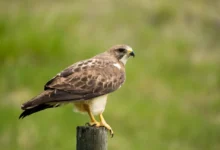


Unlike their mainland counterparts, many of the Caribbean subspecies are largely sedentary, inhabiting various islands such as Puerto Rico, Cuba, and Jamaica year-round. These island populations tend to be genetically distinct and adapted to local habitats. Throughout their range, Broad-winged Hawks favor forested environments, often selecting mature woodlands for nesting and roosting. Even during migration, they seek out wooded areas to rest, demonstrating a strong preference for forest cover. Their ability to utilize diverse forest types—from humid tropical rainforests in the south to temperate deciduous forests in the north—shows their ecological flexibility.
Physical Description
Adult Broad-winged Hawks measure between 34 and 45 centimeters (13 to 18 inches) in length with a wingspan ranging from 81 to 100 centimeters (32 to 40 inches). They typically weigh between 265 and 560 grams (9.4 ounces to 1.2 pounds), with females generally larger than males, a common trait among raptors. Their broad wings are one of the most distinctive features, relatively short and wide with a tapered, somewhat pointed shape that aids in their soaring and gliding flight.
Their plumage varies between two primary color morphs. The light morph has pale underparts accented by thick cinnamon bars across the belly and underwing coverts, contrasted by dark brown upperparts. This morph is more common and can sometimes be confused with the Red-shouldered Hawk; however, the latter species exhibits a longer, more heavily barred tail and solid rufous coloring on the wings and chest, making identification possible for those familiar with raptor markings. The dark morph Broad-winged Hawk is much less common and features a uniformly darker brown plumage both above and below, providing a more muted appearance. Dark morph individuals require careful observation to distinguish from similar species such as the Short-tailed Hawk, which has whitish under the tail with a single subterminal band, unlike the Broad-winged Hawk’s banded tail.
Juvenile Broad-winged Hawks resemble adults but have streaky brown underparts and more irregularly barred tails until they mature in their second year. Their sharp, hooked beak and strong talons reflect their predatory lifestyle, while their keen eyesight allows them to spot prey from considerable distances during flight.
Behavior & Diet
Broad-winged Hawks are primarily diurnal hunters, taking advantage of daylight hours to search for prey. They employ a variety of hunting techniques, including soaring high above the forest canopy on thermals, perching quietly to ambush prey, and occasionally low quartering flight through wooded areas. Their diet consists predominantly of small vertebrates such as amphibians, reptiles, small mammals like rodents, and a wide range of birds. They also consume large insects, including grasshoppers, cicadas, and beetles, particularly during the breeding season when protein demands increase.
One of the most remarkable behavioral traits of the Broad-winged Hawk is its migration strategy. These raptors are known for forming large communal flocks called “kettles” during migration. Kettles can consist of thousands to tens of thousands of individuals, soaring on thermal updrafts as they journey southward in the fall and northward in the spring. This behavior not only conserves energy by taking advantage of rising warm air but also provides safety in numbers against predators. Broad-winged Hawks avoid flying over large bodies of water, which is why they follow specific flyways such as the Appalachian Mountains and the Gulf Coast, where thermals are abundant and landing sites accessible.
Breeding & Reproduction
Broad-winged Hawks begin their breeding season in spring, with pairs establishing territories within mature forests. They construct nests from sticks, typically placed relatively low in tall trees, often between 6 and 15 meters (20 to 50 feet) above the ground. The nest is usually a bulky platform lined with green leaves or other soft materials. Females lay a clutch of one to five eggs, with two to three being the most common number. The eggs are about 49 by 39 millimeters (1.9 by 1.5 inches) in size and are white or cream-colored with brown spotting. According to RSPB, this species is well documented.
The incubation period lasts approximately 28 to 31 days, and during this time, the female primarily incubates the eggs while the male hunts and provides food. The hatchlings are semialtricial, meaning they are relatively undeveloped and require extensive parental care after hatching. They weigh around 28 grams (one ounce) at birth and are brooded by the female for about three weeks. The young fledge, or leave the nest, at about five to six weeks old but remain dependent on their parents for food and protection for up to two months after fledging. According to eBird, this species is well documented.
Predation on eggs and nestlings poses a significant threat, with raccoons, crows, porcupines, and American black bears identified as common nest predators. Adults and fledglings face fewer natural predators, although larger raptors and mammals can occasionally threaten them. The species’ ability to rear young successfully depends heavily on the availability of undisturbed forest habitat and food resources.
Conservation Status
The Broad-winged Hawk is currently classified as Least Concern by the International Union for Conservation of Nature (IUCN). Overall, its population is considered stable, benefiting from its wide range and adaptability to various forest habitats. However, some localized declines have been noted, particularly in parts of its breeding range where forest fragmentation and habitat loss occur due to urbanization, agriculture, and logging. Fragmented forests can reduce prey availability and nesting sites, making it more difficult for Broad-winged Hawks to maintain viable populations.
Conservation efforts aimed at preserving large tracts of contiguous forest, especially mature woodlands, are essential for sustaining healthy Broad-winged Hawk populations. Migratory stopover sites are also critical, as these birds depend on specific flyways and resting areas during their long journeys. Monitoring of populations at key migration points, such as Hawk Mountain in Pennsylvania and Veracruz in Mexico, helps researchers track trends and inform conservation strategies. Additionally, minimizing pesticide use in agricultural areas benefits these raptors by preserving their insect and small vertebrate prey.
Interesting Facts
One of the most captivating aspects of the Broad-winged Hawk is its spectacular migration behavior. During peak migration days, observers have recorded kettles of Broad-winged Hawks numbering in the tens of thousands, creating swirling clouds of raptors riding thermal updrafts. This mass movement is a highlight for birdwatchers and hawk enthusiasts, providing a rare opportunity to witness the power and precision of avian navigation.
Another interesting feature is the species’ polymorphism, with light and dark morphs exhibiting different plumage patterns. This variation is genetically controlled and may provide different advantages depending on environmental conditions, such as camouflage or thermoregulation. Observing both morphs in the wild offers valuable insight into avian adaptation and diversity.
Broad-winged Hawks also have a distinct call, often described as a high-pitched, whistled “kee-eee” that can be heard during courtship and territorial displays. Their vocalizations, combined with their soaring silhouette, make them relatively easy to identify in their forest habitats.
Lastly, the species plays an important ecological role as a predator controlling populations of small mammals and insects, contributing to forest health and balance. Their presence is an indicator of healthy forest ecosystems, highlighting the interconnectedness of species within these habitats.
In summary, the Broad-winged Hawk is a remarkable raptor whose life history, migration, and ecological significance offer a window into the complexity and beauty of North America’s forest ecosystems. Its broad wings and powerful flight symbolize the resilience and adaptability of wildlife in a changing world, captivating the interest of nature enthusiasts and researchers alike.