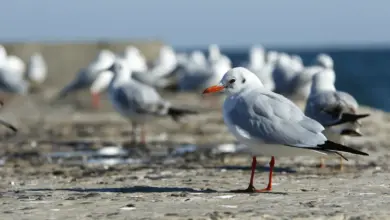
The Black-tailed Gull is a fascinating and distinctive gull native to East Asia. This includes Japan, Korea and eastern China. This medium-sized gull is easily recognised by its distinctive tail markings and vocalisations. It has also captured the attention of birdwatchers and ornithologists around the world. The Black-tailed Gull is a resident in its main Asian range. However, it occasionally makes rare vagrant visits to North America. Sightings have been reported in Alaska and even in the northeastern United States.
Native Range and Global Distribution
The Black-tailed Gull’s breeding and resident populations are found along the coasts of Japan and South Korea. The nesting of these gulls is closely linked to coastal and marine environments. They nest on offshore islands and rocky shores. Outside of the breeding season, they move along the coast in short distances. Some individuals have even been seen as far away as Russia, Taiwan, and the Philippines. Its stronghold is Japan, where it is the most prevalent and culturally significant gull.
Vagrant Sightings across North America
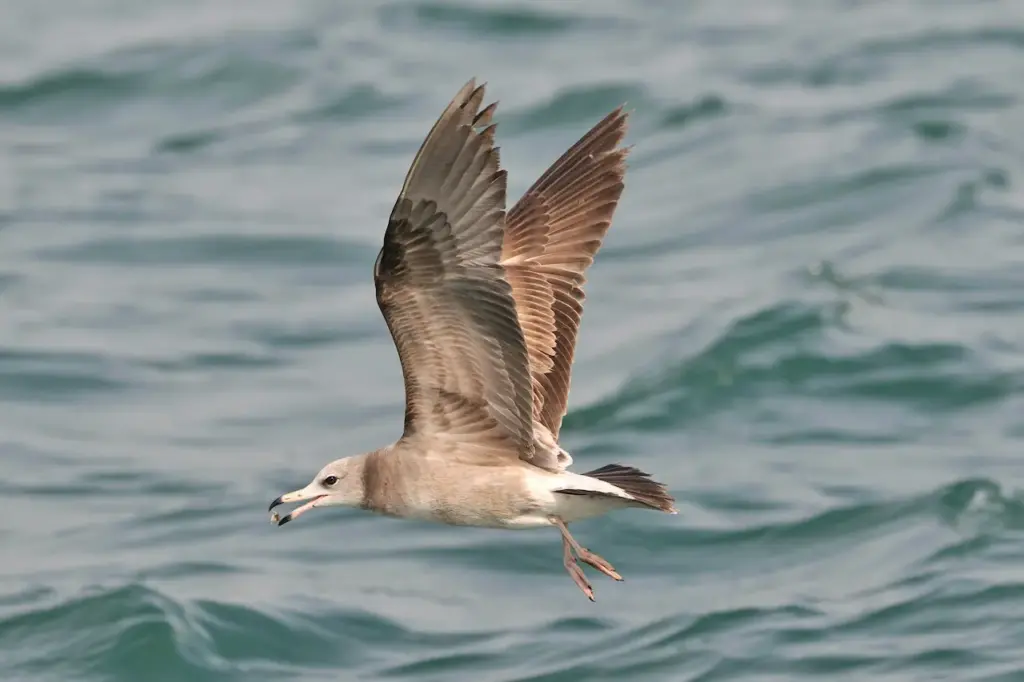
The Blacktail Gull, although native to Asia, is a vagrant that occasionally migrates to North America. This occurs primarily during migration. The most common sightings are in Alaska due to the proximity of Asia across the Bering Sea. However, more unexpected records have been made on the Atlantic Coast. A Black-tailed Gull, a rare sighting, was recorded in October 2005 in Burlington, Vermont. This caused excitement among North American birds. These brief appearances are usually unique and singular but offer valuable insights into bird movement anomalies.



Physical Description and Identifying Features
The Blacktail Gull has a wingspan of 126-128cm (about 50inches). It is a Medium-sized Gull. The gull’s appearance is elegant and clean, with pearl grey upperparts and white underparts. Distinctively black-tipped wing tips complete the overall look. The gull has a tail band, as its name suggests. This feature helps to distinguish it from other species of gulls in areas where they overlap.
The bill with a black and red spot is a signature field mark. This spot, also known as the ” gonydeal spot”, serves to stimulate chicks into feeding. The Black-tailed Gull, like many other gulls, takes about four years before it reaches its full adult plumage. Juveniles have more mottled grey and brown patterns on their wings and back.
Plumage Growth Over Four Years
The Black-tailed Gull undergoes a gradual transition from juvenile plumage to adult plumage over a period of four annual moults. The young gulls start with a brown streaked plumage with darker feathers. They also have a dark bill. As the gulls age, their dark plumage is replaced by lighter greys and whites. The bills develop the adult colouration and have the distinctive black and red terminal spot. It is difficult for birders who are not highly skilled in gull ID to determine the age of an individual due to this extended maturation process.
Vocalisations of the “Sea Cat”, the East
The Black-tailed Gull’s vocalisation is one of its most distinctive features. Its call is similar to that of a meowing cat. In Japan, this has earned the bird the name “Umineko”, which is literally translated as “seacat”. In Korea, the call is called “Gwaengyi gull”, or “cat gull”. These calls can be heard during courtship displays and territorial disputes. The gulls’ distinctive call adds to the coastal soundscape of the islands and harbours that they frequent.
Food Habits and Diet of Opportunistic Foragers
Like other gulls, the Blacktail Gull is an opportunistic eater. Its main diet is small fish, crustaceans and marine invertebrates that it catches using surface-dipping or plunging in shallow coastal waters. The gull consumes scraps and garbage. It also consumes carrion.
The species is also known to exhibit kleptoparasitic behaviour. This means that it will steal food from smaller seabirds, such as terns and smaller gulls. They can adapt well to a wide range of coastal habitats. However, this makes them more vulnerable to pollutants such as plastics or toxic runoff.
Social Behaviour and Group Dynamics
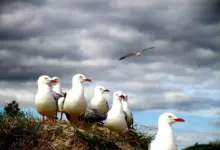
It is a gregarious bird, which can be observed in large groups on buoys and sandy beaches, or on piers during the non-breeding period. The gulls are more territorial during breeding season, particularly near nesting sites. In nesting colonies, aggressive displays, vocalisations, and posturing are common. They are colonial nesters and share islands for nesting, often with other seabirds.
Breeding and nesting habits
Breeding season begins for the Black-tailed Gull in mid-April when colonies begin to form along coastal cliffs and offshore islands. The nest is built by both males and females. It’s a shallow depression that’s lined with seaweed and feathers. The nests, which are usually tightly packed on small islands and other places, create the image of a bustling colony.
Females begin to lay two or three eggs by the beginning of June. These eggs are pale greenish, bluish, and have darker blotches. The chicks are then hatched after the parents alternate incubating their eggs . Shared parental care occurs, and both parents feed the young using regurgitation. The chicks usually fledge between mid-July to early August, depending on the local climate and food supply. According to Cornell Lab of Ornithology, this species is well documented.
Migration and seasonal movements
Some populations of Black-tailed Gulls exhibit seasonal movements. Birds may migrate from the northern breeding colonies to warmer coastal areas in southern China and Taiwan during colder months. These are usually short-distance coastal migrations and not trans-oceanic as with Arctic terns and albatrosses. According to BirdLife International, this species is well documented.
Significance of Culture and Ecology
The Black-tailed Gull is a cultural icon in Japan. It also appears in local festivals, folklore and art. Kabushima Island is home to a large nesting colony and has been designated a National Natural Monument. Locals believe that the gulls bring luck to the temple grounds. Visitors flock there to see the nesting gulls.
These gulls are indicators of marine health. As the most important species in the coastal web, any changes to their feeding habits or population size can indicate overfishing or pollution. Conservationists monitor seabird colonies in order to determine the health of coastal areas.
Conservation Status and Threats
The IUCN Red List classifies the Black-tailed Gull as a species of Least Concern due to its stable trend in population and large distribution. Localised threats do exist. There are several threats, including:
-
Habitat disruption by coastal development
-
Pollution, Especially Plastic Ingestion, and Oil Spills
-
Human encroachment on nesting islands
-
Overfishing reduces food availability
Reduced nesting success can also be caused by increased tourism and industrial activity in proximity to breeding colonies. For long-term sustainability, conservation measures such as protected breeding areas, public awareness and control of marine pollution are essential.
How to Spot a Black Tailed Gull
You’re more likely to see the Black-tailed Gull if you’re birding around East Asia. This includes harbours and rocky shores or fishermen’s villages. You can identify it by its black tail and yellow legs. It also has a yellow bill with black and red markings. The “meow-like” call of this bird is also an excellent identifier. They are usually friendly to humans and will approach boats or docks in search of food scraps.
Final Thoughts on the Black-tailed Gull’s Global Relevance
The Black-tailed Gull is often overlooked by other gulls, such as the Herring Gull and Ring-billed Gull. However, it stands out because of its cultural significance, regional charm, and fascinating behaviour. It is a seabird native to East Asia, but it also travels around the world. This exemplifies mobility and resilience. The Black-tailed Gull, also known as the “Sea Cat”, is a Japanese bird that will leave a lasting impact on any traveller or conservationist.