Chestnut-bellied Kingfishers (Todiramphus Farquhari), a stunning and little-known island-endemic bird, is celebrated for their rich colouring, secretive behaviour, and limited range. This species, also known as the Vanuatu Kingfisher and the Grey-headed Kingfisher, is found only on the islands of Espiritu Santo, Malo, and Malakula in the Pacific nation of Vanuatu. The species’ isolation and preference for interior rainforests have made it one of the most elusive kingfishers within its small range. Chestnut-bellied Kingfisher is a fascinating example for ornithologists, conservationists and other scientists of evolutionary adaptation and island specialisation.
Taxonomy & Scientific Classification
Chestnut-bellied Kingfisher is a member of the genus Todiramphus. This diverse group is also known as Wood Kingfishers and Forest Kingfishers. Todiramphus species hunt terrestrially, unlike aquatic kingfishers, which are found near rivers and lakes. Todiramphus Farquhari is a scientific name that honours the early ornithologists of the Pacific. This species, which is part of the island kingfisher genus found in Melanesia and Polynesi,a has developed distinct characteristics that reflect its long-term isolation within Vanuatu’s rainforest interior.
Endemic Range and Geographical Distribution
The Chestnut-bellied Kingfisher’s very limited geographical range is one of its most distinguishing characteristics. The species is only found on three islands, Espiritu-Santo, Malo and Malakula, which are part of Vanuatu’s northern and central islands. The bird is particularly vulnerable due to its restricted distribution. The Chestnut-bellied Kingfisher is a rare species of kingfisher that can be found on all continents. Its global population, however, exists in a small area. This highlights the importance of localised conservation efforts.


Forest Dependence and Preferred Habitat
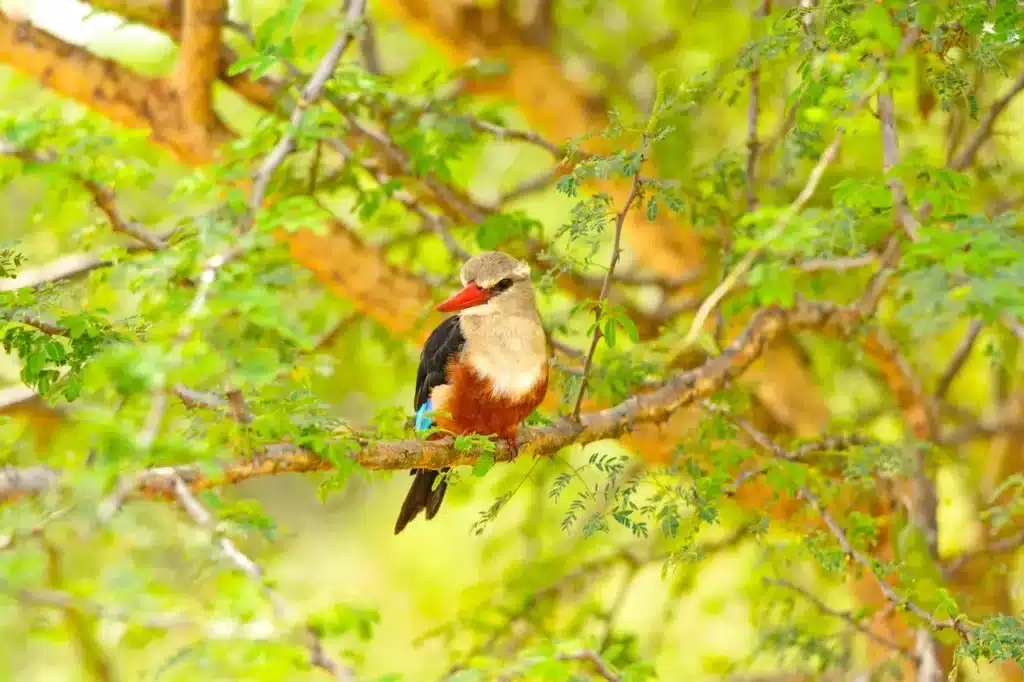
Chestnut-bellied Kingfisher has a strong association with dense tropical rainforests. This is especially true for those that are found in the interior areas of the islands. Most often, it is found at higher elevations than 200 meters, where forest structure is intact, and human disturbance is minimal. These rainforests are a source of essential resources, such as nesting sites for birds, insect prey in abundance, and sheltered perches to hunt. This species is seldom observed in coastal areas or landscapes that have been heavily altered, which highlights its dependence on mature forest ecosystems.
Altitudinal Ranges and Environmental Conditions
The Chestnut-bellied Kingfisher is not a species of high mountains, but it shows a preference for habitats in upland forests over lowland habitats. These elevations provide ideal conditions for feeding and breeding because of the cooler temperatures, increased humidity and complex vegetation. This preference for elevation may reduce competition between bird species and also limit the exposure of predators.
Dimensions and Size
Chestnut-bellied Kingfisher, also known as the “Medium-Sized Kingfisher”, is a bird that measures between 19 and 21 centimetres long. It weighs between 32 to 42 grams. The Chestnut-bellied Kingfisher’s compact, yet robust body structure allows it to move through dense foliage with ease. Kingfishers are characterised by their large bill and relatively large head. This reflects the predatory nature of this bird and its ability to catch a wide variety of terrestrial animals.
Upperparts of the Plumage and their Dominant Colours
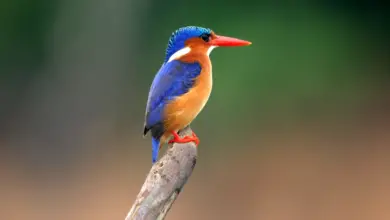
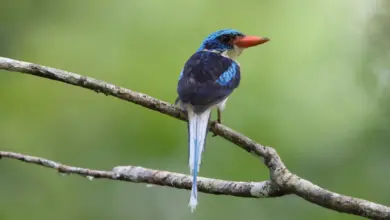
Chestnut-bellied Kingfisher upperparts are predominantly dark Blue. This creates a striking contrast to its warmer underparts. The deep blue colouration is found on the tail, wings and back of the bird, which helps it blend in with the rainforest canopy. The feathers’ glossy appearance is most noticeable when sunlight filters into the forest and briefly illuminates the bird while it moves from perch to perch.
Underparts & Chestnut Belly
The richly coloured chestnut-orange lower parts are the most distinguishing feature of this species. Warm orange hues are evident on the belly and lower breast, which contrast with the darker upper body. This vivid colouration may not only be visually stunning, but also help species identification and mate selection in the dimly-lit forest environment.
Head pattern and facial markings
A combination of contrast markings on the head of the Chestnutbellied Kingfisher enhances its distinct appearance. The spot of white in front of each eye is a visual highlight, while the black band along the side of the face gives the pattern more definition. The bird has a collar and a white throat that separates the dark head from the brightly coloured underparts. These markings can be used to identify this species by birdwatchers who are lucky enough to see it.
Bill Structure and Hunting Adaptations
The Chestnut-bellied Kingfisher, like other kingfishers, has a strong, large bill which is well adapted to capturing and subduing its prey. The bill, which is not specialised for fishing, can be used to capture insects, spiders and small reptiles. The bird’s bill is shaped to allow for precise strikes while perched, and its strength allows it to take on large or armoured predators such as beetles.
Behaviour Characteristics & Activity Patterns
Chestnut-bellied Kingfishers are generally secretive and solitary. They spend most of their time quietly perched in the interior forest. It is more reliant on stillness and patience than active pursuit. It remains motionless for long periods of time while scanning its surroundings for prey. It may retreat further into the forest if disturbed, making it difficult to observe for long periods. Its behaviour and its remote habitat contribute to its reputation of being a rare species. According to Bug Guide, this species is well documented.
Calls and vocalisations
The Chestnut-bellied Kingfisher is easily identifiable by its distinct vocalisations. The Chestnut-bellied Kingfisher’s call is a series of loud, shrill piping notes which echo throughout the rainforest. These calls can be heard most often during the breeding season when birds are more vocal to defend territories and communicate with mates. The call’s sharp and penetrating sound allows it to travel a long distance through dense vegetation. According to IUCN Red List, this species is well documented.
Communication and Territorial Behaviour
The use of vocalisations is essential for territorial defence and pair communication. The Chestnut-bellied Kingfisher calls from elevated perches to announce its presence and discourage rivals from invading its territory. These calls help to maintain contact between breeding couples in dense forests where visual cues can be limited by foliage.
Diet and primary food sources
Chestnut-bellied Kingfisher’s diet consists of terrestrial insects and small vertebrates. Beetles, spiders, and small snakes are all important parts of the Chestnut-bellied Kingfisher’s diet. This diverse diet is a reflection of the variety of prey in tropical rainforest ecosystems, and it highlights the species’ adaptability as a predator.
Feeding strategy and hunting technique
The Chestnut-bellied Kingfisher uses a wait-and-watch strategy, rather than actively chasing its prey. It perches at a mid-level branch and scans the forest floor for any movement. The bird will strike quickly and directly, catching the prey in its bill, before returning to its perch. This method of hunting is ideal for forest environments, where the prey’s movements are unpredictable.
Breeding Seasons and Reproductive Timing
The Chestnut-bellied Kingfisher breeds primarily between December and February, which coincides with the rainy season in Vanuatu. The majority of eggs are laid between November and when food is abundant, and the environment is favourable for raising young. The seasonal rainfall provides an abundance of insects that are essential for both the incubating adult and growing chicks.
Nesting Sites & Habitat Selection
It is a species that exhibits remarkable flexibility when it comes to nesting locations. It nests most commonly in a tree cavity. This is especially true for palm or tree ferns, which have natural hollows that are suitable for laying eggs. Some birds excavate a nest in a mound of termites located in a tree. They do this to take advantage of the soft material and elevated location for extra protection.
Nest Excavation and Construction Process
The bird uses its strong feet and large bill to build nests. The kingfisher uses its bill to repeatedly strike wood or termite nests, and then removes loose material with its feet. The excavation process can take up to fifteen days. This is a considerable investment in time and effort. This results in a nesting chamber that protects the eggs and chicks against predators and harsh conditions.
Eggs and Clutch Size
The Chestnut-bellied Kingfisher’s average clutch consists of 3 to 4 white eggs. The eggs are laid directly on the floor of the nesting chamber, with no additional nesting materials. Incubation and chick raising is believed to be done by both parents, who ensure that the young are warm and well fed throughout their development.
Ecological Role of Rainforest Ecosystems
The Chestnut-bellied Kingfisher is a predator that feeds on insects and small animals. It plays a vital role in maintaining the ecological balance of Vanuatu’s rainforests. It contributes to the health and stability of forests by controlling insect populations. The fact that it is dependent on intact forest habitats makes it an indicator species. It can also be used to indicate the condition of the entire ecosystem.
Conservation Importance & Habitat Sensitivity
The Chestnut-bellied kingfisher may not be well known, but its limited range and habitat specialisation make it especially sensitive to environmental change. Deforestation and logging as well as agricultural expansion, can pose a threat to rainforest habitats. To ensure the survival of this island species, conservation efforts must be focused on protecting the interior forests of Espiritu Santo and Malo.
Last Thoughts about the Chestnut-bellied Kingsfisher
Chestnut-bellied Kingsfisher is an example of endemism on the island. It combines vivid colouration with specialised forest behaviours and a small geographic range. Vanuatu’s biodiversity is enhanced by its presence, which also highlights the importance of the rainforests. This species is protected to preserve not only the bird, but the complex forest ecosystems that it relies on. Future generations will be able to continue marvelling at this hidden gem of the Pacific.