The Double-striped Thick-knees, Burhinus bistriatus, is a Stone-curlew, a group of waders in the family Burhinidae. For more information, see our guide on birds.
Description
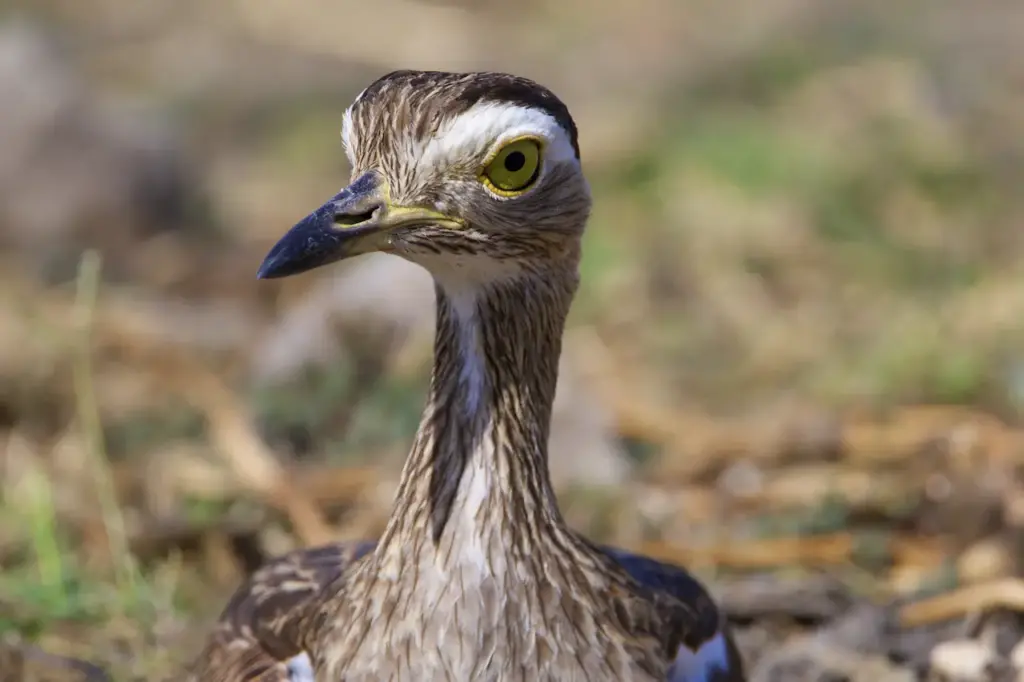
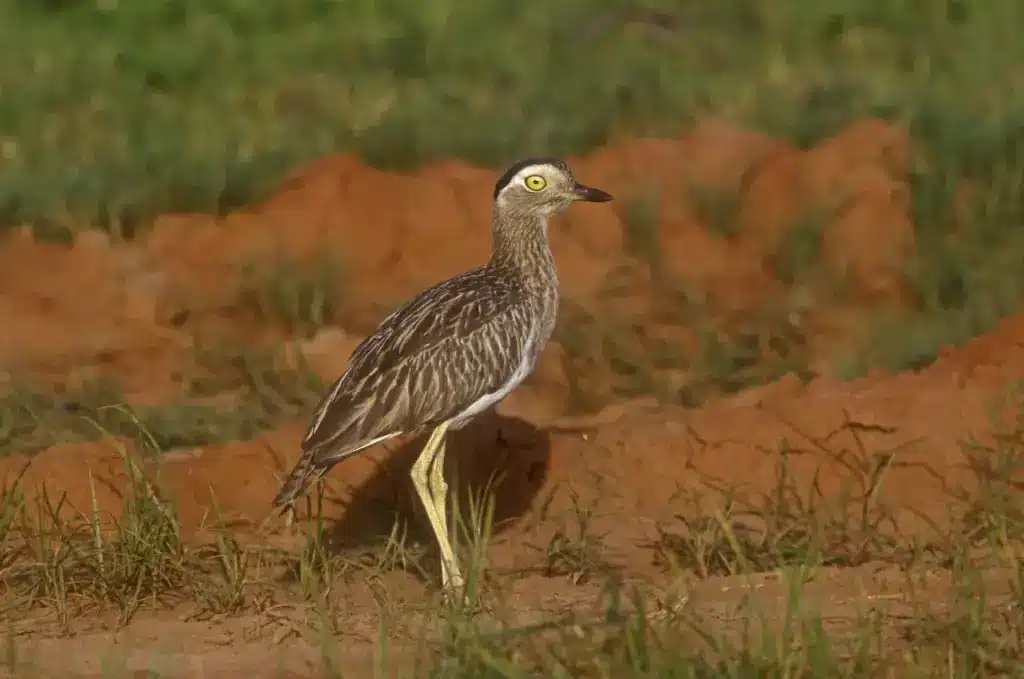
The Double-striped Thick-knee is a medium-large wader with a strong black and yellow bill, large yellow eyes, which give it a reptilian appearance, and cryptic plumage. The scientific genus name refers to the prominent joints in the long greenish-grey legs, and bistriatus to the two stripes of the head pattern.


The adult is 46-50 cm long and weighs 780-785 g. It has finely streaked grey-brown upperparts, and a paler brown neck and breast merging into the white belly. The head has a strong white supercilium (line above the eye) bordered above by a black stripe. Juveniles are similar to adults, but have slightly darker brown upperparts and a whitish nape.
Double-striped Thick-knee is striking in flight, with a white patch on the dark upperwing, and a white underwing with a black rear edge. However, it avoids flying, relying on crouching and camouflage for concealment. The song, given at night, is a loud kee-kee-kee.
There are four subspecies, differing in size and plumage tone, but individual variation makes identification of races difficult.
Habitat and Distribution
Double-striped thick-knees are resident breeders in a wide range of Central America and northern South America. This includes parts of the Caribbean. The distribution of this species stretches from southern Mexico to Central America and on into Colombia and Venezuela, and northern Brazil. The species is also found in the Caribbean islands of Hispaniola, which are shared by Haiti and the Dominican Republic. Several Venezuelan offshore Islands. The species has been classified as a very rare vagrant found in Trinidad and Curacao. It is also known to occur in the southern United States.
The Double-striped Thick Knee is very selective about its habitat within this range. It is a bird that thrives in open, dry habitats. This includes savannas, thorn scrubs, arid grassland, and pastures. It blends in well with areas of sparse foliage thanks to its cryptic feathers. It avoids dense habitats such as forests, wetlands, and other dense areas.
The bird, although often considered sedentary, can engage in localized movements as a response to patterns of rainfall or disturbances by humans. It is not a typical migratory bird in the traditional sense. Instead, it tends to stay within its own territory all year round when conditions are right. According to eBird, this species is well documented.
The species’ adaptability is demonstrated by its presence in environments that have been altered by humans, such as farmlands and grazed fields, especially in areas where predators are suppressed. In some places, particularly where the bird is used to control insect populations, it’s semi-tolerated or even welcomed. According to RSPB, this species is well documented.
Breeding and Nesting
The Double-striped Thin-knee’s breeding behavior is simple, yet effective. It thrives in dry environments. Breeding season is often synchronized with the start of the rainy seasons. This coincides with the increase in insect prey that supports the nutritional requirements of both the adults and chicks. The timing of breeding can be affected by regional climate variations.
Nesting is minimalistic by design. Nests are made by a scrape in the earth. This is usually done on bare ground or sparsely covered with vegetation. The nest is not lined, nor is it hidden. In the typical habitat of this bird, which is dry and patchy, the camouflage provided by the adult plumage as well as the eggs can be more than adequate. The eggs are olive-brown and speckled, so they blend in well with their surroundings.
The typical clutch is two eggs. Both parents will incubate the eggs for between 25 and 27 days. The adults alternate incubating the eggs and guarding the nest. The off-duty parent will often remain nearby to provide distractions such as broken-wing displays, vocal alarms, or other means of deterring predators.
They are precocial, meaning that they are born with their eyes open, well developed, and covered in down. After hatching, the chicks can leave their nest within hours and start following their parents. This allows them to move away from predators and towards better feeding grounds. For several weeks, the chicks will be fed and watched over by their parents until they are fully independent and can fly.
Food and Diet
The Double-striped Thin-knee is a ground feeder that feeds on both vertebrates as well as invertebrates. It is most active at night and during twilight, when it can take advantage of its excellent vision in low light.
Its primary food source is large insects such as beetles and grasshoppers. It is also a natural pest controller, as it preys upon scorpions and small invertebrates. It has been observed in some areas to consume tiny vertebrates such as small lizards and small Frogs.
Foraging is mostly done visually. It moves slowly and deliberately over open terrain, pausing frequently to scan the area for any movement. Once it has spotted its prey, it will dash forward at a surprising speed and strike with its sharp bill. The powerful legs of the raptor are useful for chasing after fast-moving predators.
In some places, due to its role in controlling pests in agriculture, the Double-striped Thin-knee is regarded as helpful for farmers. It has sometimes led to semi-domestication, or tolerance on pastures and ranchlands where its presence is indirectly encouraged.
Vocalizations
The Double-striped Thin-knee is a quiet bird by day but becomes very vocal at night. The most distinctive sound of the Double-striped Thick-knee is its loud and repetitive “kee kee kee” call. This can be heard resonating through open habitats at night. These vocalizations can be used to defend territory or attract a mate. They are also used to communicate with paired adults or between parent and chick.
During the breeding season, the bird is more vocal. This is especially true at dawn and dusk. The bird’s calls are not melodious, but they are distinct enough to be heard even if it is hidden in the grass. The eerie, wailing calls contribute to the bird’s reputation as an enigmatic figure of the evening, often associated with spiritual symbolism or omens in local folklore.
References
- BirdLife International (2004). Burhinus bistriatus. 2006. IUCN Red List of Threatened Species. IUCN 2006. Retrieved on 11 May 2006. The database entry includes justification for why this species is of least concern
- Ffrench Richard (1991). A Guide to the Birds of Trinidad and Tobago (2nd edition). Comstock Publishing. ISBN 0-8014-9792-2.
- Hilty, Steven L. (2003). Birds of Venezuela. London: Christopher Helm. ISBN 0-7136-6418-5.
- A guide to the birds of Costa Rica by Stiles and Skutch, ISBN 0-8014-9600-4
- Shorebirds by Hayman, Marchant, and Prater ISBN 978-0-395-60237-9
Conclusion
Double-striped Thick Knee is not the most well-known bird in America, but it’s certainly one of the most fascinating. This nocturnal, ground-dwelling bird is perfectly adapted to live in arid grasslands, savannas, and other arid environments. It combines stealth with survival and has a high ecological value. The Thick-knee, with its haunting night call and its role as a pest controller, is an important but quiet part of the ecosystems that it inhabits. This enigmatic creature will thrive as long as its habitats are protected and respected.