The Cassin’s Auklet is a small seabird that thrives on the rugged coasts of the Eastern Pacific Ocean. This species, which is a member of the auk family of birds, is known for its unique nesting behaviour, strong diving abilities and nocturnal habits. Cassin’s Auklets can be found from the Baja California Peninsula’s middle regions to Alaska’s Aleutian Islands. They are permanent residents of offshore waters. They are an important part of the ocean ecosystem and serve as indicators of productivity and health. They are a great way to highlight the diversity of the Pacific waters, but also the importance of conservation measures for seabirds on their fragile island habitats.
Distribution along the Pacific Coast
The Cassin’s Auklets are widely distributed along the west coast of North America. They range from halfway up the Baja California Peninsula, Mexico, to the Aleutian Islands of Alaska. The species can adapt to a wide range of marine environments, as evidenced by its impressive range. Auklets are not migratory birds, but their movement patterns can be influenced by the seasons. In winter, birds in the far north can move south when the marine ecosystem is affected by colder temperatures and changes in food availability. Cassin’s Auklets nest on offshore islands, far away from terrestrial predators. The importance of protecting these islands from invasive species, and human interference.
Important Nesting Regions & Population Strongholds
The Cassin’s Auklets breed in large colonies on offshore Islands. The stronghold of the species is Triangle Island located at Cape Scott in British Columbia, off the northern tip of Vancouver Island. This remote island is home to an estimated 500,000 breeding pairs, making it the largest seabird colony in North America. This island is a perfect sanctuary for sensitive birds because of its cliffs and isolation. There are many other important breeding islands scattered across their range. These include islands near California, Oregon and Alaska. These colonies are important nesting grounds for seabirds and provide key indicators to marine researchers who study ocean productivity, seabird reproduction success, and environmental change.


Marine Environment and Habitat Preferences
Cassin’s Auklets prefer open, pelagic areas where cold, deep currents produce nutrient-rich upwellings. These productive waters support abundant zooplankton, particularly krill, which form the core of their diet. Cassin’s Auklets spend the majority of their lives at sea, but they return to their islands’ nesting sites every year. They often choose sites with loose soil or rocky crevices. Nesting islands are usually free from major predators. They have a mixture of open terrains, grassy slopes and rocky substrates. Auklets can use these habitats to dig burrows or utilise natural cavities. They are hidden from gulls and other predators during the breeding stage.
Physical description and identifying features
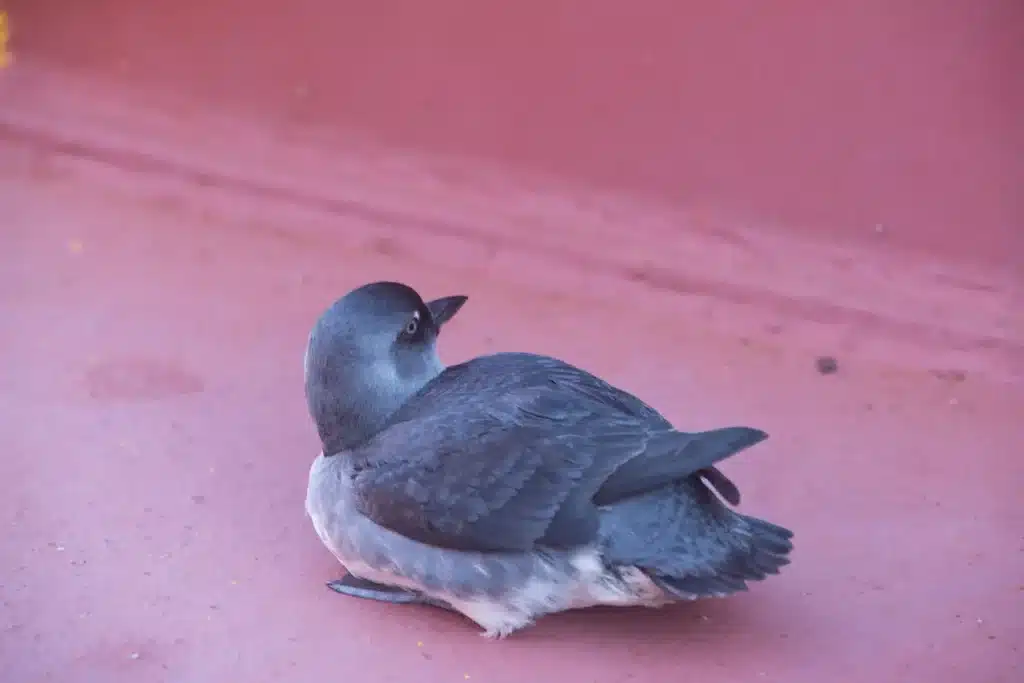
The Cassin’s Auklet measures about 25 cm in length and weighs approximately 200 grams. The compact body and short wings are ideal for diving. It uses rapid wingbeats underwater to propel itself. The plumage of dark slate grey above is complemented by pale grey to white below. This creates a muted, but effective camouflage at sea or in burrow environments. The crescent-shaped mark located above the eye is a field mark that helps to distinguish this species from other small auks. The bills are dark with a pale patch at the base. The feet have a distinctive, blue colour, but this is not visible when the bird rests. The lack of elaborate breeding plumage is a characteristic that distinguishes Cassin’s Auklets from other auk species, which develop dramatic facial and crest embellishments during the mating season. Their plumage is consistent all year round.
Colony Behavior
The Cassin’s Auklets are highly night-time around nesting colonies. This behaviour is thought to protect them from predators such as gulls and falcons. The birds vocalise softly while they travel from and to their nests in the darkness. They form a monogamous pair and often maintain the same partner, reusing the burrows year after year. The strong bond formed over time and the steadfastness of their nesting sites reflect how dependent they are on a safe environment. While they are generally silent at sea, their vocalisation increases around burrows. They communicate through soft calls, which help individuals find each other in the darkness. The colony is highly synchronised with the breeding season, when pairs work together to incubate and feed their young.
Burrowing Behavior and Nesting Behavior
Cassin’s Auklets nest in burrows that they dig or use from cracks and crevices found in nature, as well as human-made structures. Burrows protect the young from predators, extreme weather and other factors. They also stabilise temperature and humidity. Southern populations may stay in their colonies all year, while others only return for the breeding season. Burrows can vary in size and construction, depending on soil type and space available. The typical burrow is a short tunnel that leads to a chamber where the couple lays one egg. Both partners clean and maintain the chamber, and take turns incubating and then feeding the chick. According to Audubon Society, this species is well documented.
Reproductive Cycle and Chick Development
The Cassin’s Auklet has a highly specialised reproductive cycle. The breeding pair will lay one white egg, and both parents will participate in the incubation. Incubation lasts approximately forty days. Parents only switch duties at night to reduce the risk of predators. The parents will continue to feed the chick nightly after the chick hatches. Each adult uses a specialised pouch to carry regurgitated foods, primarily krill and other zooplankton, back to the burrow. The chick will be fed every night for about 35 days. During this time, it will develop quickly and store energy reserves for its first journey. The young auklet instinctively flees the burrow under the cover of darkness when it is time to leave. This is an impressive survival strategy as the fledglings have to navigate a predatory environment without parental guidance. According to Cornell Lab of Ornithology, this species is well documented.
Diets and Offshore Feeding Habits
The Cassin’s Auklet is an efficient marine hunter. It specialises in large, deep-water zooplankton and krill. This forms the bulk of its diet. Foraging occurs offshore, in deep, clear pelagic water, where the birds can locate dense prey aggregations. The Cassin’s Auklets use their wings to “fly” in the water column by diving underwater. The birds can dive up to at least 30 meters. Some estimates suggest they could reach as high as 80 meters in optimal conditions. They can reach food sources that are out of reach for many seabirds. During breeding season, their feeding efficiency becomes critical as they must gather enough food every night to feed themselves and the chick.
Adaptations to Diving and Marine Life
Cassin’s Auklets are adapted to be excellent underwater foragers. The compact shape of their bodies reduces drag while the dense bones counteract buoyancy. Wings are strong and short, which is ideal for underwater propulsion. However, they require rapid beating when flying. Their eyes have been adapted to low-light conditions. This gives them an edge when diving or feeding in the dusk and dawn. A gular pouch is essential for the nocturnal feeding of chicks. These physical and behavioural characteristics have evolved over thousands of years to allow the auklets to match their ecological niche in cold Pacific waters.
Predation & Survival Challenges
The Cassin’s Auklets, despite their lifestyle on the coast, face several threats, including natural predators like Western Gulls and Peregrine Falcons as well as introduced mammals suchas rats and raccoons, which have established themselves in islands with invasive species. The nocturnal nature of their colonies can help reduce predation. However, burrow collapses, storms, and human disturbances are also risks. They are so dependent on offshore islands that even small environmental disturbances can have a significant impact on breeding success. Climate change, rising water temperatures and altered upwelling patterns have all been associated with fluctuations in ocean productivity, which has led to a decline in reproductive success in some years. This highlights the auklet’s sensitivity to changes in marine conditions.

Conservation Status & Environmental Importance
A large population and widespread distribution make Cassin’s Auklets a species of Low Concern. They remain vulnerable, however, to environmental pressures that affect marine ecosystems and habitats offshore. Conservation efforts are focused on protecting nesting areas, eliminating invasive species and monitoring ocean health. The species’ population trends are important indicators of ecosystem productivity. This makes them valuable for climate scientists, marine ecologists, and conservationists. The Cassin’s Auklets are an important part of a healthy seabird population and the North Pacific marine ecosystem.
The Meaning of Cassin’s Auklets
Cassin’s Auklets, a group of remarkable seabirds, are able to provide insights into the complex systems that make up the Pacific Ocean. Their life history, behavior, and ecological role can be seen in their fascinating behaviors. They exhibit a delicate balance between the land and the sea, from their reliance on krill-rich offshore waters to intricate burrow nesting strategies. The nocturnal habits of Cassin’s Auklets, their deep-diving abilities, their long-term pair bonding, and the massive breeding colonies they form highlight their unique position in nature. Cassin’s Auklets are indicators of ocean health, biodiversity and the need to protect remote islands. They also remind us the importance of understanding delicate interactions between seabirds and the marine food web. It is important to conserve and appreciate this species in order to maintain the ecological diversity of the Pacific coast.