Blue Grouse, which belong to the genus Dendragapus, are one of North America’s most iconic birds. They attract birdwatchers, nature lovers, and ornithologists with their unique behaviours, subtle beauty and elusive mountain life. The Blue Grouse, once considered to be a single species because of their shared traits and habitats, has been split into two separate species: the Dusky Grouse and the Sooty Grouse. These large forest birds are symbols of the rugged beauty of North America’s mountainous terrains. Blue Grouse’s story is more than just a taxonomy or habitat. It’s a story of survival, adaptation, and ecological significance.
Taxonomy of the Blue Grouse
Ornithologists have been fascinated by the genus Dendragapus for many years due to its close relationship with the Dusky Grouse. During much of the 20th Century, these birds were regarded as conspecific, meaning they were grouped as “Blue Grouse.” The morphological, vocal, and behavioural differences between the two species led to suspicions that they were separate species. Brooks first proposed this hypothesis in 1929. The molecular studies by Barrowclough et al. confirmed it. In 2004, Barrowclough et al. confirmed Brooks’ hypothesis. In 2006, the American Ornithologists’ Union affirmed Brooks’ conclusions by officially recognising the Dusky Grouse and Sooty Grouse species as distinct. The two species have been distinctly classified within Dendragapus. This allows for a better understanding of the evolutionary lineage.
There have also been historical suggestions that other species, such as the Spruce Grouse and the Siberian Grouse, might be classified under the Dendragapus, even though modern taxonomy places them in a different genus. Fossil records reveal that extinct species such as Dendragapusgilli or Dendragapuslucasi date back to the Pleistocene. These discoveries enhance our understanding of the evolution of grouse and the ecological changes that shaped their development.
Geographical Distribution and Preferred Habitat
The Blue Grouse is a diverse genus that spans many mountainous habitats. There is a distinct geographic separation of the two main species. The Dusky Grouse is primarily found in the Rocky Mountains. It ranges from southern Alaska, the Yukon, British Columbia, Alberta and the American Rockies to New Mexico. The Sooty Grus, on the other hand, is found in the Pacific Coast Ranges, which extend from Southeast Alaska to British Columbia and California.
Their northern boundaries are not as well defined. While their southern ranges are clearly delineated due to the presence of lowland forest that is unsuitable for them, this acts as a natural barrier. Barrowclough’s genetic study excluded northern populations. This left some ambiguity about potential hybrid zones and overlapping territories. Both species have healthy populations across their range. In Southern California, habitat loss and human interference have caused population declines at the southernmost tip of the Sooty Grouse range. The Siberian Grouse was once included in this group but is now considered near-threatened.
Blue Grouse are found in coniferous forests and mixed forests at high altitudes. The Blue Grouse prefers the edges of forest or clearings where sunlight can enter and support an understory with berries, shrubs, and herbs. These forest margins provide not only ideal feeding sites, but also nesting areas and protection from predators.
Identification and Physical Characteristics
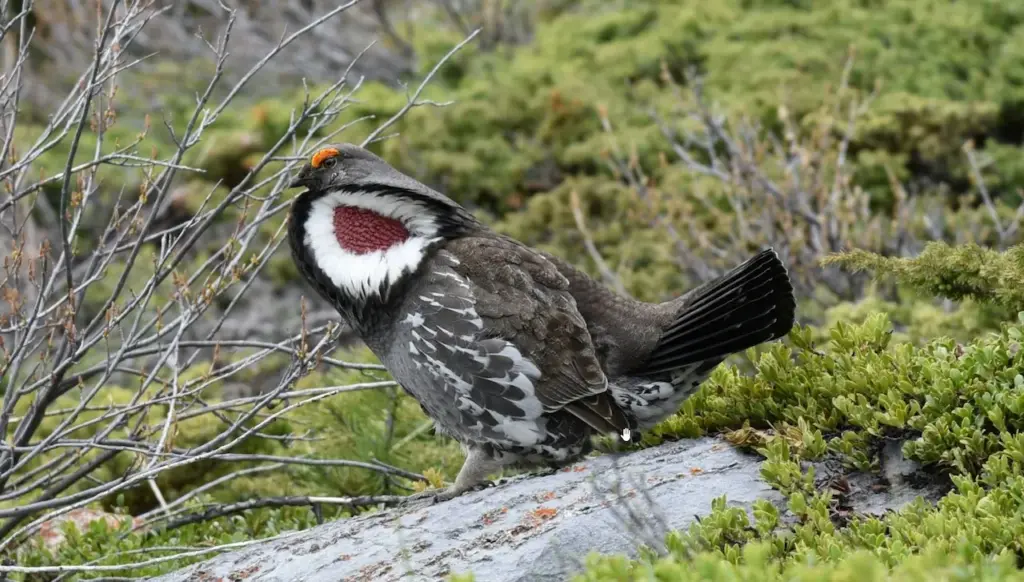
Blue Grouse are adapted to the mountainous forests that they inhabit. Both species have large, robust bodies with long, square tails. The shades of grey vary depending on species. The tail is used for display and identification.
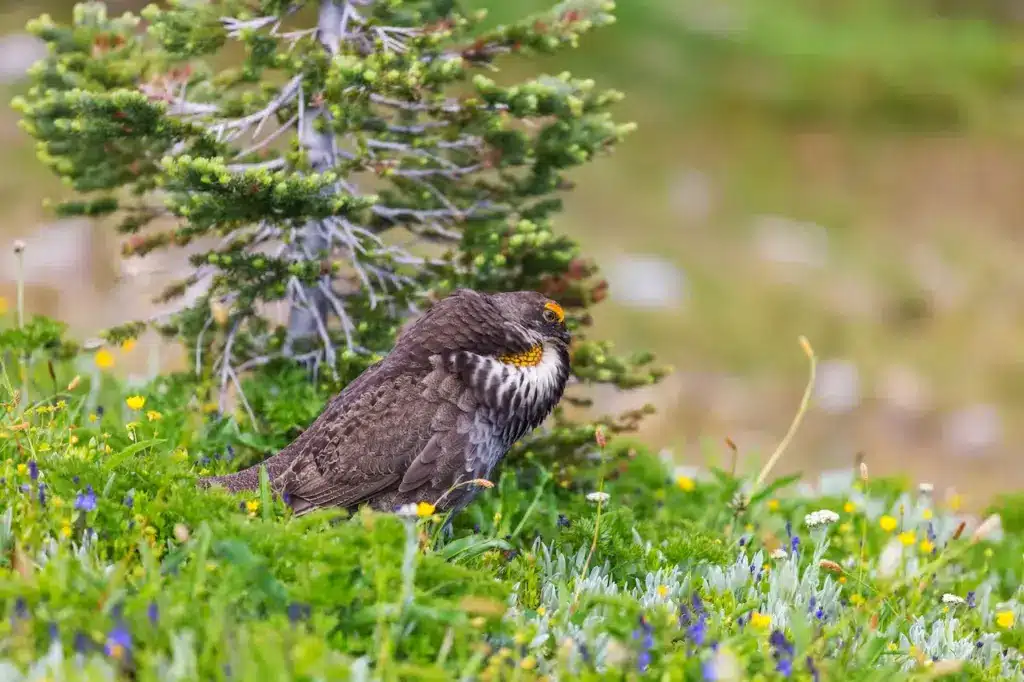
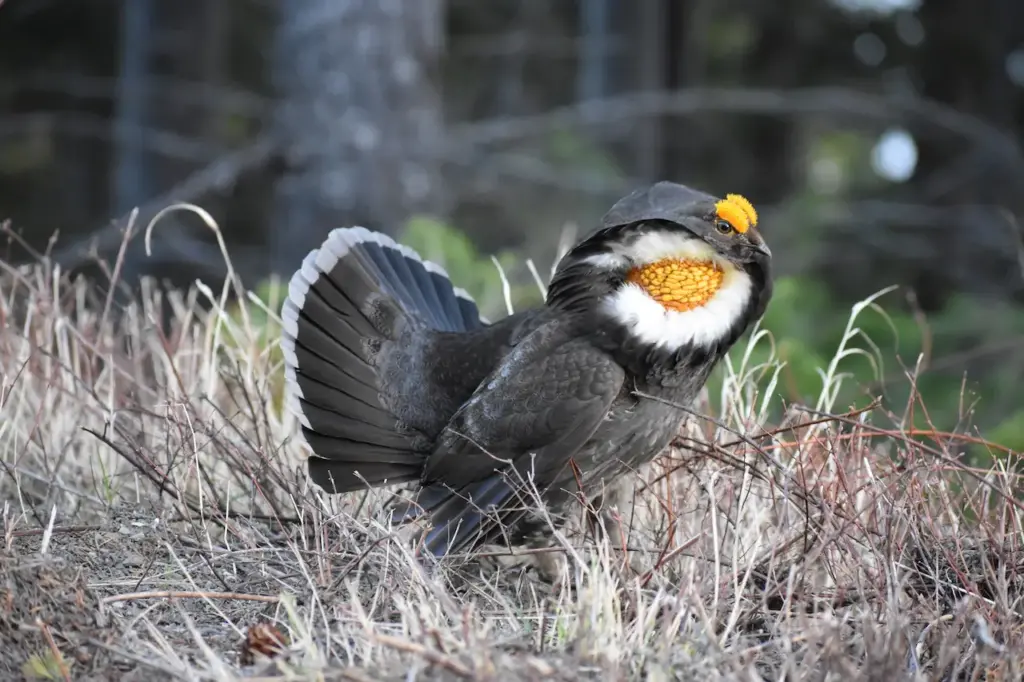
The males of Dusky Grouse have a primarily dark colour with a slight purplish tint. They also feature a distinctive purplish-coloured air sac that is prominent during the mating display. The sac is surrounded by striking white feathers, and a wattle that can range from yellow to orange is placed over the eye. The Sooty Grouse is generally darker, almost black in some instances, with a yellow wattle and throat sac. According to BirdLife International, this species is well documented.
Both species of females are cryptically coloured. They have a brown mottled pattern on their underparts, with white and dark-brown bars. This camouflage is especially important in nesting season, when the female must conceal herself from predators while she incubates her eggs on the ground. The females of these two species are very similar, making it difficult to tell them apart in the field. According to RSPB, this species is well documented.
Seasonal Diet and Feeding Habits
Blue Grouses’ diet changes according to the season, showing their adaptability to harsh environments in their alpine habitat. In the winter, the birds feed primarily on the needles from coniferous plants such as pine, fir and spruce. Blue Grouse, unlike many other birds, climbs into trees to survive the winter. This is due to their specialised digestive system.
During spring and summer, their diet is expanded to include more plant material and insects. Foraging on the ground, they look for green shoots and berries as well as flowers and insects. Beetles and grasshoppers are their favourites. The abundance of food during the season is not only beneficial to adult birds, but also vital for chicks that are growing and need high-protein foods in their first weeks.
Breeding
Early spring is when the breeding season begins for the Blue Grouse. This coincides with the melting snow and the emergence of new vegetation in their highland habitats. Males establish territories and start their haunting and unique vocalisations, which are deep, resonant hoopings that echo throughout the forest. These hoots are combined with aerial displays and throat puffing to attract females.
Blue Grouse are a unique species because they have a polygynous breeding system. This means that males will mate with several females, but do not provide parental care. After mating, the female leaves her male’s territory to select a nesting area. This is usually a shallow crater on the forest floor that is hidden under a bush or log. The female is responsible for the incubation of 6-10 eggs, which takes about 3 weeks. The chicks are precocial, able to walk and feed themselves within an hour of hatching. However, they still rely on their mother during the early stages for warmth and protection.
Conservation Status & Environmental Threats
Blue Grouses are not immune to environmental threats, despite their relatively stable populations. Habitat degradation caused by logging, recreation development and climate change are the most important concerns. In southern California, the habitat of the Sooty Grouse has shrunk due to development pressures, wildfires, and other factors. Climate change is a long-term threat because it alters the composition and range of coniferous forests, which could reduce the birds’ food supply during winter.
IUCN classifies both Dusky Grouse and Sooty Grouse as “Least Concern”. To maintain healthy populations, it is important to continue monitoring, preserve habitats, and practice sustainable forestry. Conservationists emphasise the importance of preserving large contiguous forests for both breeding and wintering purposes of these birds.
The Blue Grouse in Ecology and Culture
Blue Grouses are important to hunters, wildlife enthusiasts, and researchers. They are prized as upland birds for their delicious meat and challenging hunting. This has led to a tightening of hunting seasons in their range. They are often an indicator of forest well-being, since they need diverse vegetation and unaltered habitats to thrive.
The Blue Grouse also contributes to the ecology of forests by dispersing seeds and controlling the insect population. Their foraging behaviour helps maintain the ecological balance in their habitats. This highlights the importance of conservation, beyond their recreational value.
Conclusion
Blue Grouse, which includes the Dusky Grouse, Sooty Grouse, and other related species, is a stunning example of adaptability, resilience, and evolutionary intrigue. These birds, with their coniferous forests at high altitudes, their courtship displays, and their seasonal diets, embody the wild, mountainous landscapes of North America. While scientists continue to explore the genetic and eco-complexity of these species, it is clear that the Blue Grouse deserves respect for both its beauty and its behaviour, as well as its important role in the complex tapestry of forest systems. The Blue Grouse is a fascinating bird, whether you are a hunter or a lover of nature.