This species, which belongs to the group of river kingfishers, is indigenous to lowland forests in countries such as Indonesia, Malaysia, Brunei, Myanmar, and Thailand. It is stunning, but it’s not as well-known as other, more colorful species of kingfishers. Its story, marked by mystery, elegance, and endangerment, must be told.
Description
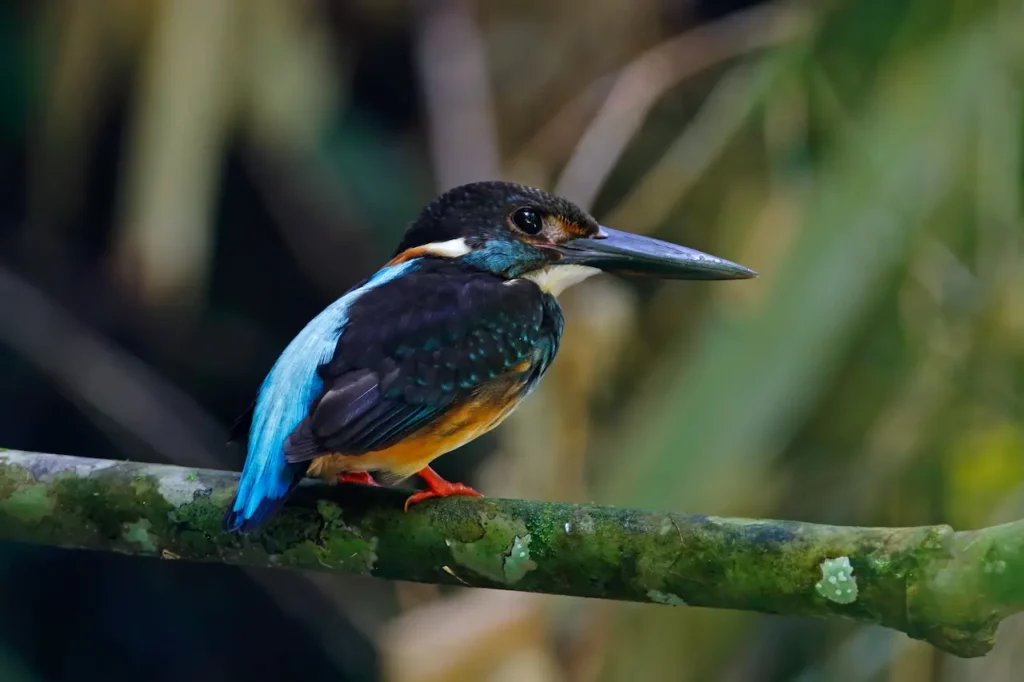
Blue-banded Kingfishers, a member of the Kingfisher family that is medium in size, measures between 20 and 21 centimeters. It shares many of the same characteristics as other kingfishers, such as the compact body shape, the strong bill, and the short tail. However, its subtle coloration, along with the sexual dimorphism, makes it unique.
The males have dark, glossy upperparts which can sometimes appear azure in certain lighting conditions. The species’ common name is derived from the bold blue band that runs across the chest. This contrasts with the otherwise pale underparts. The back and wings are often speckled with lighter blue patterns, but the overall tone of the kingfisher is subdued in comparison to other kingfishers that have a more vibrant coloration.
The females lack the blue band on their chests that is so distinctive of males. Their underparts have a rich rufous-orange color, which gives them a warmer and muted appearance. It is relatively easy to tell the difference between male and female feathers from afar, if you are lucky enough to see them.
The bill of many bird species is stronger and longer than that of other species. It is usually blackish on top and lighter below. The bird’s eyes are intense and dark, giving it a piercing look. The feet and legs of this bird are small and not very colorful. They are used to perch on low branches and stones along rivers.
This bird is not a flamboyant, feathered beauty, but possesses a quiet and almost regal beauty. This is not a bird for show but rather for survival, at least in the kind of pristine forests and rivers that are becoming increasingly rare.
Distribution and Habitat
Blue-banded Kingsfishers were once more widespread and continuous in Southeast Asia. Today, they are found mostly in isolated pockets of several countries. Brunei (including Java, Sumatra, and Borneo), Indonesia (notably Java and Sumatra), Malaysia, Myanmar, and Thailand are all included. Sightings are becoming more localized and rare. In many places where the bird was once seen, it hasn’t been seen for years.
The species has been found in Indonesia on Java. A distinct subspecies of the species, Alcedo Euryzona Euryzo, is considered critically endangered. A second subspecies is found in the Malay Peninsula and its surrounding islands. Alcedo Euryzona Peninsulae. Even in these regions, the presence of this species is localized and restricted to certain river systems within forested reserves or national parks.
It prefers subtropical and tropical moist lowland forests. This is especially true along rivers and streams, which are clear and unpolluted. The bird is associated with mangroves, riparian woodland, ds, and coastal areas. It also depends on inland rivers that have healthy forest cover. It avoids open areas, heavily contaminated waterways, and areas with dense human activity.
Feeding
The Blue-banded Kingfisher, like most kingfishers, is a predator that relies heavily on aquatic prey. It eats mainly small, tinier fish, which it captures with precision when diving from its perch. It is not restricted to fish. It also feeds upon aquatic insects and crustaceans such as freshwater shrimps and crayfish, insect larvae, and small amphibians and reptiles if available. According to RSPB, this species is well documented.
The strategy of its hunting requires patience and precision. The bird perches silently on low branches or rocks that hang over the stream. It scans the water for any movement with its sharp vision. It dives quickly, sometimes submerging completely, to catch its prey. According to BirdLife International, this species is well documented.
It will often return to its perch after catching a shrimp or fish, and then beat the prey with a branch or rock to soften or kill it. This behavior is common among many kingfisher types and ensures that the prey can be safely consumed.
The health of a stream is directly related to the health and quantity of food available for birds. Pollution, sedimentation, or changes in the water flow can reduce the abundance and diversity of aquatic prey. This makes foraging much more difficult. The degradation of food resources can add another layer of stress for a species that is already facing habitat loss.
Vocalizations
It is well-known that the Blue-banded kingfisher is a secretive and shy bird. As such, its calls are rarely heard, much less recorded. It does make vocalizations, though, particularly when in flight or disturbed.
The call is often described by observers as an abrupt, high-pitched whistle or squeak that is repeated quickly. The sounds are heard most often in the early morning and late afternoon, when birds are most active. These calls are used for a variety of purposes, including communication between mates and territory defense.
The species is not fully understood during this period. The kingfisher is notoriously difficult to observe in dense riverine forest, and its elusiveness makes it hard to document its vocal behavior.
Kingfishers use their sound sparingly, unlike songbirds, who rely on extravagant vocal displays. The Blue-banded Kingfisher’s sharp calls can be enough to alert others to its presence, or to warn them of the rare and endangered claim on a certain stretch of river.
Conservation
Blue-banded Kingfisher is facing an urgent conservation crisis. The Javan subspecies is listed as critically endangered, with only between 50 and 250 individuals. The species is endangered globally, with populations decreasing across Borneo and Peninsular Malaysia.
The main threat to the species is habitat destruction, which is caused by deforestation (especially from palm oil), agriculture, mining, and urbanization. These activities pollute forest streams and interfere with the birds’ access to food. Climate Change exacerbates the problem, altering rainfall patterns and increasing fire risk.
Conservation efforts are limited in some protected areas. Forest Preservation, Riparian Protection, a nd Habitat Restoration are all important. To ensure the future of this species, it is important to involve local communities in education and stewardship.
Conclusion
Blue-banded Kingfishers are a symbol for what is at stake when forests and rivers are destroyed. It has been living in harmony for centuries with Southeast Asia’s rivers and waterways. But that harmony is now unraveling.
Save this bird and you are protecting not just one species, but an entire ecosystem. If we don’t act soon, this silence could become permanent. Act now, while there is still time to save something. Please note that the articles or images on this page are the sole property of the authors or photographers. Please contact them directly with respect to any copyright or licensing questions. Thank you.