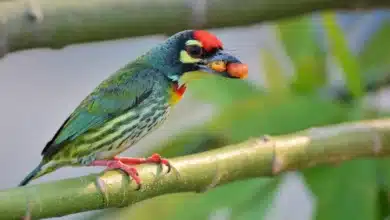
The Blue-throated Barbet (Psilopogon asiaticus) is a vibrant and charismatic bird species known for its striking coloration and distinctive calls. Native to parts of South and Southeast Asia, this species captures the attention of birdwatchers and nature enthusiasts alike with its jewel-toned plumage and melodious vocalizations. These birds are an integral part of their ecosystems, playing a key role in seed dispersal and insect control. Their presence across a variety of forested habitats, as well as urban gardens, reflects their adaptability and ecological significance.
Scientific Classification
The Blue-throated Barbet belongs to the family Megalaimidae, commonly known as Asian barbets, which comprises brightly colored, stout birds predominantly found in tropical Asia. Formerly classified under the genus Megalaima, recent taxonomic revisions based on molecular studies have placed this species in the genus Psilopogon. Its full scientific name is Psilopogon asiaticus. This genus includes around 30 species, all notable for their robust bills and vibrant plumage. Barbets are closely related to toucans and woodpeckers, sharing similar feeding and nesting behaviors, such as cavity nesting and fruit consumption.
The Blue-throated Barbet is one of the larger barbets, distinguished by its colorful head markings and its characteristic blue throat patch. Sexual dimorphism is minimal, with males and females exhibiting similar plumage, making them challenging to differentiate visually. Juvenile birds, however, display more muted colors, which gradually brighten as they mature. The species name “asiaticus” reflects its widespread distribution across Asia.


Geographic Range & Distribution
The Blue-throated Barbet inhabits a broad range across South and Southeast Asia. Its distribution extends from northeastern Pakistan and northern India through Nepal, Bhutan, Bangladesh, and into Myanmar, Thailand, Laos, Vietnam, and southern China. This widespread presence across multiple countries highlights its adaptability to various subtropical and tropical environments.
Within these regions, Blue-throated Barbets typically occupy hilly and montane areas, often found at elevations ranging from 300 to 2,400 meters above sea level. They are especially common in the foothills of the Himalayas, where dense forests provide ample food and nesting sites. These birds prefer montane evergreen forests and mixed deciduous forests but are also frequently observed in teak forests, orchards, and even urban gardens and parks where fruiting trees are present.
The species’ ability to thrive in both pristine forest habitats and human-modified landscapes illustrates its ecological flexibility. Seasonal movements are generally limited, though some local altitudinal shifts may occur in response to food availability or climatic conditions. Overall, the Blue-throated Barbet’s distribution overlaps with several biodiversity hotspots, making it a valuable indicator species for forest health in these regions.
Physical Description
The Blue-throated Barbet measures approximately 23 to 28 centimeters (9 to 11 inches) in length, including its tail, and weighs between 78 to 103 grams (2.7 to 3.6 ounces). This medium-sized barbet is robust, with a compact body and a large, heavy bill adapted for its frugivorous diet. The bill is predominantly dark, often with a slight yellowish tinge near the base, ideal for breaking into fruits and accessing insects.
Its most striking feature is its vivid coloration. The head showcases a brilliant green with a bright blue throat patch that extends down to the upper chest, giving the bird its common name. The crown and nape are marked with red patches, creating a colorful mosaic that contrasts sharply with the green body. The underparts are a lighter green, while the wings and tail are darker with subtle black barring. The eyes are deep red or crimson, adding to the bird’s distinctive appearance.
Both males and females share this vibrant plumage, which remains consistent year-round. Juvenile Blue-throated Barbets have duller, less intense colors, with a less pronounced blue throat and muted red markings. This gradual development of coloration helps young birds avoid predation by blending more easily into the forest canopy until they reach maturity.
Behavior & Diet
Blue-throated Barbets are diurnal and highly active throughout the day, often seen perched conspicuously in the mid to upper canopy layers of forests. They are known for their loud, repetitive calls—resonant “kot-roo” or “kow-kow” sounds—that serve both territorial and mating purposes. These vocalizations are a common feature of tropical forests, providing a sonic backdrop to the dense greenery.
As omnivores, Blue-throated Barbets have a varied diet, though they are primarily frugivorous. Figs (genus Ficus) form the bulk of their diet, supplemented by a wide variety of other fruits such as berries and drupes. Their strong bills enable them to pluck and consume fruits efficiently. These barbets also feed on flowers and nectar occasionally, contributing to pollination.
In addition to plant matter, Blue-throated Barbets consume a diverse array of insects and other invertebrates. Their insect prey includes grubs, crickets, mantises, ants, cicadas, dragonflies, locusts, beetles, and moths. This mixed diet supports their nutritional needs, particularly during breeding seasons when protein demands are higher. They forage mainly in the forest canopy but will descend to lower shrubs and even gardens to find food.
These birds are generally solitary or found in pairs but may occasionally join mixed-species feeding flocks. Their foraging behavior is deliberate yet agile, moving steadily through foliage in search of ripe fruits and insects. The Blue-throated Barbet’s role as both seed disperser and insect predator makes it an important participant in maintaining the ecological balance of its habitat.
Breeding & Reproduction
The breeding season for Blue-throated Barbets generally spans from March to July, coinciding with the onset of warmer weather and increased food availability. Courtship involves several fascinating behaviors, including mutual feeding between pairs and vocal duets. These duets, where male and female alternate notes, strengthen pair bonds and establish territory. According to Bug Guide, this species is well documented.
Both members of the pair participate actively in nest construction. Unlike many birds that build nests from twigs and leaves, Blue-throated Barbets excavate nest cavities in dead or decaying branches of trees, typically positioned 1.5 to over 8 meters above the ground. Their strong bills enable them to chisel out these nesting holes, which provide safe, concealed sites for raising young. According to IUCN Red List, this species is well documented.
Inside the nest cavity, the birds line the space with soft materials such as grasses, wool, and plant fibers to create a comfortable environment for their eggs. The clutch size ranges from two to five eggs, which are white, oval, and slightly glossy with thin shells. Both parents share incubation duties, which last approximately 14 days.
After hatching, the chicks are altricial, meaning they are born blind and featherless, requiring extensive parental care. Both parents feed and protect the young, bringing a steady supply of insects and soft fruits. The chicks fledge between 30 to 40 days after hatching, gradually gaining independence while remaining under parental supervision for some time. This biparental care ensures a higher survival rate for offspring in the wild.
Conservation Status
The Blue-throated Barbet is currently classified as Least Concern by the International Union for Conservation of Nature (IUCN). This status reflects its wide distribution, relative abundance, and adaptability to different habitats, including human-altered landscapes. However, like many forest-dependent species, it faces potential threats from habitat loss and fragmentation due to deforestation, agricultural expansion, and urbanization.
Although the species tolerates some habitat disturbance, large-scale clearing of forests, especially in the Himalayan foothills and Southeast Asia, could negatively impact local populations. Conservation efforts focusing on preserving forest habitats and maintaining fruiting tree diversity are essential for sustaining healthy populations of Blue-throated Barbets.
In several parts of its range, the species benefits from protected areas and national parks that safeguard important forest tracts. Additionally, its presence in gardens and orchards helps maintain its population stability, highlighting the importance of integrating biodiversity-friendly practices in agricultural and urban planning.
Interesting Facts
One of the most captivating aspects of the Blue-throated Barbet is its vocal behavior. Its loud, repetitive calls are among the defining sounds of the forests it inhabits, often heard during early mornings and late afternoons. These calls serve multiple functions—from defending territory to attracting mates—and are an important aspect of its social behavior.
Another intriguing fact is their role as seed dispersers. By consuming various fruits, particularly figs, they help propagate numerous tree species. Their digestive system allows seeds to pass through unharmed, facilitating forest regeneration and biodiversity.
Unlike many bird species, Blue-throated Barbets excavate their own nesting cavities, a behavior more commonly associated with woodpeckers. This skill allows them to select secure nesting sites away from many predators. Their nests are often located in dead branches, which are easier to hollow out and provide excellent camouflage.
Despite their bright coloration, these birds can be surprisingly elusive due to their preference for dense canopy cover. Skilled birdwatchers often rely on their distinctive calls to locate them rather than visual sightings. Photographers prize the Blue-throated Barbet for its vivid colors and striking appearance, making it a favorite subject in tropical bird photography.
Lastly, the species is an example of the dynamic nature of avian taxonomy. Formerly placed in the genus Megalaima, it was reclassified based on genetic studies, reflecting ongoing advances in understanding bird evolution and relationships.
Conclusion
The Blue-throated Barbet (Psilopogon asiaticus) is a remarkable bird species that enriches the forests and gardens of South and Southeast Asia with its vibrant colors and lively presence. Its adaptability to diverse habitats, varied diet, and unique nesting habits make it an important ecological player and a captivating subject for bird enthusiasts. While currently not threatened, ongoing habitat preservation remains crucial to ensure that this jewel of the Asian forests continues to thrive for generations to come. Observing the Blue-throated Barbet offers a vivid glimpse into the intricate tapestry of tropical forest ecosystems and the fascinating lives of their avian inhabitants.