The Blue-tailed Bee-eaters, Merops philippinus, are a near passerine bird in the bee-eater family Meropidae.
This species is sometimes considered to be conspecific with the Blue-cheeked Bee-eaters, M. persicus (of, or belonging to, the same species).
Blue-tailed Bee-eaters are native to South and Southeast Asia. They thrive in subtropical, warm regions, and they’re most common near large bodies of water. The Blue-tailed Bee-eaters prefer wide open spaces such as farmland, rice fields, riverbanks and coastal areas. Although they are not native to Australia, they are very similar to our Rainbow Bee-eaters and provide a fascinating comparison for those who enjoy bee-eaters from around the world.

Behaviour
Blue-tailed bee-eaters are social birds who love to live in communities. They rarely live alone. Instead, they feed, breed, and live in large groups. Their colonial nesting behaviour is one of their most fascinating characteristics. Many breeding pairs will dig nest tunnels together in the same sandy riverbank or cliff. These colonies may number in the hundreds or dozens, turning a peaceful bank into an active neighbourhood with fluttering wings and loud calls.
The fact that they are so cooperative adds an extra layer of intrigue. Other adult bee eaters usually have their previous offspring or similar birds act as helpers. These helpers are often used to defend the nest or feed the chicks. Common is communal feeding and roosting, which offers safety in numbers while strengthening social bonds. Bird enthusiasts will enjoy their coordinated group flying displays and coordinated hunting.
Distribution / Range
Blue-tailed Bee Eater is widely distributed in India and Southeast Asia. In India, nesting is most common along the banks of major rivers such as the Godavari, Krishna and Kaveri, where sand riverbanks are ideal. In addition to Myanmar, Thailand and Cambodia, they are known to breed in eastern Sri Lanka. They prefer open areas near sources of freshwater. During breeding season, when they gather in great numbers, their preference for habitats adjacent to wetlands makes it easier to see them.
They also migrate according to the seasons, following the changes in weather and the availability of food. In certain parts of their range, such as Peninsular India or Malaysia, these birds only appear during specific seasons, either to breed or to escape harsher conditions further north. In places like Tanjung Tuan, Malaysia, and Promsri Hill in southern Thailand, massive diurnal movements, in which flocks of birds travel together during the day, can be a stunning sight. In some places, they overlap with their cousins, the Blue-cheeked Honey-eaters. This is especially true in western India.
Description
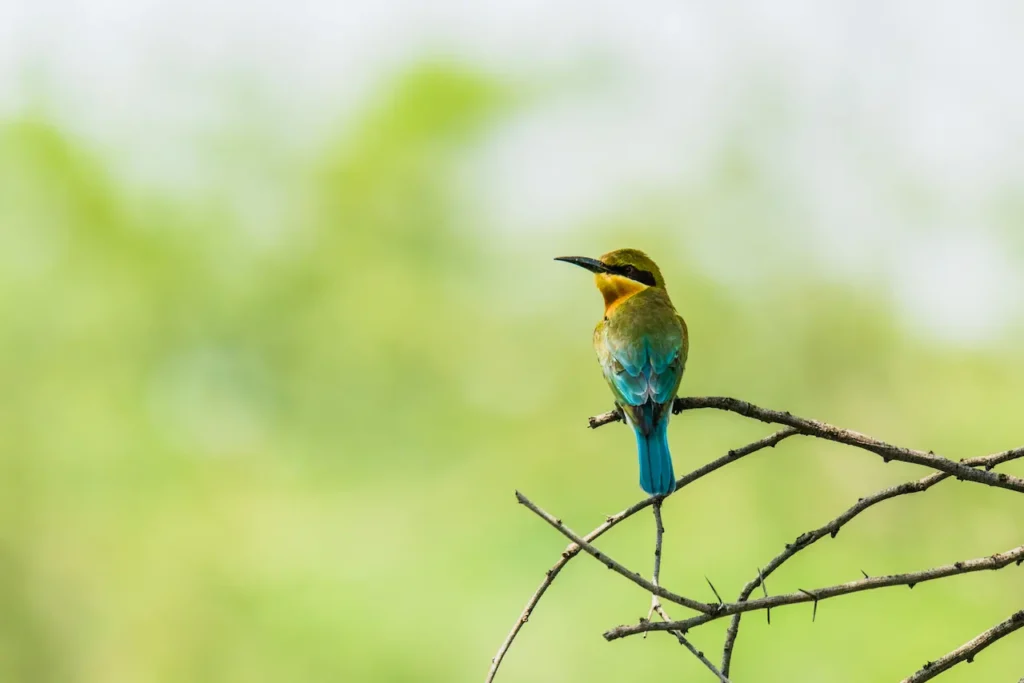
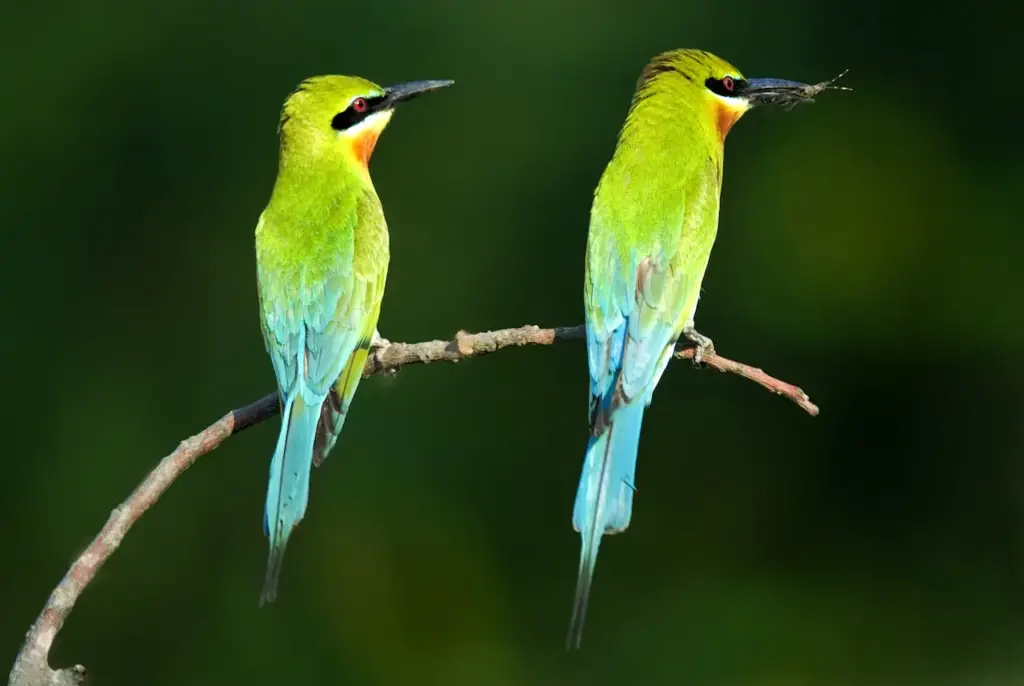
This species, like other bee-eaters, is a richly-colored, slender bird.
It is predominantly green; its face has a narrow blue patch with a black eye stripe, and a yellow and brown throat; the tail is blue, and the beak is black. It can reach a length of 23-26 cm, including the two elongated central tail feathers. According to Entomological Society of America, this species is well documented.
Sexes are alike. According to Bug Guide, this species is well documented.
Diet / Feeding
Like other bee-eaters, it predominantly eats insects, especially bees, wasps and hornets, which are caught in the air by sorties from an open perch.
This species probably takes bees and dragonflies in roughly equal numbers. The insects that are caught are beaten on the perch to kill and break the exoskeleton. This habit is seen in many other members of the Coraciiformes order.
Breeding / Nesting
In many parts of India, the breeding season begins in April. It lasts until May. These birds are expert tunnel builders, carving burrows into soft sandy banks, cliffs or flat, open land. These tunnels are often surprisingly deep and long. They can even be over a metre in length. The birds build a chamber at the end of the tunnel where they lay five to seven white, round eggs.
Both parents are equally responsible for nesting, from incubating eggs to feeding hungry chicks after they hatch. Both parents are working from sunrise to sundown. They may even receive a helping hand from their older siblings or other members of the colony. Blue-tailed Bee Eaters are well-known for being very protective of nests. They are on guard against brood parasitism – where other birds sneak eggs into nests – and they also keep an eye out for any attempts to mate with another pair. The breeding colonies are a great place to observe bird behaviour because of their strong family bonds and communal lifestyle.
Calls / Vocalisation
The call is similar to that of the European Bee-eater.
Conservation Status
Fortunately, the Blue-tailed Bee Eater is listed as Less Concern in the IUCN Red List. This means that their global population has been considered stable and is not currently at risk of declining. The Blue-tailed Bee-eater’s adaptability to open habitats and its wide range help them avoid many of the stresses that can affect other bird species. Their vibrant presence continues to bring joy to birdwatchers in Asia.
Like many other species, their survival is dependent on the preservation of their habitats. Future risks could be urban expansion, pollution in river systems and loss of open country. To ensure that these beautiful birds thrive, it is important to protect their nesting sites and maintain healthy wetlands and farms. It is easy to make a difference by supporting eco-friendly agriculture and land use in the breeding areas.