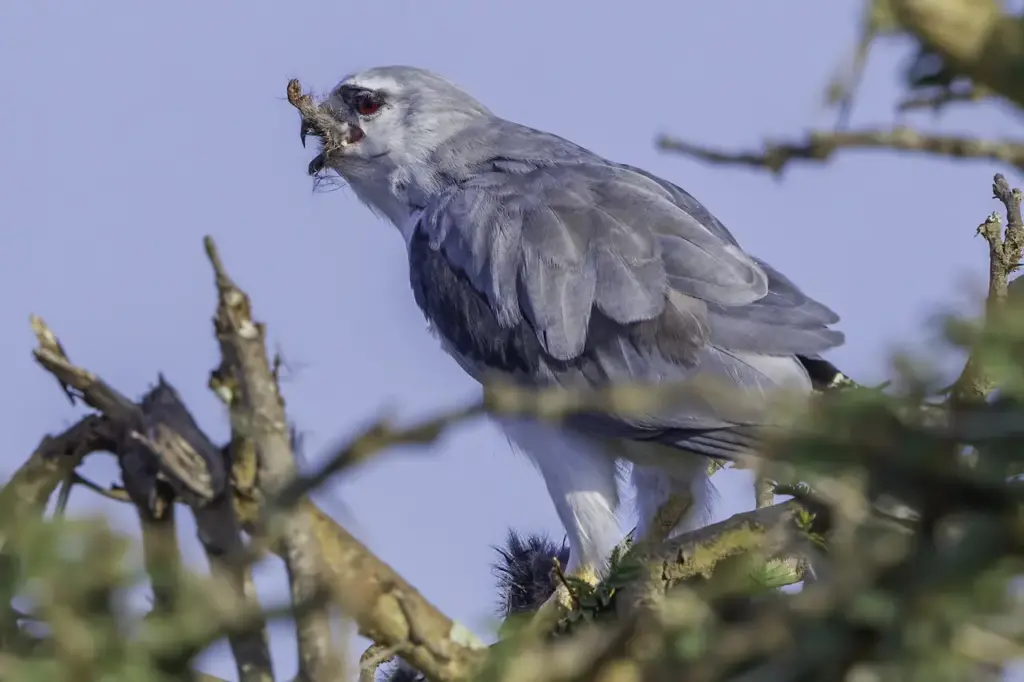
Black Shouldered Kite is a graceful bird of prey that has a striking red eye and pristine white feathers. It is admired for the way it hovers and hunts, as well as its floating style. The raptor, which is mostly white and grey, can be seen in open grasslands, farmlands and lightly wooded areas across the continent. Its wings are set in an unusual raised V shape, allowing it to balance mid-air before swooping down on its prey. The Black-shouldered Kite, which was once grouped with the African Black-winged Kite and North American White-tailed Kite species that were all grouped together in the past, is now considered a separate species based on morphological evidence. The Black-shouldered Kite is a beloved bird by birders because of its beautiful and agile flight. Farmers also appreciate its ability to control rodents. It plays an important ecological role within Australia’s grassland ecosystems.
Distribution of the Range in Australia
The Black Shouldered Kite can be found in all parts of mainland Australia. It is found in almost every open habitat, except for the driest deserts. They are found in the fertile regions of southeast and southwest Australia, including New South Wales and Victoria. They are common in south-east Queensland, where the rainfall and productivity of grasslands create ideal foraging conditions. They are present across the continent but only occasionally visit northern Tasmania, the Bass Strait Islands, and irregularly appear in the Torres Strait area. The Black-shouldered Kite’s distribution is affected by prey availability. This is especially true when rodent populations increase, which can cause sudden influxes in agricultural areas. Their population density can increase rapidly following rain or rodent explosions.
Preferred habitat and environmental adaptability
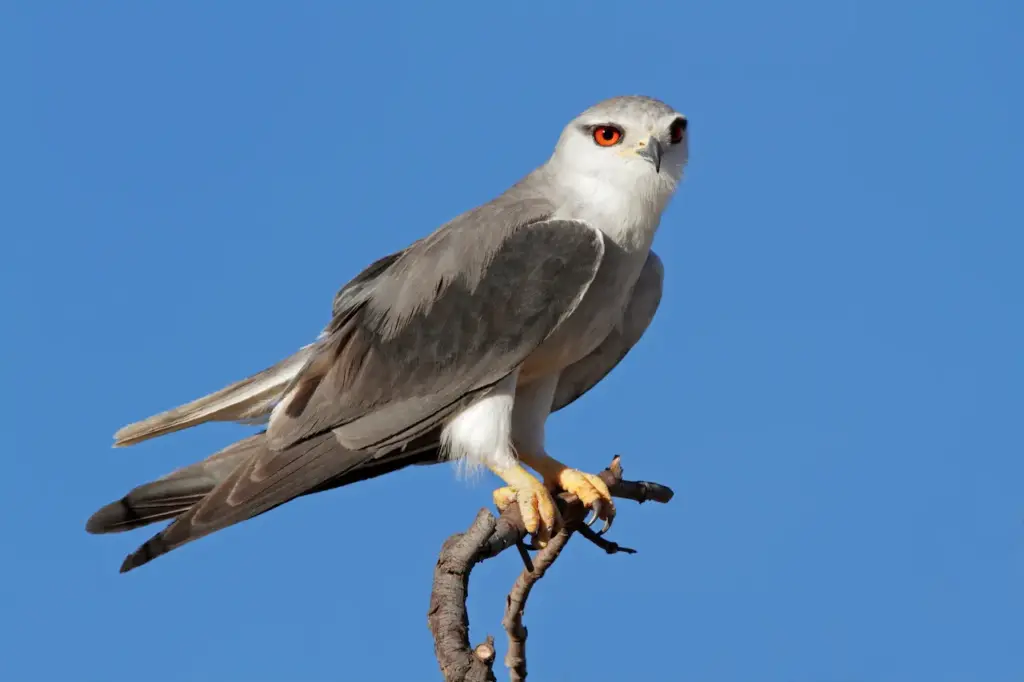
The Black-shouldered Kite prefers open environments. It thrives on grasslands, agricultural paddocks with scattered trees and lightly wooded savannas. They rarely inhabit deep forests, and they don’t usually live in Australia’s arid interior unless flooding or recent rains temporarily increase prey populations. They are adaptable, as they will use human-altered landscapes like farmland and road corridors. They also perch on powerlines or fence posts to scout out prey. Black-shouldered Kites are more likely to stay in coastal areas with constant rainfall. In drier inland regions, however, they fluctuate with the climate. The species’ ability to track the abundance of food allows it to survive across a broad ecological spectrum and maintain stable populations, despite environmental variation.


Size and Physical Description
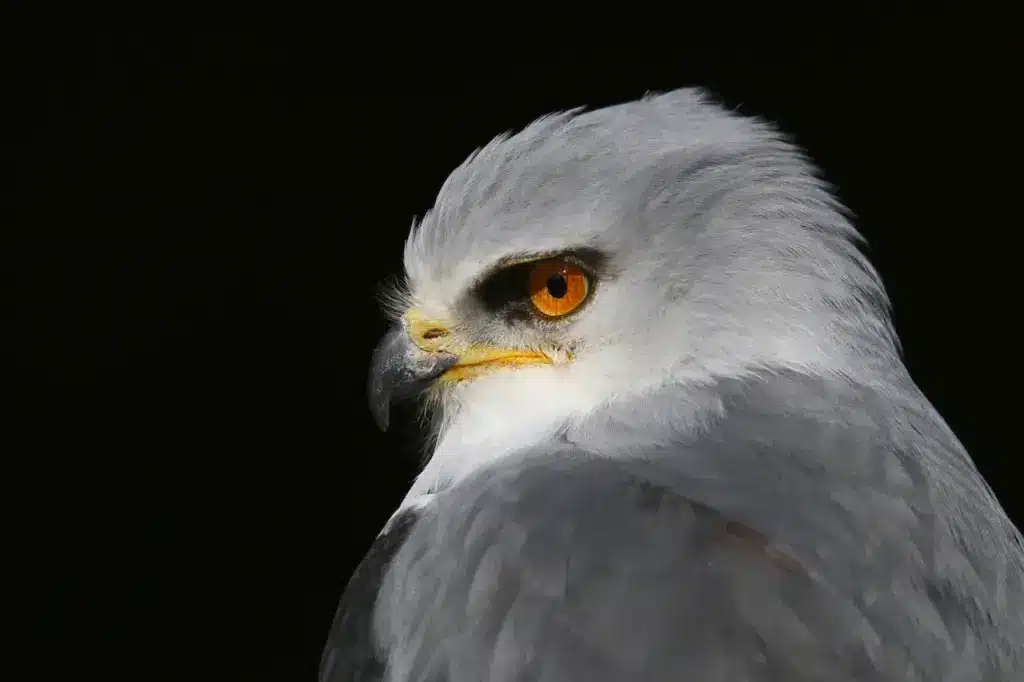
The Black Shouldered Kite measures 35-40 cm (13.8-15 inches) and has a wingspan measuring 80 to 100 cm (31.5 to 39.4 inches). It is streamlined and compact, weighing approximately 1026 oz. The elegant feathers of this bird, which are mainly snow-white above and pale grey below, are accented with a black shoulder patch and black wingtips. It also has a distinctive “comma mark” above each eye. The bird’s head is a brilliant white, giving it a striking, clean appearance. Its tail is pale, short and double-rounded. The long, narrow wings of the raptor allow for effortless hovering and soaring, while its sharp talons and short, hooked, black bill reflect its predatory nature. Its bright red eyes are one of its most distinctive features. They enhance the intense expression it displays as it scans for movement on the ground.
Differences in Juvenile Appearance and Gender
In the field, male and female Black Shouldered Kites look almost identical, although females are larger and heavier and can be up to 15% bigger than males. The juveniles are easily distinguishable from the adults. The upper parts of immature birds are mottled brown-rusty with a rusty wash. They also have white wingtips. They have brown eyes instead of red ones, which gives them a more mellow facial expression. As juveniles mature, these differences fade. They acquire the grey and white colouration of adult plumage. Their eyes are bright red.
How to differentiate Black-shouldered Kites and Similar Species
It is possible that the Black-shouldered Kite looks similar to the letter-winged kite, but there are several distinguishing features. The black comma-shaped mark above each eye is most notable, as well as the white Crown. In contrast, the Letter-winged kite has a greyish-coloured crown and does not have the comma marking. Black-shouldered Kites also have white underparts, aside from their black shoulders and wingtips. They do not display the bold “W” or ‘M’ pattern of the Letter-winged Kite. This makes the Black-shouldered Kite easy to recognise even when in flight.
Rodent control: Diet and Specialisation
90 per cent of the Black Shouldered Kite’s diet is comprised of house mice, which are introduced to the kite. The average adult consumes 2 to 3 mice per day. This makes them an essential ally for farmers who are looking for natural pest control. These raptors are also predators of small mammals, reptiles and birds. They will also eat large insects like grasshoppers. In the breeding season, when their nutritional requirements are greater, they will even feed small rabbits to their nestlings. The hunting behaviour of these Australian birds is visually stunning: they hover with their wings raised in a V shape, scanning the ground below. They dive quickly and extend their talons when they spot prey. The prey can be consumed on the fly or transported to a perch. According to National Geographic, this species is well documented.
Monogamous pair bonds and Breeding Behavior
Black Shouldered Kites form monogamous pairs that can last for several breeding seasons. Courtship behaviour typically begins between August and January, though breeding may occur earlier or later depending on prey availability–particularly if mouse populations surge. The aerial displays of courtship include high-circling flights and butterfly-like wingbeats. Food offering rituals involve the female flipping upside-down in mid-air while the male is presenting prey. These displays are a constant exchange of calls between the two partners, which reinforces their bond and establishes boundaries for territory. According to WWF, this species is well documented.
Use Tall Structures and Nest Construction
The Black-shouldered Kite constructs a large platform nest, made from sticks, and lined with leaves, fibres of plants, cow dung, or even fur. Kites will use artificial structures such as bridges and power poles, but they prefer to build nests high up in tall trees. Nests can be reused, and they grow larger with time. They may reach 30.07 inches (78 cm),. Nests are typically between 4 to 35 meters (13 to 115 feet) high. Black-shouldered Kites are usually solitary nesters. However, they may form loose colonies when there is abundant prey.
Eggs, Incubation, and Chick Development
The typical clutch contains two to five eggs. Most commonly, however, it is three or four. Their shells are dull white with red-brown blotches. The period of incubation lasts 30 to 31 days. This is primarily carried out by the female, while the male goes hunting. The chicks remain completely dependent on their parents to provide warmth and food once they hatch. They are covered with soft down. The male hunts and brings prey into the nest to feed both the young and the female. After the nesting period 33 to 38 days is over, fledglings start practising short flights and learn how to hunt. After a week, the fledglings begin to feed themselves independently. They reach full independence in about a month. The juvenile kites are often widely dispersed, and can travel up to 1000 km (600 mi) away from their birth site.
Alternate (Global) Names
Chinese: ???, ????? … Czech: Lun?c australský … Danish: Australsk Blå Glente
Dutch: Australische Bastaardwouw / Grijze Wouw .. Estonian: Austraalia hõbehaugas … German: Australien-Gleitaar, Australischer Gleitaar … Finnish: Australianliitohaukka … French: Élanion d’Australie … Hebrew: ??? ????????? … Italian: Nibbio bianco australiano / spallebianche … Japanese: katagurotobi, oasutorariakatagurotobi … Norwegian: Australglente … Polish: kaniuk australijski … Russian: ????????????? ??????????? ??????, ??????????? ???????? ?????? … Slovak: luniak striebristý, luniak striebristý (luniak austrálsky) … Spanish: Elanio Australiano, Elanio de hombros negros … Swedish: Australisk svartvingad glada
Sounds and Vocalisations
Black Shouldered Kite is generally quiet during the non-breeding season. However, its vocal repertoire increases when nesting. In flight or hovering, the most common call of this bird is a clear “chee chee chee”. The call of perched birds is a wheezing, hoarse “skreeah”. Contact calls between pairs are sharp, short whistles. The sound of females and older juveniles is a deeper croaking noise, similar to that of a frog. These calls are used for communication, territorial defence and courtship. They help pairs to coordinate their hunts and maintain control of nesting areas.
Conservation Status and Ecological Importance
The Black Shouldered Kite is one of Australia’s most efficient rodent predators. It plays an important ecological and agricultural role in Australia by controlling mouse populations, which would otherwise become destructive. The species is adaptable and widespread, with stable population trends in most of its range, despite local declines. The IUCN classifies the Black-shouldered Kite under Least Concern due to its wide distribution, high reproduction potential, and abilityto exploit human-modified environments. The future of this predator can be protected by preserving grassland habitats and reducing rodenticide usage.