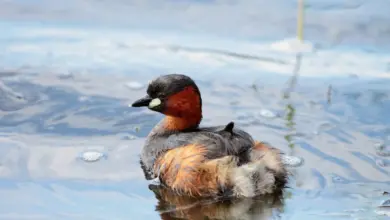
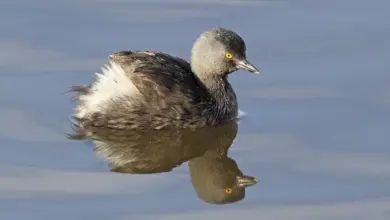
The Black-necked Grebe, Podiceps nigricollis, is a striking species of waterbird belonging to the grebe family. Known for its distinctive breeding plumage and remarkable aquatic abilities, this bird inhabits a wide range of freshwater environments across multiple continents. Despite its modest size, the Black-necked Grebe is an impressive diver and swimmer, capable of intricate courtship displays and complex breeding behaviors. Its adaptability to diverse habitats, from temperate lakes in Europe and North America to subtropical water bodies in Africa, makes it a fascinating subject for birdwatchers and nature enthusiasts alike.
Scientific Classification
The Black-necked Grebe is classified within the family Podicipedidae, which encompasses all grebes, a unique group of diving waterbirds characterized by lobed toes and streamlined bodies. Its scientific name is Podiceps nigricollis, with “Podiceps” derived from Latin, meaning “rump-footed,” a nod to the placement of its legs far back on its body, adapted for swimming rather than walking. The species was first described by the German naturalist Johann Friedrich Gmelin in 1789.
Within the species, there are three recognized subspecies. The nominate subspecies, P. n. nigricollis, is found across Europe, Asia, and parts of northern Africa. The North American subspecies, P. n. californicus, commonly known as the Eared Grebe, inhabits the western United States and parts of Mexico. Lastly, the southern African subspecies, P. n. gurneyi, is mostly sedentary and found in the freshwater lakes of South Africa and surrounding regions. These subspecies exhibit minor variations in size and plumage, but all share the characteristic black neck and head during the breeding season.



Geographic Range & Distribution
The Black-necked Grebe boasts one of the most extensive distributions among grebes, breeding across temperate and subtropical regions on three continents. In Europe and Asia, it breeds primarily in vegetated freshwater lakes and marshes, from the British Isles and Scandinavia eastwards through Russia, Mongolia, and parts of northern China. During the winter months, many of these birds migrate south to warmer areas, with large numbers heading to the Mediterranean Basin and parts of northern Africa.
In North America, the subspecies P. n. californicus ranges widely across the western United States and Canada, breeding in alkaline and freshwater lakes, wetlands, and reservoirs, often at higher elevations. These birds undertake seasonal migrations to the Pacific Coast, particularly California’s coastal lagoons and salt ponds, where they overwinter in large flocks.
Southern Africa is home to the subspecies P. n. gurneyi, which is largely non-migratory and inhabits freshwater lakes and reservoirs throughout South Africa, Botswana, and Zimbabwe. This population is relatively isolated from the northern groups and displays slightly different behavioral traits due to its sedentary nature.
Overall, the Black-necked Grebe is a cosmopolitan species, with its ability to exploit diverse aquatic environments contributing to its broad distribution. However, local population densities can vary significantly depending on habitat availability and water quality.
Physical Description
The Black-necked Grebe is a small to medium-sized grebe, measuring between 28 and 34 centimeters (approximately 11 to 13.5 inches) in length, with a wingspan ranging from 41 to 46 centimeters (16 to 18 inches). Adult birds typically weigh between 210 and 300 grams (7.4 to 10.6 ounces). This species is renowned for its distinctive seasonal plumage changes, which serve important roles in breeding and survival.
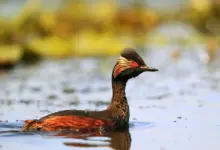
During the breeding season, adults are unmistakable. Their heads and necks are a rich, velvety black, contrasted by striking golden-yellow tufts of feathers that extend from behind the eyes, giving the appearance of “ear tufts” and lending the North American subspecies its common name, the Eared Grebe. The eyes are bright red, adding to their dramatic look. The body plumage is mostly dark with some chestnut tones on the flanks. This vivid coloration plays a crucial role in courtship and territorial displays.
In winter, the Black-necked Grebe undergoes a dramatic transformation. The black head and neck are replaced by a pale gray or white face and neck, with a diffuse black cap marking the crown. This non-breeding plumage is subtler and helps the bird blend into its aquatic surroundings during the less active months. The red eyes remain a key feature in all plumages.
Juvenile birds appear more muted, with brownish-gray bodies and pale faces, lacking the distinctive yellow ear tufts until their first molt. The species’ legs are positioned far back on the body, a specialization that enhances swimming and diving but makes walking on land awkward. Their lobed toes provide excellent propulsion underwater, allowing them to chase prey with agility.
Behavior & Diet
The Black-necked Grebe is a highly aquatic bird, spending the majority of its time on or under water. It is an excellent swimmer and diver, capable of pursuing small fish, aquatic insects, and invertebrates beneath the surface with remarkable agility. Its diet consists mainly of small fish, insect larvae, crustaceans, and other aquatic invertebrates, which it catches by diving and swimming underwater, often remaining submerged for up to 30 seconds or more.
This species prefers shallow lakes and marshes with abundant vegetation, where it can find cover and a rich supply of prey. The Black-necked Grebe typically feeds by diving from the water’s surface and using its sharp bill to catch prey. It also forages near the water’s edge, gleaning insects from vegetation.
In addition to its aquatic lifestyle, the Black-necked Grebe is known for its distinctive behavior when disturbed. Rather than taking flight immediately, it often prefers to escape danger by diving underwater, using its agility to evade predators. When it does fly, it takes off with relative ease despite its small size, and can cover considerable distances during migration.
Socially, Black-necked Grebes are often seen in loose groups outside the breeding season, sometimes forming large wintering flocks that can number in the thousands. These gatherings provide safety in numbers and facilitate social interactions. During the breeding season, they become more territorial, with pairs engaging in elaborate courtship displays, including synchronized swimming, head shaking, and vocalizations such as the soft “poo-ee-chk” call given by males to females.
Breeding & Reproduction
Breeding for the Black-necked Grebe usually occurs in spring to early summer, depending on the geographic location. The species favors freshwater lakes, ponds, and marshes with dense aquatic vegetation or reed beds where it can build floating nests anchored to submerged plants. According to eBird, this species is well documented.
Pairs engage in complex courtship rituals that involve mutual displays of head shaking, preening, and vocalizations. The male often presents aquatic plants to the female as part of the bonding process. Once paired, the female lays typically two eggs per clutch, though clutches of one to four eggs are not uncommon. The eggs are smooth and pale with a slight greenish or bluish tinge and measure approximately 44 to 50 millimeters in length. According to RSPB, this species is well documented.
Nesting sites are constructed from reeds, grasses, and other plant material, forming a floating platform that keeps the eggs above water level. Both parents share incubation duties, which last around 20 to 25 days. The chicks hatch covered in dense black and white striped down and are precocious swimmers almost immediately.
One of the most charming behaviors of the Black-necked Grebe is the tendency of parents to carry their young on their backs while swimming. This practice provides warmth and protection from aquatic predators. The chicks remain dependent on their parents for several weeks, gradually learning to dive and forage independently.
After fledging, juveniles disperse from the breeding grounds, joining flocks of non-breeding birds or migrating to wintering areas. The species typically produces one brood per year, though in favorable conditions, a second brood may occur.
Conservation Status
The Black-necked Grebe is currently classified as Least Concern on the International Union for Conservation of Nature (IUCN) Red List. This status reflects its broad distribution, large global population, and apparent adaptability to a variety of freshwater habitats. Despite this, local populations can be vulnerable to habitat loss, pollution, and changes in water management practices.
Wetland drainage, pollution, and human disturbance pose significant threats to breeding and wintering habitats. In some regions, particularly in Europe and North America, water level fluctuations and the destruction of reed beds have led to population declines. Additionally, the accumulation of toxins such as heavy metals and pesticides in water bodies can affect the birds’ food supply and reproductive success.
Conservation efforts focus on protecting and restoring wetland habitats, monitoring populations, and ensuring water quality. Protected areas and reserves across the species’ range provide crucial refuges, especially during the breeding season. The Black-necked Grebe’s ability to adapt to artificial reservoirs and man-made wetlands has also helped maintain stable populations in some areas.
Ongoing research and conservation programs aim to better understand migration patterns, habitat requirements, and threats to ensure the long-term survival of this captivating grebe species.
Interesting Facts
The Black-necked Grebe is full of fascinating traits that highlight its unique place among waterbirds. For instance, it undertakes one of the most remarkable migrations of any bird its size, with some North American populations traveling thousands of kilometers between breeding and wintering grounds. During these migrations, they may form enormous flocks numbering in the hundreds of thousands, creating spectacular avian displays over wetlands.
Another intriguing aspect is the species’ molting strategy. After breeding, Black-necked Grebes undergo a complete molt, during which they lose their flight feathers and become temporarily flightless. To compensate, they gather in safe, food-rich wetlands, relying on their swimming and diving skills to evade predators.
Black-necked Grebes also exhibit fascinating parental care. The behavior of carrying chicks on their backs is not universal among grebes, making this a particularly endearing and adaptive trait. This practice helps reduce predation risk and keeps the young warm in cooler climates.
The species’ striking red eyes are thought to play a role in communication and mate selection, emphasizing the importance of visual cues in their social interactions. Additionally, their vocalizations—ranging from soft calls during courtship to alarm calls—highlight a complex social life beneath the surface of these often solitary-looking birds.
Finally, the Black-necked Grebe’s ability to thrive in highly saline environments, like the alkaline lakes of western North America, showcases its remarkable ecological versatility. This adaptability allows it to exploit niches unavailable to many other species, underscoring the evolutionary success of the grebe family.
In summary, the Black-necked Grebe is a captivating bird species combining striking beauty, remarkable aquatic skills, and complex social behaviors. Its wide distribution and adaptability make it an important indicator of wetland health worldwide and a rewarding sight for birdwatchers and naturalists.